UK Imports & Exports: Trade Profile & Top Partners
The United Kingdom is one of the world’s largest trading economies and a top exporter of services. Cars, machinery, pharmaceuticals,


Most people treat the importer of record and the consignee like two words for the same thing. They are not. One of them carries the legal weight of every shipment entering the United States. The other might just be the warehouse receiving the boxes. Mix them up on a CBP filing, and you can end up with penalties, delayed cargo, or a compliance audit that should have been a routine entry.
That confusion has gotten more expensive in the past year. With the Section 321 de minimis exemption eliminated on August 29, 2025, every commercial shipment into the US now needs a qualified party to make entry.
At Artemus Transportation Solutions, we help US importers, customs brokers, and freight forwarders stay on the right side of CBP with purpose-built software for ISF, AMS, and AES filings, along with dedicated IOR profile services for non-resident importers. This guide breaks down who the importer of record is, who the consignee is, how they differ in practice, and what every US importer needs to know in 2025 and beyond.
Table Of Contents
The importer of record (IOR) is the party legally responsible to US Customs and Border Protection for an imported shipment, including duties, taxes, accurate documentation, and full compliance with CBP regulations under 19 CFR 141. The consignee is the party named on the bill of lading to whom the goods are shipped and physically delivered. In most US imports, the IOR and the consignee are the same party, but not always.
The IOR carries legal liability to the government. The consignee holds physical custody of the cargo. When they are different parties, the IOR number appears in Box 23 of CBP Form 7501, and the ultimate consignee number appears in Box 22.
An importer of record is the party that US Customs and Border Protection holds legally accountable for every aspect of an imported shipment. Under 19 CFR 141, the IOR is responsible for filing the entry paperwork correctly, classifying goods under the right HTSUS code, declaring the accurate dutiable value, paying duties and taxes, and following every applicable regulation from CBP and partner government agencies like the FDA, EPA, USDA, or DOT.
The legal weight here is real. CBP regulations at 19 CFR 141.1 treat the liability for duties as a personal debt owed directly to the United States government. That debt can only be extinguished by full payment of all duties legally accruing, unless the law provides a specific exemption.
If a shipment clears customs under a false value, or if the goods are misclassified, or if duties go unpaid, the IOR is the one who answers to CBP. Not the shipper. Not the freight forwarder. Not the consignee.
To be registered as an IOR, a party must have a valid identification number. CBP accepts three formats: a US Social Security Number, an IRS-assigned Employer Identification Number, or a CBP-Assigned Number (sometimes called a CAIN). Foreign importers without an SSN or EIN go through the CBP-Assigned Number process by filing CBP Form 5106. CBP typically activates a new IOR in two business days and processes updates in about five.
Know More About: Can A Customs Broker Be The Importer Of Record Legally?
A consignee is the party named on the bill of lading as the recipient of the goods. If the importer of record is a legal designation tied to CBP accountability, the consignee is more of a physical designation tied to the shipment itself. This is who the carrier hands the cargo to at the destination.
But there is more to it than that. CBP and the customs community actually distinguish between two types of consignee, and the difference matters.
Nominal consignee. A nominal consignee is a party named on the bill of lading as the receiver, but who is not the ultimate destination for the goods. Freight forwarders often appear as nominal consignees when cargo is being consolidated or when they are coordinating delivery downstream. A nominal consignee has the right to designate a customs broker to make entry, but they are not typically the IOR.
Ultimate consignee. The ultimate consignee is the party in the United States who will actually receive the merchandise after CBP releases it. This is the end buyer, the end user, or the party taking physical possession for commercial purposes. On CBP Form 7501, the ultimate consignee number appears in Box 22. If the IOR and ultimate consignee are the same party, the word ‘SAME’ can be entered in Box 22 instead.
This distinction shows up in real compliance work. When a freight forwarder is listed as the consignee on the bill of lading, but the goods are actually headed to a distributor in Ohio, the forwarder is the nominal consignee and the distributor is the ultimate consignee. CBP wants to know both parties, but only one of them carries IOR responsibility, and that depends on the commercial arrangement, not the shipping documents.
Know More About: What Is Customs Clearance? Meaning & Regulations
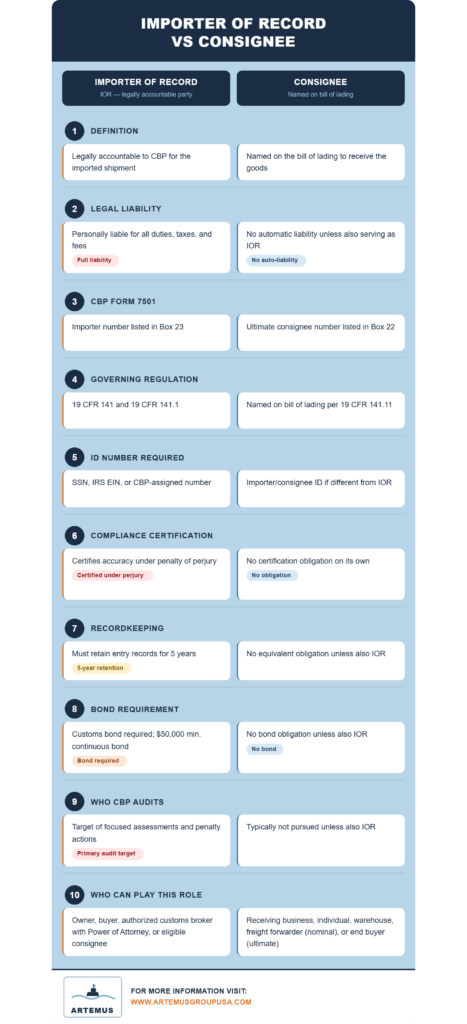
The two roles overlap on most shipments, but they split in ways that matter whenever something goes wrong. Here are the seven practical differences every importer should understand.
1. Legal liability. The IOR is personally liable to the US government for all duties, taxes, and fees. The consignee, unless they are also the IOR, carries no automatic liability for duty payment. When CBP issues a bill, it goes to the IOR.
2. Role in CBP filings. The IOR signs the entry and the entry summary under penalty of perjury, certifying that the information filed with CBP is accurate. The consignee is simply named on the bill of lading and on the entry documents as the party receiving the shipment.
3. CBP Form 7501 placement. This is the detail most competitor guides skip. On CBP Form 7501, Box 23 holds the importer number, and Box 22 holds the ultimate consignee number. When the IOR and ultimate consignee are the same party, the importer number can be entered in both boxes, or the word ‘SAME’ can be written in Box 22. On consolidated entry summaries covering multiple ultimate consignees, the importer number goes in Box 23, and ‘CONSOLIDATED’ is entered in Box 22.
4. Financial responsibility. Duties, taxes, merchandise processing fees, harbor maintenance fees, and any post-entry adjustments flow to the IOR. A consignee may reimburse the IOR commercially, but that is a private contractual matter between them. CBP does not involve itself in that arrangement.
5. Compliance certifications. The IOR is the party certifying accuracy and compliance to CBP. That certification extends to origin declarations, trade agreement preference claims, partner government agency requirements, and forced-labor compliance under the Uyghur Forced Labor Prevention Act. The consignee does not make these certifications unless they are also serving as IOR.
6. Recordkeeping obligations. The IOR must retain records of each entry for five years from the date of entry. This encompasses commercial invoices, purchase documentation, HTSUS classification support, origin documentation, and any other materials pertinent to the declared value or duty calculation. The consignee has no equivalent recordkeeping obligation unless they are the IOR.
7. Who CBP audits. When CBP launches a Focused Assessment, a verification, or a penalty action, the target is the IOR. That is the party whose identification number sits in Box 23, not the party whose warehouse received the boxes. The IOR carries the audit risk, which is why so many customs brokers decline to act as IOR for clients they do not know well.
Know More About: Continuous Bond Vs Single Entry: 6 Key Differences To Know
The cleanest US import scenario is when one party orders the goods, pays for them, takes title, and receives them. In that case, the buyer is both the IOR and the ultimate consignee, the Form 7501 gets marked ‘SAME’ in Box 22, and the paperwork is simple. But plenty of real-world arrangements do not look like that. Here are the situations where the two roles split, along with what determines who carries the IOR responsibility.
1. Standard domestic purchase. A US company buys goods from a foreign supplier. The goods ship directly to the US company’s facility. The US company is both the IOR and the ultimate consignee. Same party, same identification number, Form 7501 shows ‘SAME’ in Box 22.
2. Drop-ship and triangle trade. A US seller buys goods from a foreign manufacturer and has them shipped directly to the end customer in the United States. This is one of the messier scenarios in practice, because the bill of lading may show the end customer as the consignee while the US seller is functionally the importer.
Depending on the commercial arrangement and who holds title at the time of importation, either party could be the IOR. This is the kind of fact pattern that ends up as a thread on customs broker forums, and it is worth getting written advice from a licensed broker before the shipment moves.
3. DDP Incoterms. When a foreign seller ships goods under Delivered Duty Paid terms, the seller is responsible for duties and customs clearance in the destination country. For US-bound shipments, that means the foreign seller must either register as a non-resident IOR or hire a US-based IOR service. The US buyer is the consignee but not the IOR.
4. FOB, CFR, or CIF Incoterms. Under these terms, risk and responsibility transfer to the buyer at an earlier point in the shipping chain. For US-bound shipments, the US buyer becomes the IOR at the destination. The foreign seller’s liability ends at the port of loading or the point where the carrier takes over.
5. Customs broker as IOR. A licensed customs broker can appear as IOR on an entry if the actual owner grants them a Power of Attorney. Per 19 CFR 141.20, the broker may later transfer liability to the actual owner by filing a superseding bond in the owner’s name. Until that transfer happens, the broker is on the hook.
6. Foreign (non-resident) importer of record. A foreign company without a US presence can still act as IOR. They need a CBP-Assigned Importer Number and a US customs bond with a minimum continuous bond amount of $50,000.
The process involves filing CBP Form 5106, providing Articles of Incorporation, IDs for two authorized officers, and a customs Power of Attorney to a US broker who can handle the filings. This is what Artemus’s IOR Profile service is built for.
Know More About: ISF Form (Importer Security Filing): Elements & Top Practices
The mistakes that get importers in trouble are almost always structural: they mix up the roles of IOR and consignee, or they assume someone else in the chain is carrying the compliance weight. Here are the pitfalls worth knowing before they become penalties.
1. Listing the wrong party in Box 22 vs Box 23. When the IOR and ultimate consignee are different parties, both numbers must be reported separately. Getting this wrong is one of the most common errors on Form 7501, and it can trigger review holds and liquidated damages.
2. Assuming the freight forwarder acts as IOR. Freight forwarders typically show up as nominal consignees on bills of lading, not as IORs. Most do not want the liability and do not accept it. If you assumed your forwarder was handling IOR responsibility, verify that in writing before the next shipment moves.
3. Missing the 5-year recordkeeping window. The IOR must keep all records supporting the entry for five years from the date of entry. If CBP opens a verification three years after the fact and the importer cannot produce the commercial invoice that supported a preference claim, the penalty exposure is real.
4. ISF penalties. Importer Security Filing penalties can run up to $5,000 per violation. The IOR is the party responsible for ensuring the ISF is filed accurately and on time, at least 24 hours before the cargo is loaded onto a vessel bound for the United States.
5. Fraudulent use of the bona fide gift exception. The one remaining narrow exception to the de minimis suspension is bona fide gifts valued under $100 and labeled ‘gift’ in English. CBP has telegraphed that fraudulent use of this exception carries severe penalties, and they are watching for it.
6. Assuming the consignee absorbs liability when the IOR disappears. When an overseas seller sets up as an IOR and then winds down the entity, the consignee sometimes ends up holding the cargo with no clear line of responsibility. That is not a compliant position. The entry needs an accountable IOR that CBP can reach.
Know More About: 5 Types Of ISF Penalty & Fines To Know To Avoid Losses
Getting IOR and consignee right is not complicated when the systems and the right partners are in place. Artemus Transportation Solutions builds trade compliance software and services specifically for US importers, customs brokers, freight forwarders, and non-resident importers who need to move goods cleanly through CBP.
Our Importer of Record Profile service handles the full onboarding for non-resident and foreign companies importing into the United States. For companies that do not have a US entity but need to move goods into the US market, this is the fastest path to a compliant IOR setup.
For the filings every IOR has to manage, Artemus offers three core software platforms. Our ISF 10+2 web application has been in continuous operation since 2008 and handles Importer Security Filings for ocean shipments into the United States, with automated data checks and integration into the ACE platform.
Our AMS web software streamlines cargo manifest submissions for ocean, air, and rail carriers. And our AES filing platform manages Electronic Export Information submissions for US exporters shipping internationally.
Licensed customs brokers who act as IOR on behalf of their clients use our Customs Broker Software to manage filings, entry data, and compliance workflows across their entire book of business. Whether you are a single-entity importer, a non-resident company entering the US market, or a broker managing dozens of IOR relationships, the goal is the same: accurate filings, on time, with a clear paper trail.
Know More About: Exporting From Australia To USA: A Complete Guide
Sometimes, but not always. In many US import transactions, the same party is both the ultimate consignee and the IOR, and Form 7501 reflects that with the word ‘SAME’ in Box 22. In other arrangements, such as drop-ship, DDP Incoterms, or non-resident IOR setups, the two roles sit with different parties.
CBP recognizes four categories: owners or purchasers with a financial interest in the goods, licensed customs brokers holding a Power of Attorney, business entities acting as purchasers, and consignees in specific circumstances. Whichever party fits, they need a valid identification number, either an SSN, IRS EIN, or CBP-Assigned Number.
The IOR is personally liable for duties, taxes, and fees, and that liability is treated as a debt to the US government. The IOR is also responsible for accuracy of every data element on the entry, ISF compliance with penalties up to $5,000 per violation, five-year recordkeeping, and any post-entry adjustments CBP decides to pursue.
A consignee can be the IOR, but is not automatically. The default IOR is the party with a financial interest in the goods, which is usually the owner or purchaser. A consignee becomes the IOR only when the purchaser transfers title and consigns the goods specifically for entry, or when the consignee is also the purchaser.
Technically, the bill of lading names the consignee rather than the IOR. The IOR designation appears on CBP entry documents, not on the bill of lading itself. In many cases the consignee named on the bill of lading and the IOR named on Form 7501 are the same party, but not always. The controlling document for IOR identity is the entry filing, not the shipping paperwork.
Yes. A foreign or non-resident company can act as IOR by obtaining a CBP-Assigned Importer Number via Form 5106, posting a US customs bond with a minimum continuous bond amount of $50,000, and typically appointing a US-based customs broker under Power of Attorney to handle filings. CBP processes new IOR applications in about two business days.
The consignor is the shipper, the party sending the goods. The consignee is the receiver, the party to whom the goods are shipped. On a bill of lading, the consignor sits at the top as the origin party and the consignee sits below as the destination party. Neither term is the same as importer of record, which is a legal designation under US customs law.
Not unless they are also the IOR. CBP collects duties from the party listed as importer of record on the entry. The consignee, if different from the IOR, may end up reimbursing the IOR through a commercial arrangement, but they have no direct duty liability to CBP.
The difference between the importer of record and the consignee sounds like a technicality until it lands on your desk in the form of a CBP notice.
The IOR is the party the US government holds accountable. The consignee is the party who takes delivery. Sometimes they are the same entity, sometimes they are not, and the commercial setup behind each shipment is what determines which is which.
Knowing how to read that distinction on a bill of lading, on CBP Form 7501, and in your own contracts is one of the cleanest ways to keep a shipment moving and an audit quiet.
Know More About: What Is The Purpose Of Tariffs? Key Insights To Know

The United Kingdom is one of the world’s largest trading economies and a top exporter of services. Cars, machinery, pharmaceuticals,
Mexico became the United States’ number-one trading partner in 2024, surpassing both Canada and China. According to the Office of
Colombia is one of Latin America’s most active trading economies. Crude oil, coffee, coal, and cut flowers flow out. Machinery,