What Does The US Export To Switzerland? Trade Insights
International trade between the United States and Switzerland highlights the strong economic relationship between the two nations. With its highly



When it comes to international trade, the role of customs brokers is indispensable. These professionals are experts in navigating the intricate web of customs regulations, ensuring your goods move seamlessly across borders. However, availing of their services comes with a cost, and understanding custom broker fees is essential for businesses engaged in global commerce.
In this comprehensive guide, we’ll delve deep into the world of custom broker fees, demystifying the various charges and shedding light on factors that influence them. But that’s not all – we’ll also introduce you to Artemus, a trailblazing solution in the customs brokerage industry.
Artemus Transportation Solutions offers not just custom broker software but a suite of services, including insurance estimates and real-time shipment status checks, empowering importers and exporters to streamline their operations and navigate customs with ease.
Let’s embark on this journey to unravel the intricacies of custom broker fees while discovering how Artemus can be your trusted partner in international trade.
Table Of Contents
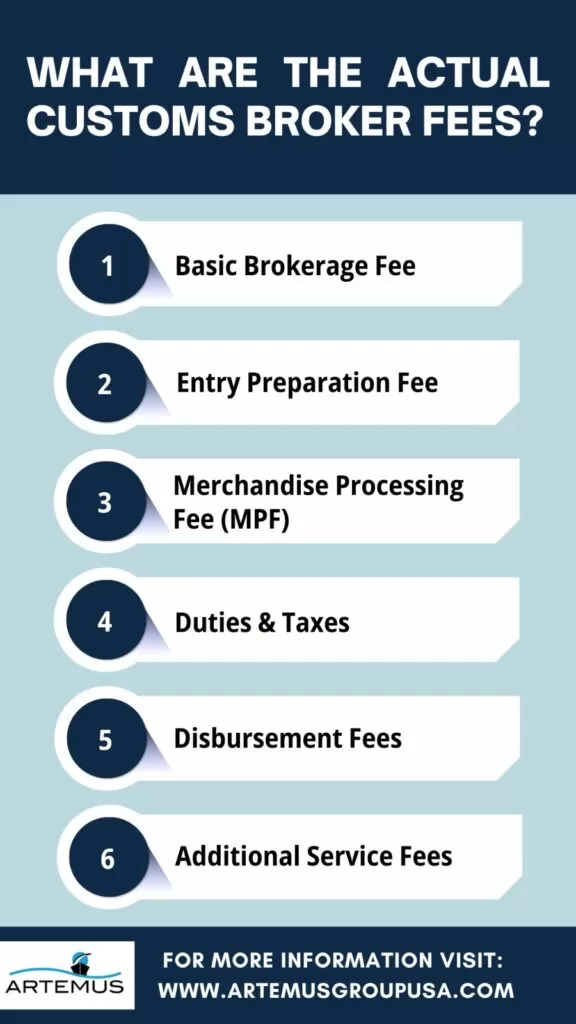
Customs broker fees vary widely based on the broker you choose, the complexity of the entry, the number of tariff classifications required, any additional services you need, and whether government user fees apply. Below is an accurate breakdown of the typical components of these costs as of 2025-2026.
This is the core service your broker provides – preparing and filing your customs entry, handling documentation, submitting information to the U.S. Customs and Border Protection (CBP), and managing compliance.
Entry preparation (sometimes bundled with the basic brokerage fee) covers the labor involved in classifying goods, preparing documents, and submitting the entry. Brokers vary widely in how they label this fee.
This is not a broker fee but a mandatory CBP user fee collected on most U.S. imports. Brokers usually pay it on your behalf and include it on your invoice.
Key points (effective October 1, 2025):
These changes are part of annual inflation adjustments under the FAST Act.
Duties and taxes are government charges based on the tariff classification and country of origin. They are not broker fees, but brokers calculate them and often advance payment on your behalf.
The amount depends entirely on your goods and applicable tariff rates.
When a broker advances payment of government fees (MPF, duties, taxes) on your behalf, they typically charge a disbursement fee for handling these transactions.
Typical range:
Customs brokers may charge extra fees when the entry requires additional work or special filings. These can include:
These fees vary widely by broker and service level, and they are above and beyond basic brokerage and government user fees.
Related: How To Get A Customs Bond In 5 Easy Steps?
Customs broker fees for licensing cover a series of government-mandated charges that applicants must pay at different stages, from taking the license exam to maintaining ongoing compliance with U.S. Customs and Border Protection. Knowing how these fees are structured helps brokers plan costs accurately and stay compliant:
Before becoming licensed, candidates must appear for the Customs Broker License Examination.
After passing the exam, applicants must submit a license application along with the applicable fee.
These fees cover the administrative cost of reviewing and processing license applications.
All applicants must complete fingerprinting as part of the background verification process.
Brokers who wish to operate under a national permit are subject to both initial and recurring fees.
The annual permit fee is payable every year and must be submitted online through the eCBP portal. Non-payment can result in the revocation of the national permit.
To maintain an active license, all customs brokers are required to file a triennial status report.
Failure to submit the report and fee within the reporting window may lead to suspension or revocation of the broker license.
Most recurring customs broker fees, including permit user fees, are announced annually in the Federal Register.
Related: How To Become A Customs Broker? A Step-By-Step Journey
Customs broker fees vary based on factors like the type of goods, their value, documentation requirements, and geographic location. Understanding these influences is crucial for importers to budget effectively for customs brokerage services.
The complexity and nature of the imported goods play a significant role in determining customs broker fees. Some products, such as hazardous materials or perishable goods, may require specialised handling, documentation, and permits. These additional requirements can result in higher fees as the customs broker needs to navigate the intricacies of regulations and ensure compliance.
The declared value of the imported goods directly impacts customs broker fees. Customs brokers often charge a percentage of the merchandise’s declared value as their fee. Therefore, higher-value shipments will incur higher fees. Importers need to accurately report the value of their goods to customs to avoid penalties and ensure accurate fee assessments.
The volume and complexity of required documentation can affect customs broker fees. Importers must provide various documents, including invoices, bills of lading, permits, and certificates of origin. Customs brokers may charge more if extensive documentation is needed, as they are responsible for preparing and submitting these documents to customs authorities. Additionally, customs brokers must ensure compliance with import regulations, which may involve extra time and effort.
The location of the customs broker’s office relative to the port of entry can influence their fees. Brokers located in major port cities or regions with high import traffic may have a different fee structure than those in less busy areas. In some cases, proximity to customs authorities and familiarity with local regulations may lead to more competitive pricing.
Related: When Is A Customs Bond Required? Situation To Consider
Understanding customs broker fees is crucial for various reasons:
1. Cost Management: Importing goods involves various expenses, and customs broker fees can be a significant part of that. By understanding these fees, importers can create accurate financial plans and allocate funds accordingly. This helps prevent financial surprises, ensuring that they have the necessary resources to cover customs brokerage costs while maintaining a healthy profit margin.
2. Compliance & Accuracy: Accurate reporting of the value of imported goods is critical to compliance with customs regulations. Knowing the fees associated with customs brokerage encourages importers to provide precise information, reducing the risk of customs audits, fines, or penalties. It promotes adherence to legal and regulatory requirements, fostering a positive relationship with customs authorities.
3. Service Evaluation: Different customs brokers offer varying levels of service and have different fee structures. Understanding these fees allows importers to make informed choices when selecting a customs broker. They can evaluate the services offered, compare costs, and choose a broker that meets their specific needs while staying within their budget.
4. Transparent Transactions: Clarity regarding customs broker fees enhances transparency throughout the importation process. Importers and customs brokers can have clear, mutually agreed-upon terms, reducing the potential for misunderstandings or disputes related to fees and services. This transparency fosters a collaborative and efficient working relationship.
5. Profitability & Decision-Making: An in-depth understanding of customs broker fees enables importers to assess the overall profitability of international trade ventures. By factoring in all associated costs, including customs brokerage, importers can make data-driven decisions about sourcing, pricing, and inventory management. This informed decision-making process can contribute to the long-term success and sustainability of their business.
Related: What Is A Customs Bond? A Guide For Importers & Others
Customs brokers provide a range of services to facilitate the smooth and compliant importation of goods into a country. These services typically include:
Related: ISF Filing Process: A Detailed Step-By-Step Guide
Importers are not always legally obligated to hire a customs broker. In many countries, they have the choice to handle customs clearance themselves. However, there are scenarios where using a customs broker is highly advisable.
For complex or regulated goods and when dealing with specific trade agreements, customs brokers’ expertise can ensure compliance and streamline documentation, expediting the import process. While not mandatory, engaging a customs broker can simplify imports, reducing errors and delays. Importers should assess their needs to determine if a customs broker is advisable for their situation.
Related: Customs Bond Renewal: All Facts You Need To Know
Custom broker fees are not typically regulated by a single set of global or national regulations. Instead, they are determined through contractual agreements between the customs broker and the importer or client. However, there are some key principles and considerations that influence how customs broker fees are determined and charged:
Related: When Does ISF Need To Be Filed? Know The Deadline

Artemus is the premier customs broker software, simplifying and streamlining the complexities of customs brokerage. Trusted by customs brokers and importers alike, Artemus offers a comprehensive toolset for efficient and compliant import processes. From customs clearance to duty calculation, documentation management, product classification, valuation support, and compliance guidance, Artemus covers it all.
What makes Artemus stand out is its user-friendly interface catering to users of all levels of expertise. Its advanced capabilities ensure precision in customs procedures, helping users navigate intricate regulations and documentation with ease. For those in need of dependable and efficient customs broker software, Artemus consistently delivers simplified solutions and peace of mind.
Related: ISF Bond Cost Breakdown & Management For Import Success
Importers and exporters rely on customs brokers to manage customs filings, classification, and regulatory compliance when moving goods across international borders.
Customs broker fees usually begin with a base charge of around $40 to $50 and can range from $200 to $400 or more per shipment, depending on shipment complexity, services required, and market conditions.
One disadvantage of using a customs broker is the added cost, as professional brokerage services involve service fees. Another drawback is reduced direct involvement in the clearance process, since compliance and filings are handled by a third party.
The broker license application fee is $300 for an individual applicant and $500 for an organization application. In addition, a fingerprint processing fee applies to the individual applicant or to each officer, member, or owner listed in an organization application.
CBP currently accepts electronic payment for customs broker exam fees and triennial status report fees through the eCBP portal. However, license and permit application fees, as well as permit user fees, must still be submitted to the designated processing center or port where the application is filed or the license was issued, with plans to expand electronic payment options in the future.

In conclusion, understanding customs broker fees is paramount for importers and exporters navigating the world of international trade. While these fees can vary based on factors such as the type of goods, their value, and the services required, they play a crucial role in ensuring efficient customs clearance and compliance. By grasping the nuances of customs broker fees and considering the factors that affect them, businesses can streamline their import processes, avoid unexpected costs, and ultimately foster successful international trade ventures.
Related: Late ISF Filing: What To Do If Missed The Deadline?

International trade between the United States and Switzerland highlights the strong economic relationship between the two nations. With its highly
Cold Nordic waters, advanced engineering, and a strong maritime economy make Norway a powerful exporter despite its size. Many of
Trade between the United States and Canada is one of the largest bilateral trading relationships in the world. Understanding what
 Optimized by Seraphinite Accelerator