What Does The US Export To Switzerland? Trade Insights
International trade between the United States and Switzerland highlights the strong economic relationship between the two nations. With its highly




Navigating the world of international shipping requires more than just logistics expertise; it demands compliance, credibility, and the right licenses. One such essential credential is the NVOCC (Non-Vessel Operating Common Carrier) license, which empowers companies to manage and consolidate ocean freight shipments without owning vessels.
NVOCCs play a vital role in global trade, acting as carriers that bridge shippers and consignees across borders. Whether you’re entering the freight industry or looking to expand your operations, obtaining an NVOCC license is a strategic step toward regulatory compliance and long-term growth.
In this blog, we’ll walk you through everything you need to know from eligibility and application steps to financial requirements and operational responsibilities.
Moreover, Artemus Transportation Solutions supports NVOCCs with powerful software solutions for ISF, AMS, and AES filing to simplify compliance and streamline your operations.
Table Of Contents
An NVOCC (Non-Vessel Operating Common Carrier) license is a regulatory authorization granted by maritime authorities to companies engaged in consolidating and managing ocean freight shipments without operating their own vessels.
Issued by the Federal Maritime Commission (FMC) in the United States and similar authorities in other countries, the NVOCC license signifies compliance with industry standards and regulations.
This license allows NVOCCs to issue their own bills of lading, offering greater flexibility and control over the shipping process. It also establishes credibility and ensures that the NVOCC adheres to the necessary financial and operational requirements, promoting trust and transparency within the maritime industry.
Related: How To Find HTS Code? Tips For HTS Code Identification
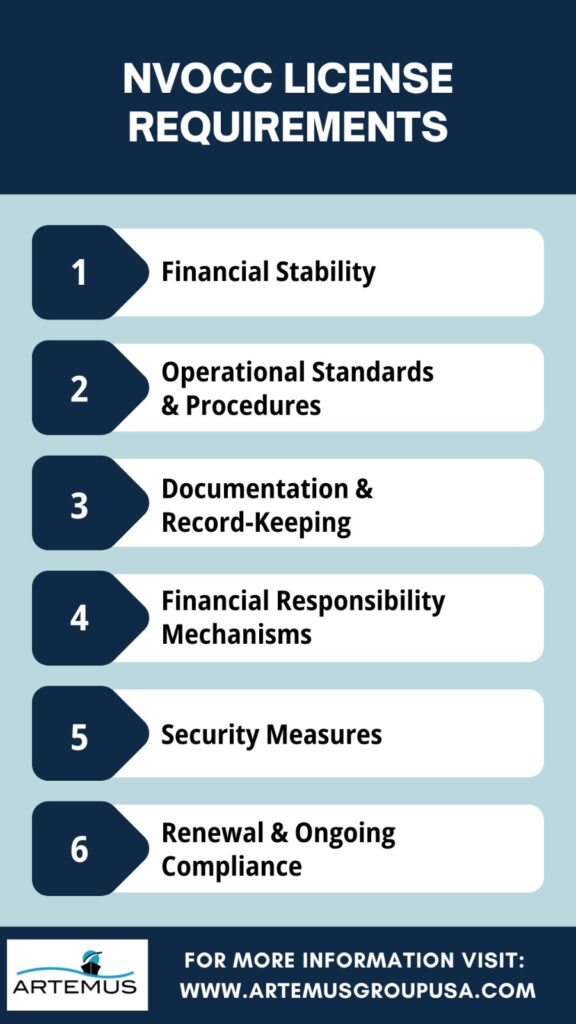
Navigating the complex world of international shipping requires more than logistical expertise; it demands full compliance with industry regulations. For companies looking to operate as Non-Vessel Operating Common Carriers (NVOCCs), obtaining a valid license is not just a legal formality; it’s a mark of credibility and operational readiness in the global logistics ecosystem.
Below is an overview of the key requirements for securing an NVOCC license:
A strong financial foundation is a critical requirement. Applicants must demonstrate financial stability, often through audited financial statements or other verified financial documents, to ensure they have the capacity to meet operational and legal obligations in the shipping industry.
NVOCCs must follow established operational protocols, including accurate cargo documentation, booking procedures, and proper handling of shipments. Adherence to these standards ensures smooth operations and enhances customer trust and regulatory compliance.
Thorough documentation is essential. Applicants are typically required to provide business plans, organizational charts, and evidence of financial responsibility. Once licensed, NVOCCs must maintain proper records to comply with audits and reporting requirements.
To safeguard stakeholders, NVOCCs are required to secure financial instruments such as surety bonds or liability insurance. For example, U.S.-based NVOCCs must obtain a $75,000 bond, while foreign-based operators need a $150,000 bond to comply with FMC requirements.
Regulatory bodies expect NVOCCs to implement robust cargo security protocols. These measures help prevent loss, tampering, or theft during transit and demonstrate the company’s commitment to maintaining the integrity of global supply chains.
Holding an NVOCC license means committing to continuous compliance. This includes staying updated on regulatory changes, renewing licenses within stipulated timelines, and adapting business practices to align with evolving standards.
Related: HS Code VS HTS Code: 10 Differences You Need To Know
Applying for an Ocean Transportation Intermediary (OTI) license specifically as a Non-Vessel Operating Common Carrier (NVOCC) through the Federal Maritime Commission (FMC) involves a structured, multi-step process. Here’s a detailed guide to help you navigate the application:
Begin by familiarizing yourself with FMC’s licensing requirements. Understand the financial responsibility standards, operational expectations, and legal obligations for NVOCCs operating in or serving the U.S. trade.
Gather the necessary documents, including financial statements, proof of insurance or surety bond, details of your business structure, and any required disclosures. Ensure all documentation is complete, accurate, and up to date.
Visit the FMC website and navigate to the Licensing & Registration section. The application process is handled entirely through the FMC’s online system.
Fill out Form FMC-18, providing comprehensive information about your company, financial status, ownership structure, and compliance history. Be precise and ensure consistency with your supporting documents.
Submit the required application fee as specified by the FMC. Payments are typically processed via the online portal. Check the latest fee schedule on the FMC website before proceeding.
Upload and submit your completed application and supporting documents through the FMC’s electronic system. Retain a confirmation receipt for your records.
The FMC will evaluate your application, verify the submitted data, and assess your company’s compliance readiness. This stage may take several weeks, depending on application volume and completeness.
If the FMC requests clarification or additional documentation, respond promptly. Delays in response can extend the review process.
The FMC will verify your financial responsibility, typically through a surety bond. U.S.-based NVOCCs must maintain a $75,000 bond, while foreign-based NVOCCs must maintain a $150,000 bond.
Be prepared for a potential site visit or audit. The FMC may evaluate your operational practices, document management, and compliance protocols to ensure you meet regulatory standards.
Upon successful review, the FMC will issue your OTI license, authorizing you to operate as an NVOCC. Review the license conditions and keep track of renewal timelines to remain compliant.
Enhance your ongoing compliance by using specialized software tools. Artemus Transportation Solutions offers powerful solutions for ISF, AMS, and AES filings, designed to support NVOCCs in maintaining accurate and timely compliance.
Related: Customs Compliance Software: Key Benefits & Top Suggestions
Ensuring uninterrupted shipping operations as an NVOCC (Non-Vessel Operating Common Carrier) requires ongoing attention to compliance and timely updates. While the FMC license itself does not require annual renewal, financial responsibility filings, tariffs, and company details must be maintained and updated regularly. Here’s what you need to stay on top of:
Rather than annual renewals, NVOCCs licensed by the Federal Maritime Commission (FMC) must ensure continuous compliance, which includes keeping surety bonds active and maintaining valid tariff filings and contact information.
Maintain updated financial statements, insurance certificates, and corporate structure documents. These may be required for audits or when updating records with the FMC.
Ensure your surety bond remains valid, $75,000 for U.S.-based and $150,000 for foreign NVOCCs, as it serves as proof of financial responsibility. Lapsed bonds can lead to license revocation or suspension.
If there are changes in your business operations, such as ownership, address, or key personnel, file updates promptly with the FMC to maintain accurate and compliant records.
Keep track of changes in FMC regulations or international shipping laws. Proactive compliance helps avoid penalties and ensures smooth operations across your NVOCC activities.
Related: Where Can I Buy A Customs Bond? Understand Your Options
Embarking on the journey of becoming a licensed Non-Vessel Operating Common Carrier (NVOCC) opens doors to numerous advantages in the dynamic realm of international shipping. Here are five key benefits of obtaining an NVOCC license:
Related: ISF Filing: A Compliance-Related Guide & Software Solution
Artemus Transportation Solutions offers top-tier ISF (Importer Security Filing), AMS (Automated Manifest System), and AES (Automated Export System) software solutions, specifically designed to meet the unique compliance and operational needs of NVOCCs.
Each solution is tailored to simplify filing processes, ensure regulatory accuracy, and improve turnaround times, whether you’re handling inbound shipments to the U.S. or managing export declarations.
With decades of industry expertise, Artemus empowers NVOCCs to file ISF entries swiftly and correctly, submit AMS data seamlessly to U.S. Customs, and fulfill AES requirements for exports without delays or penalties.
Our user-friendly platforms, real-time updates, and dedicated support team make compliance efficient, reliable, and hassle-free, so you can focus on growing your logistics business.
Related: ISF 5: Meaning, Compliance Requirements, & Best Practices
To start a business with NVOCC, obtain the necessary licenses, establish financial stability, build global partnerships, and invest in robust logistics technology for efficient operations.
One disadvantage of NVOCCs is the limited control over vessel schedules, leading to potential disruptions and challenges in cargo routing.
NVOCCs (Non-Vessel Operating Common Carriers) bear liabilities including cargo damage, delays, and errors in documentation during the shipping process.
NVOCC registration is the official process by which a company obtains authorization, typically from the Federal Maritime Commission (FMC) in the U.S., to operate as a Non-Vessel Operating Common Carrier. It allows the company to legally issue bills of lading and manage ocean freight without owning vessels.
Yes, NVOCCs are required to secure a surety bond, typically $75,000 for those based in the U.S. and $150,000 for foreign-based entities, as proof of their financial responsibility.
Yes, foreign-based NVOCCs can obtain a license or register with the FMC, but they must meet additional requirements, including appointing a U.S. legal agent and securing a higher surety bond.
The process typically takes 30–60 days, depending on the completeness of the application and responsiveness to any FMC queries.
Operating without a valid NVOCC license can result in hefty fines, legal penalties, and loss of business credibility. FMC enforcement is strict to ensure compliance.
In conclusion, navigating the waters of NVOCC (Non-Vessel Operating Common Carrier) license requirements is a crucial journey for those involved in the dynamic world of international shipping. We’ve explored the fundamental aspects of obtaining and maintaining an NVOCC license, from eligibility criteria to financial responsibilities and operational requirements. Achieving and maintaining compliance not only ensures adherence to industry standards but also opens doors to expanded business opportunities and enhances market credibility.
Related: What Can I Do With A Customs Broker License? A 2024 Guide

International trade between the United States and Switzerland highlights the strong economic relationship between the two nations. With its highly
Cold Nordic waters, advanced engineering, and a strong maritime economy make Norway a powerful exporter despite its size. Many of
Trade between the United States and Canada is one of the largest bilateral trading relationships in the world. Understanding what
 Optimized by Seraphinite Accelerator