Certificate of Conformance (CoC) is a fundamental document that underscores the commitment to quality, compliance, and reliability across diverse industries. In an increasingly regulated and competitive marketplace, businesses strive to uphold stringent standards and regulations to maintain their reputation and meet customer expectations.
Through this series, we’ll explore the significance, benefits, and intricacies of the CoC, shedding light on its role in fostering trust, streamlining processes, and driving industry excellence.
Artemus Transportation Solutions supports importers and logistics professionals with ISF and AMS & AES compliance software designed to help meet U.S. Customs and Border Protection filing requirements. By simplifying data submission and improving visibility into compliance processes, these tools help businesses reduce filing errors, avoid delays, and stay aligned with evolving trade regulations.
Table Of Contents
- 1 What Is The Certificate Of Conformity?
- 2 What Is A CoC Certificate In Shipping?
- 3 Benefits Of Certificate Of Conformance
- 4 What Is The Main Purpose Of A Certificate Of Conformance?
- 5 What Are The Requirements For Certificate Of Conformance?
- 6 What Information Is Typically Found On A CoC?
- 7 Types Of Certificates Of Conformance
- 8 How To Obtain A Certificate Of Conformance?
- 9 Importance Of Certificate Of Conformance In Different Industries
- 10 Certificate Of Conformance VS Certificate Of Analysis (Coc VS CoA)
- 11 Certificate Of Conformance VS Certificate Of Compliance (Coc VS CoCom)
- 12 FAQs
- 13 Conclusion
What Is The Certificate Of Conformity?
A Certificate of Conformity (CoC) is an official document that confirms a product meets the applicable regulatory standards, technical requirements, or specifications set by a specific authority or market. It is most commonly used in manufacturing and international trade to demonstrate that goods comply with safety, quality, and legal requirements before they are sold or imported.
A CoC may be issued by a manufacturer, supplier, or authorized testing body, depending on the regulation and product type. While some certificates are supported by laboratory testing or third-party inspections, others are based on documented internal compliance and technical declarations. The exact requirements vary by country, industry, and regulatory framework.
Across global supply chains, the Certificate of Conformity plays an important role in facilitating trade and reducing compliance risks. It helps regulators verify product compliance, supports customs clearance, and provides buyers and partners with confidence that the product meets the required standards for its intended market.
Related: What Is Global Trade Compliance & Its Key Components
What Is A CoC Certificate In Shipping?
In shipping and international trade, a Certificate of Conformity (CoC) is a document that confirms certain goods meet the regulatory requirements of the importing country. It is typically required for specific product categories and destinations where pre-shipment or import compliance programs are in place.
A CoC demonstrates that the products comply with applicable safety, technical, or quality standards set by the destination country’s authorities. Depending on the regulation, the certificate may be issued by the manufacturer, an authorized inspection agency, or an approved third-party body. The exact requirements vary by country and product type.
While a Certificate of Conformity does not guarantee customs clearance, it plays an important role in reducing the risk of delays, inspections, or shipment rejection when required. For exporters and importers, having the correct CoC in place helps meet regulatory obligations and supports smoother cross-border movement of goods.
Related: How Long Does Customs Clearance Take? Key Takeaways
Benefits Of Certificate Of Conformance
The Certificate of Conformance (CoC) carries a myriad of benefits across industries, serving as a cornerstone for quality assurance, regulatory compliance, and customer trust. Here are the key advantages:
- Quality Assurance: CoC provides assurance to customers that the product or service meets specified standards, ensuring consistent quality and reliability.
- Compliance Verification: It verifies compliance with industry regulations, standards, and specifications, mitigating the risk of non-compliance penalties and legal consequences.
- Enhanced Credibility: Holding a CoC enhances the credibility and reputation of the certified entity, fostering trust among customers, partners, and regulatory authorities.
- Global Market Access: Facilitates access to global markets by demonstrating adherence to international standards, easing entry into new markets, and boosting export opportunities.
- Reduced Risk: Helps mitigate risks associated with product or service defects, ensuring compliance with safety and performance requirements, thereby minimizing potential liabilities.
- Streamlined Processes: Simplifies procurement processes by providing a standardized and recognized proof of compliance, expediting transactions, and reducing administrative burdens.
- Competitive Advantage: Differentiates the certified entity from competitors by showcasing a commitment to quality and compliance, potentially leading to increased market share and profitability.
- Customer Satisfaction: Increases customer satisfaction by instilling confidence in the reliability and consistency of the product or service, leading to repeat business and positive word-of-mouth referrals.
- Supply Chain Efficiency: Improves supply chain efficiency by ensuring that suppliers and subcontractors adhere to agreed-upon standards and specifications, reducing the risk of disruptions and delays.
- Continuous Improvement: Encourages a culture of continuous improvement within the organization, driving innovation and optimization of processes to maintain and exceed compliance standards.
Related: Shipment Has Been Given A Release Status By Customs
What Is The Main Purpose Of A Certificate Of Conformance?
The main purpose of a Certificate of Conformance is to formally confirm that a product meets the regulatory, safety, and quality requirements of the market where it is being sold. Many countries require this document for certain product categories to allow smooth customs clearance and regulatory approval during import.
A Certificate of Conformance also plays an important role in building trust across the supply chain. Buyers, distributors, and end customers rely on it as proof that a product complies with recognized standards, making it easier to trade across different regions such as the United States, Europe, or Asia.
From a business perspective, having a valid CoC helps manufacturers and exporters introduce products to the market without unnecessary delays. Without it, products may be held up at customs, rejected by buyers, or blocked from sale altogether, which can directly impact delivery timelines and profitability.
Additionally, a CoC streamlines inspections and compliance checks by clearly defining the standards a product meets. This improves process efficiency, reduces repeated testing, and supports faster approval throughout the product’s lifecycle.
Related: What Does Customs Clearance Completed Mean? Key Takeaways
What Are The Requirements For Certificate Of Conformance?
A Certificate of Conformance is issued only after specific compliance conditions are met. These requirements help confirm that a product meets applicable safety, quality, and regulatory standards before it enters the market. The key requirements typically include:
- Product Testing & Assessment: The product must be tested to verify that it meets defined safety, performance, and environmental standards relevant to the destination market.
- Regulatory Compliance: The product should comply with applicable national or international regulations, such as ISO standards, CE marking requirements, or other industry-specific rules.
- Technical Documentation: Manufacturers are required to provide complete technical records, including design specifications, material details, and official test reports that demonstrate compliance.
- Manufacturing Process Review: In some cases, the production process may be inspected to ensure manufacturing practices consistently follow approved standards.
- Use Of Accredited Testing Laboratories: Testing is often required to be conducted by recognized and accredited laboratories approved by regulatory authorities.
- Ongoing Compliance Monitoring: Certain industries require periodic audits or surveillance checks even after the certificate is issued to confirm continued conformity.
- Application & Certification Fees: A proper software has to be submitted to the certification body together with the desired charges for overview and processing.
Related: What Is HS Code In Shipping? The Harmonised System
What Information Is Typically Found On A CoC?
A Certificate of Conformance (CoC) typically includes important details that verify a product’s compliance with specific standards, regulations, or contractual requirements. Common information found on a CoC may include:
- Product Description: Clear and concise description of the product or service covered by the certificate.
- Identification Details: Unique identifiers such as serial numbers, model numbers, or batch numbers to trace the product’s origin and manufacturing process.
- Standards and Regulations: Specification of the standards, regulations, or contractual requirements that the product conforms to. This may include references to industry standards, government regulations, or customer-specific requirements.
- Manufacturing Date: The date when the product was manufactured or produced, indicating its age and ensuring compliance with applicable timelines or expiration dates.
- Authorized Signatures: Signatures of authorized personnel from the manufacturer or supplier, affirming the accuracy and authenticity of the certificate.
- Statement of Conformance: A statement confirming that the product meets all specified requirements and complies with relevant standards or regulations.
- Quality Assurance Measures: Information about quality control processes, testing procedures, and inspection methods used to ensure product quality and compliance.
- Contact Information: Contact details of the issuing authority or responsible personnel, providing recipients with a point of contact for inquiries or verification.

Related: Customs Compliance Software: Key Benefits & Top Suggestions
Types Of Certificates Of Conformance

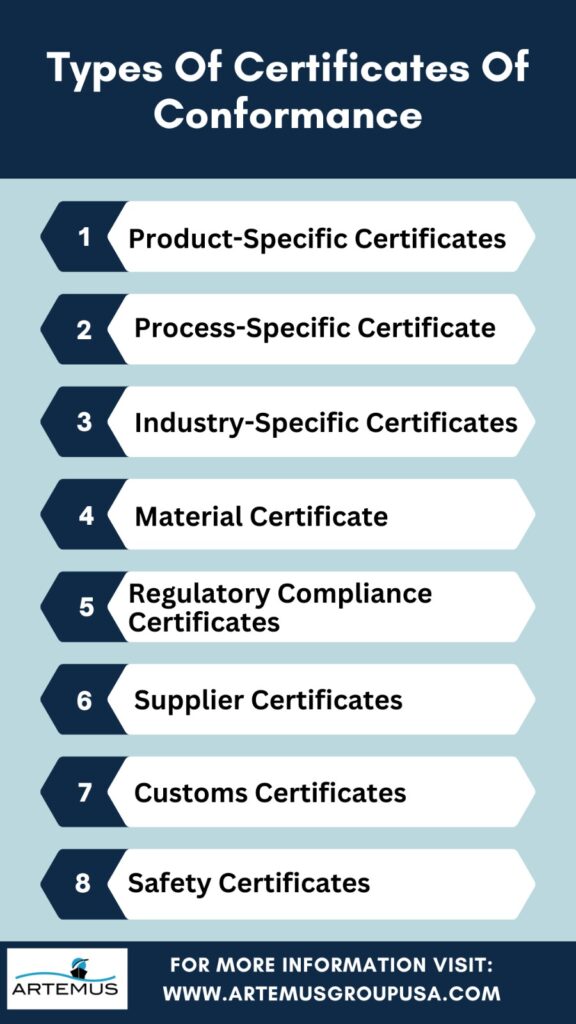
Certificates of Conformance (CoC) come in various types, each serving a specific purpose within different industries and regulatory frameworks. Understanding these types is essential for businesses to ensure compliance and meet customer expectations. Here are some common types of Certificates of Conformance:
1. Product-Specific Certificates
These certificates attest to the conformity of individual products with applicable standards, specifications, or regulations. They typically accompany each product shipment and provide details regarding its compliance, such as batch or serial numbers, testing results, and manufacturing dates.
2. Process-Specific Certificates
Process-specific CoCs certify the conformity of manufacturing or service processes rather than individual products. They validate that the production or service delivery processes meet specified standards and regulations, ensuring consistent quality and compliance across all outputs.
3. Industry-Specific Certificates
Certain industries have specialized certification requirements tailored to their unique characteristics and regulatory frameworks. Examples include ISO certifications for quality management systems, GMP (Good Manufacturing Practices) certifications for pharmaceuticals, and AS9100 certifications for aerospace manufacturing.
4. Material Certificates
Material certificates, also known as mill certificates or material test reports, confirm the properties and composition of raw materials used in manufacturing. They provide crucial information regarding material quality, traceability, and compliance with industry standards and specifications.
5. Regulatory Compliance Certificates
These certificates affirm compliance with specific regulations or legal requirements imposed by government authorities or regulatory bodies. Examples include certificates of compliance with environmental regulations, safety standards, or import/export regulations.
6. Supplier Certificates
Supplier certificates validate the conformity of products or services supplied by external vendors or subcontractors. They ensure that goods or services meet the required standards and specifications before being incorporated into the final product or delivered to the customer.
7. Customs Certificates
In international trade, customs certificates, such as Certificates of Origin or Certificates of Free Sale, facilitate customs clearance and verify the origin or quality of goods being imported or exported. They help ensure smooth cross-border transactions and compliance with trade agreements.
8. Safety Certificates
Safety certificates confirm that products or processes meet safety standards and regulations to protect consumers, workers, and the environment from potential hazards. Examples include CE marking for European Union markets and UL certification for electrical products in the United States.
Related: How To Do Custom Clearance In USA For Goods? The Process
How To Obtain A Certificate Of Conformance?
Obtaining a Certificate of Conformance (CoC) involves confirming and documenting that a product meets applicable standards, specifications, or regulatory requirements. The process typically includes the following steps:
1. Identify Applicable Standards & Regulations
Determine the relevant industry standards, regulatory requirements, or customer specifications your product must comply with.
2. Verify Product Compliance
Assess the product against the identified requirements to ensure it meets all technical, safety, and quality criteria.
3. Conduct Testing & Inspection (If Required)
Perform in-house or third-party testing and inspections where required by regulations or the importing country.
4. Compile Supporting Documentation
Gather test reports, inspection records, technical specifications, and quality control documents that demonstrate compliance.
5. Issue or Apply For The CoC
- If permitted, the manufacturer or exporter issues the CoC based on verified compliance.
- Where mandated, apply through an accredited certification body or authority.
6. Review & Address Non-Conformities
Resolve any identified gaps or non-conformities before final issuance.
7. Receive & Maintain The CoC
Once issued, retain the CoC for customs clearance, regulatory review, or customer verification, and ensure ongoing compliance for future shipments.
Related:Custom Clearance Charges & Fees: A Complete Guide
Importance Of Certificate Of Conformance In Different Industries
The Certificate of Conformance (CoC) holds significant importance across diverse industries, serving as a cornerstone for quality assurance, regulatory compliance, and customer satisfaction. Here’s a brief overview of its importance in various sectors:
- Manufacturing: In the manufacturing industry, CoCs validate that products meet stringent quality standards and regulatory requirements. They assure customers of product reliability, safety, and performance, fostering trust and confidence in the brand.
- Healthcare: In healthcare, CoCs ensure that medical devices, equipment, and pharmaceuticals adhere to strict quality and safety standards. They play a vital role in patient safety, regulatory compliance, and minimizing risks associated with substandard products.
- Automotive: In the automotive sector, CoCs certify that vehicles, parts, and components meet industry standards for safety, performance, and environmental impact. They are essential for ensuring product quality, regulatory compliance, and consumer confidence.
- Aerospace: In aerospace and defense industries, CoCs are critical for ensuring the safety, reliability, and performance of aircraft, spacecraft, and related components. They demonstrate compliance with stringent aviation regulations and quality management standards.
- Construction: In construction, CoCs verify that building materials, equipment, and structures meet industry standards for safety, durability, and performance. They are essential for regulatory compliance, quality control, and ensuring the integrity of construction projects.
- Food & Beverage: In the food and beverage industry, CoCs confirm that products meet food safety and quality standards, including hygiene, labeling, and traceability requirements. They help safeguard consumer health, ensure regulatory compliance, and maintain brand reputation.
- Pharmaceuticals: In the pharmaceutical sector, CoCs validate compliance with Good Manufacturing Practices (GMP), ensuring the quality, safety, and efficacy of drugs and medical products. They are essential for regulatory approval, product integrity, and patient safety.
- Information Technology: In the IT industry, CoCs certify that software, hardware, and IT systems meet industry standards for security, interoperability, and performance. They reassure customers of product quality, reliability, and compliance with data protection regulations.
- Energy & Utilities: In the energy and utilities sector, CoCs ensure compliance with environmental regulations, safety standards, and energy efficiency requirements. They are essential for promoting sustainable practices, minimizing environmental impact, and ensuring operational safety.
- Supply Chain Management: Across all industries, CoCs facilitate supply chain management by assuring product quality, compliance, and traceability. They help streamline procurement processes, mitigate risks, and build strong partnerships with suppliers and customers.

Related: What Is Customs Clearance? Meaning & Regulations
Certificate Of Conformance VS Certificate Of Analysis (Coc VS CoA)
Certificate of Conformance (CoC) and Certificate of Analysis (CoA) are two distinct documents that serve different purposes within various industries. Here’s a comparison between the two:
1. Purpose:
- Certificate of Conformance (CoC): It confirms that a product or service meets specified standards, regulations, or contractual requirements. It assures customers and stakeholders that the product or service complies with relevant quality and performance criteria.
- Certificate of Analysis (CoA): It provides detailed information about the composition, properties, and quality of a specific batch or lot of a product. It typically includes test results, specifications, and other analytical data related to the product’s chemical, physical, or microbiological characteristics.
2. Content:
- CoC typically includes information such as product description, identification details, manufacturing date, standards or regulations complied with, and signatures of authorized personnel.
- CoA includes detailed test results, specifications, and analytical data related to the product’s composition, purity, concentration, potency, and other relevant properties. It may also include information on methods used for testing and reference standards.
3. Scope:
- CoC focuses on confirming overall compliance with standards, regulations, or contractual requirements for a product or service.
- CoA focuses on providing specific analytical data and test results for a particular batch or lot of a product, often used to ensure product quality and consistency.
4. Applicability:
- CoC is commonly used in various industries, including manufacturing, construction, healthcare, automotive, and aerospace, to validate compliance with quality standards and regulations.
- CoA is prevalent in industries such as pharmaceuticals, food and beverage, chemicals, and cosmetics, where detailed analysis of product composition and quality is critical for regulatory compliance and product safety.
5. Usage:
- CoC is typically provided by manufacturers or suppliers to customers as a formal declaration of conformity, accompanying product shipments, or service deliverables.
- CoA is typically generated by laboratories or quality control departments as part of product testing and quality assurance processes. It may be requested by customers, and regulatory authorities, or used internally for quality control purposes.
Related: Customs Broker VS Freight Forwarder: 5 Key Differences
Certificate Of Conformance VS Certificate Of Compliance (Coc VS CoCom)
Certificate of Conformance (CoC) and Certificate of Compliance (CoCom) are both important documents used in various industries to ensure adherence to standards, regulations, and contractual requirements. Here’s a comparison between the two:
1. Purpose:
- Certificate of Conformance (CoC): It is a declaration by the manufacturer or supplier that a product or service meets specified standards, regulations, or contractual requirements. It affirms that the product or service conforms to established quality and performance criteria.
- Certificate of Compliance (CoCom): It is a formal document issued by a regulatory authority or certification body, confirming that a product, process, or system complies with relevant regulations, standards, or legal requirements.
2. Issuer:
- CoC is typically issued by the manufacturer or supplier of the product or service, assuring customers and stakeholders about the product’s conformity.
- CoCom is issued by a regulatory authority, certification body, or third-party auditor with the authority to assess compliance with specific regulations, standards, or legal requirements.
3. Content:
- CoC typically includes details such as product description, identification, manufacturing date, standards complied with, and signatures of authorized personnel from the manufacturer or supplier.
- CoCom includes information about the regulatory requirements or standards with which the product, process, or system complies, along with details of the assessment process, findings, and any conditions or limitations of compliance.
4. Scope:
- CoC focuses on confirming conformity of a specific product or service with standards, regulations, or contractual requirements, often related to quality, performance, or safety.
- CoCom verifies compliance of a product, process, or system with broader regulatory requirements, industry standards, or legal obligations, ensuring adherence to applicable laws and regulations.
5. Applicability:
- CoC is commonly used in industries such as manufacturing, construction, automotive, and aerospace to validate compliance with quality standards and contractual requirements.
- CoCom is prevalent in regulated industries such as healthcare, pharmaceuticals, food and beverage, and environmental management, where strict adherence to regulatory requirements is necessary to ensure public safety, product quality, and environmental protection.
Related: OTI License Requirements, Costs, Renewal, & Regulations
FAQs
1. Who Provides A Certificate Of Conformance?
A Certificate of Conformance is typically provided by the manufacturer or supplier of a product or service, affirming that it meets specified standards, regulations, or contractual requirements.
2. What Is The Meaning Of Conformity Certificate?
A Conformity Certificate is a document confirming that a product, process, or service complies with specified standards, regulations, or contractual requirements, ensuring adherence to quality and performance criteria.
3. Which Industries Use Certificates Of Conformance?
Certificates of Conformance are commonly used in industries such as manufacturing, automotive, aerospace, electronics, medical devices, construction, chemicals, and consumer goods. Any industry that must meet regulatory, safety, or quality standards relies on a CoC to prove compliance.
4. How Long Is A Certificate Of Conformance Valid?
There is no fixed validity period for a Certificate of Conformance. It is generally valid as long as the product design, materials, manufacturing process, and applicable regulations remain unchanged. If any of these change, a new CoC is usually required.

Conclusion

The Certificate of Conformance (CoC) serves as a vital assurance of quality, reliability, and compliance in various industries. By affirming that products, processes, or services meet specified standards, regulations, or contractual requirements, the CoC instills confidence among customers, stakeholders, and regulatory authorities. Its significance lies not only in validating adherence to established norms but also in fostering trust, facilitating market access, and mitigating risks associated with non-compliance.
As businesses continue to prioritize quality assurance and regulatory compliance, the CoC remains a cornerstone for demonstrating commitment to excellence and meeting the ever-evolving expectations of a global marketplace.
Related: Shipment Has Been Given A Release Status By Customs