UK Imports & Exports: Trade Profile & Top Partners
The United Kingdom is one of the world’s largest trading economies and a top exporter of services. Cars, machinery, pharmaceuticals,


In the complex world of logistics, the roles of freight forwarders and brokers stand out as vital cogs in the supply chain machinery. While both facilitate the movement of goods, understanding the distinctions is crucial for businesses navigating international trade. Freight forwarders act as intermediaries between shippers and carriers, managing the transportation of cargo from point A to B seamlessly.
On the other hand, brokers specialize in facilitating transactions between buyers and sellers, ensuring compliance with customs regulations and documentation requirements. In this blog, we’ll delve into the differences between freight forwarders and brokers, shedding light on the unique responsibilities and how they impact the shipping process.
Additionally, we’ll explore how Artemus Transportation Solutions offers specialized software solutions tailored to the needs of both freight forwarders and brokers – AMS and ISF software solutions.
Table Of Contents
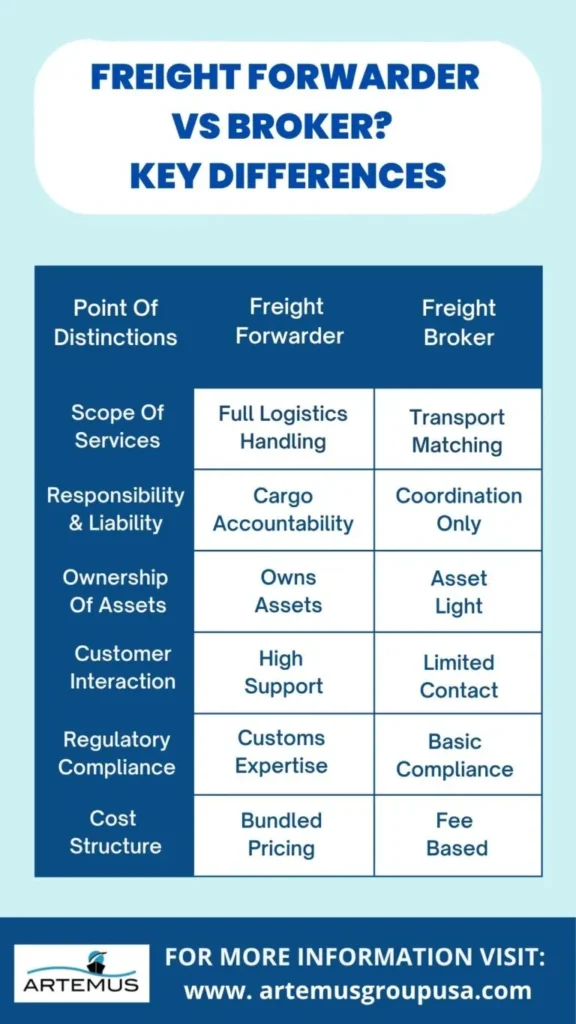
Freight Forwarder: A freight forwarder provides end-to-end logistics solutions, including booking cargo space, consolidating shipments, arranging multi-modal transportation (air, ocean, and land), handling export and import documentation, managing insurance, and coordinating delivery.
Forwarders oversee the entire shipment lifecycle, making them ideal for international trade and complex logistics needs.
Broker: A freight broker serves as an intermediary between shippers and carriers, matching loads with suitable transport providers, negotiating competitive rates, and coordinating delivery schedules. Most brokers manage domestic freight, connecting businesses with dependable carriers for trucking and regional distribution.
Brokers generally do not handle physical cargo or documentation but specialize in arranging efficient and cost-effective transportation solutions.
Freight Forwarder: Forwarders assume greater responsibility for cargo, often issuing a bill of lading and managing shipments from origin to destination. They act as a single point of contact and are accountable for cargo conditions and delivery timelines.
Broker: Brokers facilitate agreements between shippers and carriers but do not take possession of goods. Liability is limited to arranging transportation, while the carrier remains responsible once the shipment is in transit.
In the U.S., both brokers and forwarders must register with the Federal Motor Carrier Safety Administration (FMCSA) or, for ocean freight, the Federal Maritime Commission (FMC).
Freight Forwarder: Many freight forwarders own or lease logistics assets such as warehouses, containers, and trucks. This provides greater control over the shipping process and enables value-added services like warehousing and cargo consolidation.
Broker: Brokers operate on an asset-light model. They do not own transportation equipment or storage facilities but rely on a network of vetted carriers and logistics partners. Strength lies in industry connections, rate negotiation, and quick access to transport capacity.
Freight Forwarder: Forwarders maintain close relationships with customers, offering customized shipping solutions, real-time tracking, documentation management, and full support throughout the shipping journey.
For cross-border trade, forwarders often act as strategic partners.
Broker: Brokers generally have limited customer interaction. The primary role is to negotiate and coordinate shipments efficiently. However, with digital freight platforms becoming mainstream, modern brokers now provide more transparent communication and real-time tracking through automated systems.
Freight Forwarder: Forwarders specialize in trade compliance and customs management, ensuring shipments meet import/export regulations, managing documentation, and coordinating with customs authorities.
Many are licensed customs brokers or work closely with them to handle tariff classification and duties.
Broker: Brokers understand general transportation rules but typically do not manage customs procedures. Focus remains on logistics coordination. For complex international shipments, brokers often collaborate with forwarders or customs brokers for regulatory requirements.
Freight Forwarder: Forwarders usually offer bundled pricing that covers transportation, warehousing, documentation, and insurance. Although quotes may appear higher initially, forwarders often deliver better value through consolidated management, reduced delays, and lower total logistics costs.
Broker: Brokers generally charge a commission or flat fee based on shipment value or negotiated savings. The flexible service model suits businesses that prefer to manage some logistics functions independently.
With digital freight matching and AI-based rate tools, brokers now offer faster quotes and greater price transparency.
Related: How To Start A Freight Forwarding Business? 10 Easy Steps
Choosing between a freight broker and a freight forwarder depends on your shipment type, trade routes, and logistics priorities. Both play vital roles in the global supply chain, yet they serve different needs when it comes to control, cost, and operational complexity.
Freight Forwarders are ideal for businesses managing international or multimodal shipments. They provide comprehensive logistics management, handling every aspect from booking and consolidation to customs clearance, insurance, documentation, and storage.
For companies that frequently ship overseas or require end-to-end visibility across air, sea, and land transport, forwarders deliver unmatched convenience and reliability. The ability to oversee each stage of transportation makes them indispensable for organizations that prioritize seamless operations, compliance, and reduced risk over short-term cost savings.
Freight Brokers, by contrast, excel in domestic and single-lane transport. Acting as intermediaries between shippers and carriers, brokers leverage extensive carrier networks to secure competitive rates and fast turnaround times.
For businesses moving freight within a country or region, brokers offer flexibility, scalability, and cost efficiency, without the need for long-term logistics contracts.
In recent years, digital freight brokers have transformed the industry by integrating AI-powered tools for real-time pricing, route optimization, and shipment tracking, making domestic logistics faster and more transparent than ever.
In summary:
Ultimately, both contribute significant value, the best choice depends on whether your business prioritizes global reach and control or agility and cost savings in transportation.
Related: Freight Forwarders Arrange Transportation Only By Ocean Shipping
Selecting between a freight broker and a freight forwarder comes down to understanding your shipping priorities: cost, control, and complexity. The right choice isn’t about which one is better, but which aligns with your logistics strategy. Here are a few key factors to consider when deciding which option best fits your business needs:
If a business handles frequent international shipments that require customs clearance, multi-modal coordination, and documentation, a freight forwarder is the smarter choice. Expertise in compliance and risk reduction ensures smooth movement at every stage.
For domestic, high-volume, or short-haul shipments, a freight broker offers better flexibility. Brokers can quickly match loads with carriers, helping save on spot rates and adapt to seasonal demand.
If a company already has an in-house logistics or customs team, working with a broker can be more cost-efficient since payment is made only for carrier connections.
However, when internal logistics support is limited or operations span multiple countries, partnering with a forwarder provides a complete logistics solution without requiring additional in-house expertise.
Forwarders are ideal for businesses planning to scale internationally or expand into new trade lanes. Strong relationships with global carriers and customs authorities enable smoother growth.
Brokers, meanwhile, suit businesses focused on agility and quick decision-making, especially in fast-moving industries like retail or manufacturing where freight needs fluctuate.
Digital innovation has blurred the line between the two. Modern brokers now use tech platforms that rival forwarders in visibility and tracking, while forwarders are integrating AI-based systems for predictive logistics and compliance automation.
Choose a partner that offers data transparency and real-time shipment updates, these matter more than titles.
Making the right choice means identifying which model complements your operations today and supports your growth tomorrow. A logistics partner that aligns with your goals, technology needs, and customer expectations will ultimately bring the best long-term value.
Related: How To Become A Freight Forwarder: A Stepwise Guide
Artemus Transportation Solutions specializes in providing comprehensive software solutions tailored to the needs of freight forwarders and brokers. The flagship offerings, the Artemus Management System (AMS) and Importer Security Filing (ISF) software, are designed to streamline and optimize logistics operations.
With the AMS platform, freight forwarders gain access to a powerful toolset for managing shipments, tracking cargo, and handling documentation efficiently. The centralized system enhances visibility and enables companies to improve operational efficiency and maintain compliance excellence.
In addition, the ISF software solution simplifies the process of filing Importer Security Filings, ensuring compliance with U.S. Customs and Border Protection regulations.
Related: Freight Forwarder Software: Key Features & Solutions
Yes, a freight forwarder can work with a freight broker to optimize shipping services and logistics operations.
A freight forwarder manages logistics and transportation, while a freight agent typically represents or works on behalf of a freight forwarder or carrier to secure business and handle specific tasks.
Businesses involved in international trade or shipping goods globally typically need a freight forwarder.
A freight broker helps businesses find reliable carriers at competitive rates, saving time and reducing shipping costs. They simplify logistics by handling negotiations, coordination, and paperwork.
Freight forwarders manage complex international shipping tasks, from booking cargo space to customs clearance. They ensure smooth cross-border movement and compliance with trade regulations.
Use a freight forwarder when shipping internationally, managing multi-modal transport, or dealing with large or high-value shipments that require documentation and regulatory expertise.
Yes, brokers can collaborate through co-brokerage agreements to expand carrier networks or meet urgent shipment needs. However, transparency and proper contracts are crucial to avoid liability issues.

In conclusion, understanding the distinction between freight forwarders and brokers is paramount for businesses navigating the complexities of international trade. While both play integral roles in facilitating the movement of goods, their specific functions and responsibilities differ significantly.
Freight forwarders excel in managing the logistics of shipping, coordinating transportation, and ensuring smooth delivery from origin to destination. On the other hand, brokers specialize in facilitating transactions, managing customs compliance, and navigating regulatory requirements.
Ultimately, the choice between utilizing a freight forwarder or a broker depends on the unique needs and requirements of each business. However, regardless of the path chosen, one thing remains clear: efficient and effective logistics operations are essential for success in today’s global marketplace.
Related: What Does A Freight Forwarder Do? Functions & Future Trends

The United Kingdom is one of the world’s largest trading economies and a top exporter of services. Cars, machinery, pharmaceuticals,
Mexico became the United States’ number-one trading partner in 2024, surpassing both Canada and China. According to the Office of
Colombia is one of Latin America’s most active trading economies. Crude oil, coffee, coal, and cut flowers flow out. Machinery,