UK Imports & Exports: Trade Profile & Top Partners
The United Kingdom is one of the world’s largest trading economies and a top exporter of services. Cars, machinery, pharmaceuticals,


Poland and the USA share a robust and dynamic trade relationship, with Poland’s exports to the USA playing a significant role in this economic partnership. As Polish businesses continue to explore opportunities in the U.S. market, understanding and navigating the complexities of U.S. customs regulations become crucial.
This blog provides a complete overview of Poland’s export landscape to the U.S., including the biggest export categories, trade dynamics, opportunities, challenges, and the step-by-step export process. It also highlights the growing sectors that drive trade between the two countries, offering practical insights for Polish businesses looking to expand into the U.S. market.
This is where Artemus Transportation Solutions steps in, offering specialized USA compliance support with software solutions for ISF and AMS filings. With advanced software solutions tailored for Poland’s exports, Artemus ensures that Polish exporters can confidently meet U.S. customs requirements, streamlining the export process and facilitating smoother trade between Poland and the USA.
Table Of Contents
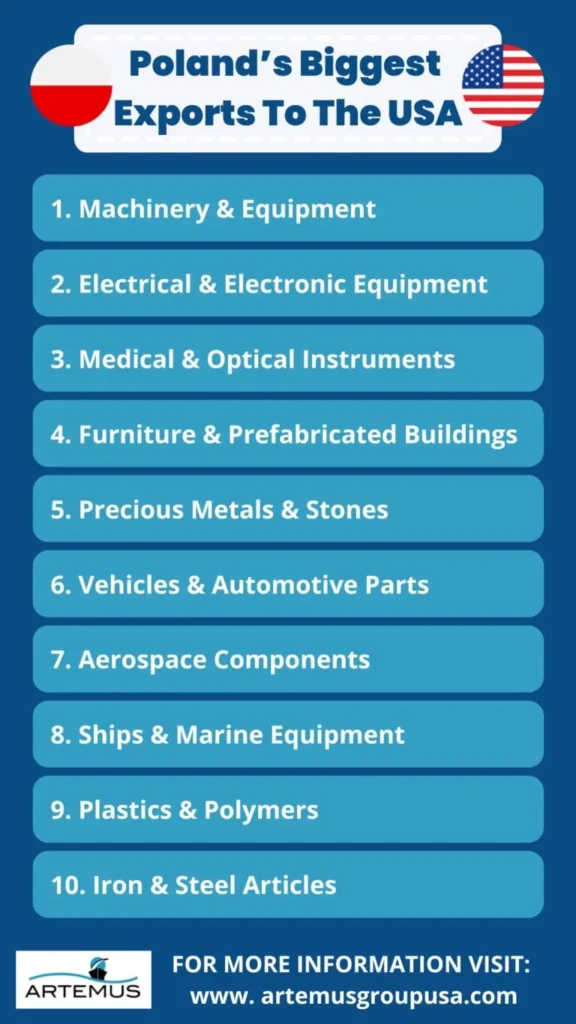
Poland has a diverse export profile to the U.S., contributing to industries from manufacturing to healthcare. In 2024, Poland’s exports to the United States totaled US $12.59 billion. Below is a breakdown of the biggest categories and how they connect to U.S. demand:
Poland’s machinery sector, including nuclear reactors and boilers, represents the country’s largest export to the U.S. These products play a vital role in supporting American construction, energy, and industrial production, strengthening infrastructure projects and advanced manufacturing capabilities.
Electrical and electronic equipment, ranging from components to consumer devices, is another major export category. These goods are essential for U.S. technology, telecommunications, and automotive sectors, ensuring the smooth functioning of supply chains and fostering innovation.
Poland’s exports of medical and optical instruments, including technical and diagnostic apparatus, highlight the country’s expertise in precision manufacturing. These products are widely used across U.S. hospitals, laboratories, and research facilities, supporting healthcare advancements and scientific development.
The Polish furniture and prefabricated building industry is globally recognized for its craftsmanship and affordability. These exports supply U.S. retailers, homes, and commercial projects, offering American consumers durable, high-quality, and competitively priced furnishing solutions.
Poland’s exports of pearls, precious stones, metals, and coins provide critical inputs to U.S. industries. These materials support jewelry manufacturing, electronics, and other high-tech applications, making them valuable both for decorative and industrial use in America.
The automotive sector remains one of Poland’s strongest industries, with vehicles and components forming a significant share of exports to the U.S. These parts are integrated into American-built vehicles, helping automakers meet production demands and deliver to a competitive consumer market.
Polish aerospace exports, including aircraft and spacecraft components, underline the country’s growing role in aviation. These products are vital for U.S. civilian aircraft manufacturing and defense operations, ensuring reliability in both commercial and military applications.
The shipbuilding tradition in Poland translates into exports of ships, boats, and other floating structures to the U.S. These products serve American logistics, naval, and defense needs, reinforcing the country’s shipping and maritime industries.
Poland’s plastics and polymer exports continue to expand, supplying key materials to U.S. industries. These products are widely used in packaging, automotive, and construction sectors, providing critical inputs for both consumer goods and industrial manufacturing.
Exports of iron and steel articles emphasize Poland’s contribution to raw and semi-finished materials. These goods support American construction, heavy machinery, and automotive production, filling supply chain gaps and strengthening U.S. industrial capacity.
Related: Exporting Mangoes From India To The USA: How To Ship?

The trade relationship between the United States and Poland continues to grow steadily, reflecting strong economic ties and expanding opportunities on both sides. Recent data shows that Poland maintains a positive trade balance with the U.S., with exports and imports both experiencing year-on-year growth.
Poland’s exports to the U.S. are diverse, with major categories including gas turbines, motor vehicle parts, and various manufactured goods. Growth has been particularly strong in areas such as electric batteries, furniture, and specialty commodities, highlighting Poland’s increasing role as a supplier of both advanced technology and high-quality consumer products.
The United States remains a key supplier to Poland, especially in high-value and energy-related goods. Imports from the U.S. are led by aircraft parts, petroleum gas, and refined petroleum, reflecting Poland’s demand for energy resources and advanced industrial components.
Both countries are seeing rapid growth in specific sectors. For Poland, rising demand for electric batteries and furniture has boosted exports, while for the U.S., surging shipments of aircraft parts and crude petroleum have strengthened its position in the Polish market. These trends point to a deepening partnership that benefits industries across energy, manufacturing, and technology.
Related: Exporting From Australia To USA: A Complete Guide

Poland’s exports to the United States remain strong, showing consistent growth in value and diversification across sectors. This performance highlights Poland’s importance as a trading partner for the U.S.
In June 2025, Poland exported goods worth $1.1 billion to the United States, an increase of $24.2 million (2.26%) compared to June 2024 (source). This rise was driven by steady demand for Polish industrial goods and consumer products.
The growth in exports was supported by notable increases in key categories. Electric batteries rose by $23.2M (113%), commodities not elsewhere specified increased by $14.5M (31.6%), and furniture climbed by $13.3M (43.5%). These figures show the sectors where Poland is expanding its export presence in the U.S. market.
Related: How To Export From India To USA? A 2025 Guide
Polish exporters still have strong opportunities in the U.S. – bilateral goods trade runs in the tens of billions of dollars annually (roughly $17–18 billion total U.S. goods trade with Poland in 2024), and U.S. demand is broad across both consumer and industrial categories.
Here are some of the key opportunities that Polish exporters can tap into:
American buyers continue to value well-made mid- and premium-segment goods. Strong demand exists for Polish machinery and machine parts, automotive components, furniture and wood products, processed foods and specialty agri-food, and certain chemical and medical supplies.
Positioning on quality, EU standards compliance, and clear technical documentation helps – many U.S. buyers treat EU-origin products as meeting reliable regulatory and quality expectations
Niches remain attractive: gourmet/ethnic food (Polish specialties), organic and clean-label food, craft and design furniture, boutique cosmetics, and specialized B2B equipment. Identifying a tightly defined buyer profile (e.g., specialty importers, regional grocery chains, boutique e-retailers) and certifying where needed (organic, non-GMO, ISO) improves market fit.
Trade data show rising value in higher-value, Differentiated Product Lines.
Cross-border e-commerce unlocked direct access to U.S. consumers for many small exporters, but recent U.S. policy removed the “de-minimis” duty exemption (effective August 29, 2025). That change means nearly all shipments into the U.S. can be subject to duties, taxes, and more customs paperwork.
Polish sellers using marketplaces or direct-to-consumer channels must update pricing, customs documentation, and checkout-time duty/tax calculations – and consider whether to use third-party logistics partners or U.S. fulfillment to simplify compliance.
At the same time, long-term e-commerce demand remains high, so investing in compliant cross-border processes still pays off.
Working with U.S. distributors, importers, and established retail/wholesale partners remains one of the fastest routes to scale. Options include exclusive distribution agreements, listing with regional chains, white-label manufacturing partnerships, and using U.S. trade service programs (e.g., ITA/SelectUSA contacts, foreign-trade zones) to lower entry friction.
The U.S. Commercial Service and trade missions can help pre-qualify partners and arrange buyer meetings.
Exporters that offer product improvements (energy-efficient machinery, Industry 4.0 features, medical device technologies) or that adapt products to U.S. standards (electrical, safety, labeling) have an edge.
For food and agricultural products, U.S. agencies require specific approvals – exporters should confirm eligibility and certification early (e.g., FSIS for meat/poultry products).
Investing in clear technical files, testing, and IP protection makes commercial conversations with U.S. buyers smoother.
Major U.S. trade shows and bilateral trade fairs remain effective for lead generation and partner scouting, they give immediate buyer feedback and often accelerate distributor agreements.
Consider aligning trade-show attendance with the U.S. Commercial Service events or an ITA trade mission to get buyer introductions and on-the-ground support. Given current logistics and regulatory shifts, use shows to test pricing that includes new duty/tax scenarios for e-commerce.
Related: 10 International Shipping Documents To Must Have In 2025
While the U.S. offers strong opportunities for Polish exporters, recent trade policies and regulatory hurdles make market entry more complex. Exporters need to be aware of three main challenges:
In August 2025, the U.S. introduced a 15% tariff on nearly 90% of EU exports and 50% tariffs on steel and aluminum, extending to products like appliances and furniture. This raises costs for Polish exporters, especially in automotive supply chains.
U.S. rules on product safety, labeling, and certification remain strict, particularly in food, electronics, and medical goods. Exporters must meet U.S. agency requirements (FDA, USDA, CPSC) and stay updated via the U.S. Commercial Service Country Guide.
Many Polish exports reach the U.S. indirectly via Germany and other EU partners. Tariffs can disrupt these supply chains and force contract renegotiations, raising costs and creating uncertainty.
Related: What Is Global Trade Compliance & Its Key Components
Exporting goods from Poland to the USA can be a rewarding venture, given the strong trade ties between the two countries. However, navigating the export process requires careful planning, understanding of regulations, and efficient logistics management. Here’s a step-by-step guide to help Polish exporters successfully export their products to the USA:
Related: Custom Clearance Documents Required In USA, India, & Japan

Artemus Transportation Solutions specializes in providing comprehensive USA compliance support for ISF (Importer Security Filing) and AMS (Automated Manifest System) filings tailored to Poland’s exports. Leveraging advanced software solutions, Artemus ensures that Polish exporters can navigate the complexities of U.S. customs regulations seamlessly and efficiently.
The software is designed to streamline the filing process, reducing errors and ensuring compliance with U.S. customs requirements. By partnering with Artemus Transportation Solutions, Polish exporters can confidently expand their exports to the USA, knowing that their shipments meet all necessary compliance standards and regulations.
Related: How To Do Custom Clearance In USA For Goods? The Process
The U.S. imports machinery, furniture, food products, chemicals, and textiles from Poland.
Germany is Poland’s biggest trade partner.
Poland is an important NATO ally and strategic partner for the U.S., sharing values of democracy and contributing to regional security.
Poland’s top export is machinery, including boilers and industrial equipment, worth about $50 billion in 2024. Electrical goods and vehicles are also major categories, together making up a significant share of trade.
Poland is best known for producing machinery, electronics, vehicles, and furniture, with its furniture exports ranking third in the world. It is also recognized for traditional crafts like Koniaków lace, now featured internationally.
The machinery industry is Poland’s largest sector and the backbone of its exports. It covers equipment, power systems, and components used across global energy and manufacturing.
Air freight takes about 1–8 business days depending on service speed, while sea freight usually takes 18–30 days. Couriers range from a few days for express shipments to several weeks for economic services.
Shipping a car from Poland to the U.S. typically costs $3,000–$6,000, depending on whether you use RoRo or container shipping, the vehicle size, and the port of entry. From October 2025, a new $150 vessel fee will slightly increase costs.
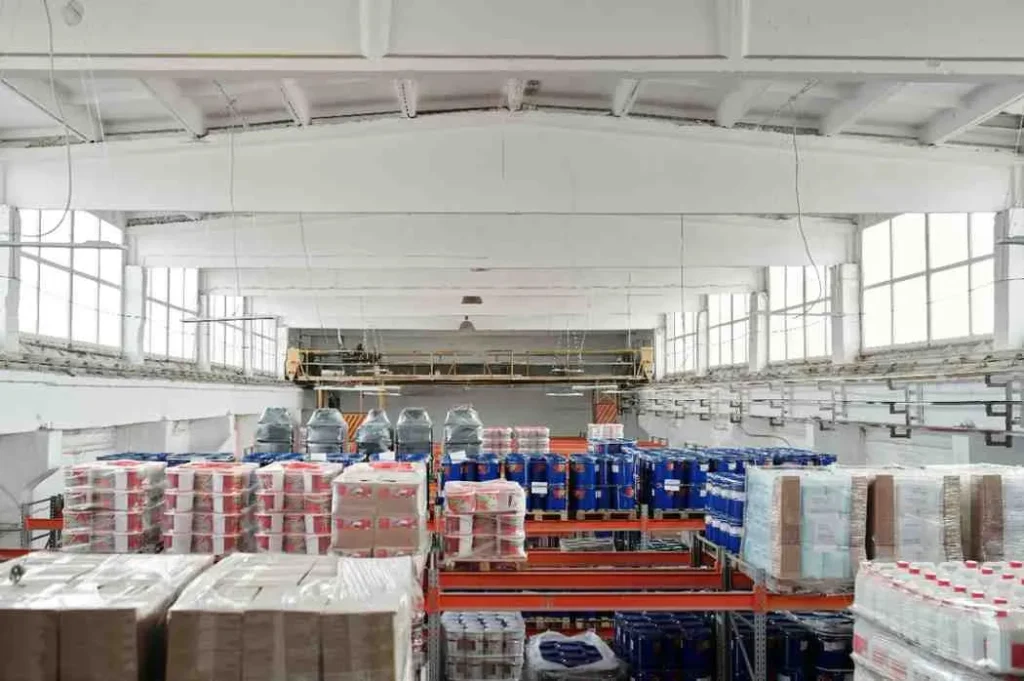
Poland’s exports to the USA continue to grow, reflecting the strong and expanding trade relationship between these two countries. With a diverse range of products from machinery and equipment to food and beverages, Polish exporters have found a receptive market in the USA. As this trade partnership flourishes, it’s essential for Polish businesses to navigate the complexities of international trade regulations seamlessly.
Related: Shipment Has Been Given A Release Status By Customs

The United Kingdom is one of the world’s largest trading economies and a top exporter of services. Cars, machinery, pharmaceuticals,
Mexico became the United States’ number-one trading partner in 2024, surpassing both Canada and China. According to the Office of
Colombia is one of Latin America’s most active trading economies. Crude oil, coffee, coal, and cut flowers flow out. Machinery,