What Does The US Export To Switzerland? Trade Insights
International trade between the United States and Switzerland highlights the strong economic relationship between the two nations. With its highly



When shipping goods internationally, finding the most efficient and cost-effective method is crucial. Less Than Container Load (LCL) shipping offers a flexible solution for businesses that don’t need a full container but still want to move their cargo safely across borders.
LCL allows multiple shipments from different shippers to be consolidated into one container, reducing costs while ensuring timely delivery.
At Artemus, we simplify this process with our comprehensive AMS and ISF solutions, ensuring seamless customs compliance. Additionally, you can request a domestic transportation quote with Artemus, making your logistics experience even more streamlined.
Table Of Contents
Less Than Container Load (LCL) is a shipping term used when a shipment doesn’t require a full container to transport goods. Instead of paying for an entire container, businesses or individuals can share space within a container with other shippers.
This method is particularly beneficial for small to medium-sized shipments that don’t fill an entire container, making it a cost-effective and efficient option.
In an LCL shipment, multiple consignments are consolidated into one container, allowing each shipper to pay only for the space their cargo occupies. The cargo is grouped based on destination, ensuring that it reaches its final location efficiently. This method also enables shippers to send smaller quantities of goods without the need to wait until they have enough to fill a container.
LCL shipping is widely used in international trade, providing flexibility and reducing overall transportation costs. However, it involves some complexity, such as coordinating with other shipments and ensuring proper documentation.
Working with a reliable logistics provider can help you navigate these challenges, ensuring your cargo reaches its destination safely and on time.
Related: Full Container Load Meaning (FCL) & Key Considerations
When it comes to international shipping, businesses often face a choice between Full Container Load (FCL) and Less Than Container Load (LCL) options.
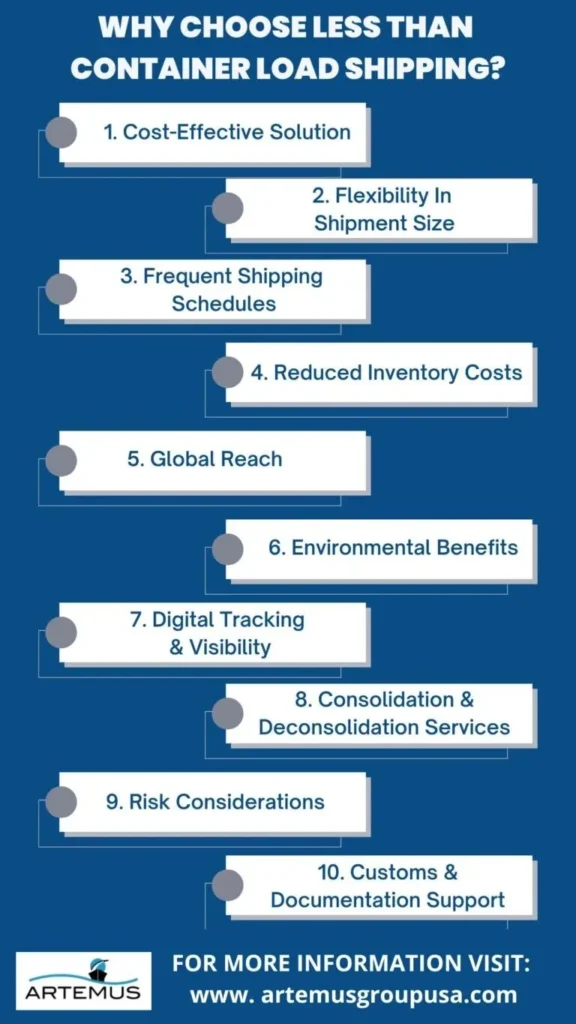
While FCL may be ideal for large shipments that require an entire container, LCL offers distinct advantages for those with smaller cargo volumes. Here’s why you should consider choosing LCL shipping:
LCL shipping allows you to share container space with other shippers, meaning you only pay for the space your goods occupy. This makes it a budget-friendly option, especially for small and medium-sized businesses that don’t have enough cargo to fill a full container. You can allocate resources more efficiently by avoiding the cost of a full container.
With LCL, you can ship smaller quantities without waiting to accumulate enough goods to fill an entire container. This flexibility means you can respond more quickly to market demands or customer orders, reducing lead times and keeping your supply chain agile.
LCL services typically offer frequent sailings, allowing you to ship your goods regularly. This can be particularly beneficial for businesses that need to maintain a steady flow of inventory or want to avoid the long wait times associated with FCL shipments.
Since LCL allows for smaller, more frequent shipments, you can maintain lower inventory levels, reducing storage costs and minimizing the risk of overstocking. This lean approach to inventory management can lead to significant savings and improved cash flow.
LCL shipping is available to and from a wide range of global destinations, providing access to international markets without the need to ship large volumes. Whether you’re importing goods from Asia or exporting to Europe, LCL makes it easier to reach new markets and expand your business globally.
Sharing container space with other shippers reduces the number of containers on the move, contributing to a smaller carbon footprint. LCL shipping is an eco-friendly option that aligns with sustainable business practices, helping to reduce the environmental impact of your logistics operations.
Many freight forwarders now offer real-time digital tracking for LCL shipments, giving you greater visibility and control over your cargo throughout the journey. This helps you monitor shipment status, anticipate delivery times, and stay informed in case of delays or route changes.
With LCL, your goods are consolidated with other shipments at the origin and deconsolidated at the destination. While this process ensures efficient use of container space, it also means that your cargo goes through additional handling. Reliable logistics partners streamline these steps to keep your goods safe and minimize delays.
Since LCL shipments involve multiple handling points during consolidation, transport, and deconsolidation, the risk of minor delays or damage can be slightly higher compared to FCL. However, choosing experienced freight forwarders and securing proper cargo insurance can help manage these risks effectively.
Freight forwarders handling LCL often provide comprehensive assistance with customs clearance and documentation. By managing paperwork and compliance requirements, they reduce the chances of delays at ports and make international trade easier, especially for businesses shipping smaller volumes.
Related: Merchandise Processing Fee (MPF): A Complete Guide
Less Than Container Load (LCL) ocean shipping is a smart choice when your cargo volume doesn’t justify paying for a full container. It is designed for businesses that need flexibility, cost savings, and access to global trade without committing to large shipments.
Below are the most common situations when LCL shipping is the right option:
If your goods don’t fill an entire container, LCL lets you share space with other shippers and pay only for the volume you use. This makes it perfect for small and medium-sized businesses.
When you need to ship products regularly in smaller quantities, LCL helps you move cargo without waiting to accumulate a full load. This keeps your supply chain consistent and avoids unnecessary delays.
For businesses exploring new markets or launching products overseas, LCL shipping reduces financial risk. You can send smaller trial shipments to test demand before scaling up to larger volumes.
Since LCL allows you to ship smaller loads more often, you can avoid tying up capital in large inventories. This approach supports lean inventory management and smoother cash flow.
If your customers need quick restocks, LCL is a practical solution. You don’t have to wait until you have enough goods for a full container, which helps you respond faster to customer needs.
Whether you are a startup, a growing e-commerce brand, or an established business, LCL makes it easier to access international markets without the cost burden of booking full containers.
Here are some important statistics related to Less Than Container Load (LCL) shipping:
The global Less Than Container Load (LCL) shipping market was valued at USD 112.37 billion in 2024, is projected to reach USD 117.42 billion in 2025, and is expected to grow to USD 174.51 billion by 2034, reflecting a steady CAGR of about 4.5%.
LCL is particularly cost-efficient for shipments under 10–15 CBM. For example, sending 10 CBM from China to the U.S. by LCL costs around USD 650, while the same shipment in a full container can exceed USD 1,200.
Transit time is another important factor. Because LCL cargo must be consolidated with other shipments at the origin and deconsolidated at the destination, it typically takes longer than direct container loads. Consolidation alone can add 2–5 extra days to the overall transit timeline. On average, shipments from China to major markets take about 28–35 days to the U.S. West Coast, 32–40 days to the U.S. East Coast, 30–40 days to Europe, and 20–28 days to India.
Related: Understanding Roll-On/Roll-Off Ships: A Complete Guide
Less Than Container Load (LCL) shipping rates in 2025 are influenced by several factors, including shifting market dynamics, geopolitical tensions, and technology, but recent data suggests a sharp decline in rates, contradicting earlier signals of relatively low pricing.
1. Market Trends:
The strong downward trend in ocean freight rates is now confirmed. For example, freight prices from China to the U.S. West Coast fell 68% since June, averaging just USD 1,802 per container as of September 1, 2025, a level not seen since December 2023. Meanwhile, the Freightos Baltic Index reports Asia to U.S. West Coast rates at USD 1,725 per FEU, and Asia to East Coast at USD 2,708 per FEU. These data points confirm that rates are well below previous peaks, yet, they are general ocean freight values rather than specific LCL rates.
2. Geopolitical & Environmental Factors:
Shipping continues to be shaped by disruptions, from geopolitical uncertainty to environmental shifts. While not tied to exact LCL price points, these factors may prompt volatility on certain routes or increase vulnerability in vulnerable corridors.
3. Technological Advancements:
Digital tools and smarter logistics platforms are gradually improving rate visibility and efficiency. Though they don’t directly lower current rates overnight, they can help shippers lock in favorable prices and reduce extra handling fees.
4. Sustainability Efforts:
As LCL and ocean freight broadly adopt greener operations, like low-sulfur fuels or emission control areas (ECAs), shipping costs may eventually rise or stabilize depending on how carriers pass costs to customers. These environmental shifts are worth watching for their potential to influence rates in the near to mid-term.
Overall, ocean freight rates in mid-2025 have dropped significantly, and it stands to reason LCL rates have followed a similar downward path. That said, for the most current LCL-specific figures, it’s best to consult providers directly or use real-time comparison tools.
Related: Customs Clearance Delays In 2024: Top 10 Reasons & Solutions
The cost of Less Than Container Load (LCL) shipping varies depending on several factors, including the shipping route, the volume and weight of the cargo, the type of goods, and any additional services required, such as customs processing or cargo insurance.
Base Costs: LCL shipping typically involves paying for the space your cargo occupies within a shared container. Charges are calculated based on the volume (cubic meters or cubic feet) or weight (whichever is greater) of your goods. The base rate for LCL shipments can range from USD 25 to USD 200 per cubic meter, though this can vary widely based on the specific trade lane.
Given these variables, a typical LCL shipment might cost anywhere from a few hundred to several thousand dollars, depending on the specifics of the shipment.
Related: What Is Harbor Maintenance Fee (HMF)? A 2025 Guide
Securing the best rates for Less Than Container Load (LCL) shipping requires strategic planning and an understanding of market dynamics. Here are some expert tips to help you achieve competitive pricing:
Related: What Happens After Custom Clearance Completed? 9 Next Steps
When it comes to international shipping, understanding the difference between Less Than Container Load (LCL) and Full Container Load (FCL) is essential for making the right logistical decisions.
Both methods offer distinct advantages depending on the volume of goods you’re shipping and your specific business needs. Here’s a closer look at the key differences between LCL and FCL:
Related: NVOCC Bond & OTI Bonds – Federal Maritime Commission
Less Than Container Load (LCL) shipping is a popular choice for businesses that need to transport smaller quantities of goods without the need for a full shipping container.
Here’s a closer look at how LCL shipping works and what makes it a valuable option for many shippers:
In LCL shipping, cargo from various shippers is combined into a single container.Each shipper only pays for the space their goods occupy, rather than the entire container. This consolidation process is managed by a freight forwarder or consolidator who groups different shipments together based on destination and other criteria.
Once cargo is consolidated, it is carefully packed into the container to maximize space and ensure safety. Each shipment is accompanied by its own set of shipping documents, including a bill of lading and packing list. These documents are essential for tracking the cargo and facilitating customs clearance.
Charges for LCL are generally based on volume (per cubic meter or CBM) or weight, whichever is greater. This pricing method makes it cost-efficient for smaller shipments that don’t justify a full container.
The consolidated container is then transported from the port of origin to the destination port. During this journey, the container may make several stops or transfers, depending on the shipping route and logistics involved. Throughout the journey, the cargo is handled with care to prevent damage or loss.
LCL shipments usually take longer than FCL shipments because of the time needed for consolidation and deconsolidation. Shippers should account for an extra 2–7 days in transit compared to full-container loads.
Upon arrival at the destination port, the container is unloaded and the cargo is deconsolidated. The individual shipments are separated and prepared for delivery to their respective recipients. Each shipment goes through customs clearance, with the necessary documentation provided to comply with local regulations.
Once customs clearance is complete, the cargo is delivered to the final destination. Depending on the arrangement, this might involve further transportation by truck, rail, or other means to ensure that the goods reach their intended location.
Since multiple shipments share the same container, LCL cargo is handled more frequently during consolidation, deconsolidation, and transfers. This increases the risk of delays or minor damage, making proper packing essential.
Related: How Does Freight Forwarding Work? A 2024 Guide
When shipping goods under a Less Than Container Load (LCL) arrangement, proper documentation is essential to ensure smooth customs clearance, accurate handling, and timely delivery. Missing or incorrect paperwork can lead to delays, penalties, or even shipment rejection.
Below are the key documents required for an LCL shipment:
The Bill of Lading is the most important shipping document. It serves as a contract between the shipper and the carrier, a receipt for the cargo, and a document of title. In LCL shipping, both House Bill of Lading (issued by the freight forwarder) and Master Bill of Lading (issued by the carrier) may be used.
This invoice is provided by the seller to the buyer and details the goods being shipped, their value, and terms of sale. Customs authorities use it to assess duties and taxes on the cargo.
The packing list provides detailed information about the shipment, including the number of packages, dimensions, weight, and contents of each package. It helps freight forwarders and customs officials identify and verify the cargo.
This document certifies the country where the goods were manufactured. Many countries require it to determine eligibility for trade agreements and to calculate applicable duties.
These forms are required by the importing country and vary depending on local regulations. They declare the nature, quantity, and value of the goods to facilitate customs clearance.
If cargo insurance is purchased, the insurance certificate serves as proof of coverage. It protects the shipper against financial loss in case of damage or loss during transit.
Depending on the type of goods and destination, additional documents may be required, such as phytosanitary certificates (for agricultural products), fumigation certificates, or compliance certificates.
Less Than Container Load (LCL) shipping is a popular choice for businesses looking to optimize their logistics, especially when they don’t have enough cargo to fill an entire container.
While it provides several advantages, it also comes with certain disadvantages that should be considered. Here’s a closer look at both sides of LCL shipping
Related: Ocean Freight Documentation For Imports: A Crucial Checklist
Artemus offers advanced freight forwarder software designed to streamline ISF (Importer Security Filing) and AMS (Automated Manifest System) filings. Our platform provides a comprehensive solution for managing the complex documentation and compliance requirements associated with international shipping.
By automating and simplifying these critical processes, Artemus ensures accuracy, efficiency, and timely submissions, allowing freight forwarders to focus on delivering exceptional service.
With our software, you can seamlessly integrate ISF and AMS filings into your operations, enhancing overall productivity and reducing the risk of compliance issues.
Related: What Is Import Compliance & Why It Matters?
There is no strict minimum weight for Less Than Container Load (LCL) shipments; however, most shipping lines prefer a minimum of around 100 kilograms (220 pounds) to ensure cost-effectiveness and efficient handling.
LTL (Less Than Truckload) and LCL (Less Than Container Load) are shipping methods used for transporting goods that don’t fill an entire truck or container, respectively. LTL refers to partial truck shipments within the same country, while LCL pertains to partial container shipments across international borders.
The capacity of an LCL (Less Than Container Load) container varies depending on the combined volume of the cargo being consolidated, but it typically ranges between 1 to 20 cubic meters or more, depending on the needs of the shippers involved.
Container status LCL (Less Than Container Load) means that the cargo is part of a shared container with goods from other shippers, allowing for cost-effective shipping without requiring a full container.
LCL shipping usually takes longer than FCL because of the time needed for consolidation and deconsolidation. On average, it can take an additional 2–7 days compared to a full-container shipment, depending on the route and handling.
LCL shipment cost is generally calculated based on the greater of volume (per cubic meter/CBM) or weight. Additional fees like handling, documentation, and fuel surcharges are also included in the final cost.
Companies prefer LCL because it allows them to ship smaller quantities without paying for an entire container. It is cost-effective, flexible, and helps maintain lean inventory levels with more frequent shipments.
There is no strict minimum weight for LCL shipping, but most freight forwarders accept shipments starting from around 1 CBM or 100–200 kg. The exact threshold may vary depending on the route and provider.
In conclusion, Less Than Container Load (LCL) shipping provides a practical and economical solution for businesses with smaller cargo volumes, allowing them to share container space and reduce costs. By leveraging LCL, shippers can enjoy flexibility and efficiency in their logistics operations.
At Artemus, we support your LCL shipping needs with our robust AMS and ISF solutions, ensuring smooth compliance and seamless processing. Contact us today for a domestic transportation quote and experience a streamlined approach to international shipping.

International trade between the United States and Switzerland highlights the strong economic relationship between the two nations. With its highly
Cold Nordic waters, advanced engineering, and a strong maritime economy make Norway a powerful exporter despite its size. Many of
Trade between the United States and Canada is one of the largest bilateral trading relationships in the world. Understanding what
 Optimized by Seraphinite Accelerator