UK Imports & Exports: Trade Profile & Top Partners
The United Kingdom is one of the world’s largest trading economies and a top exporter of services. Cars, machinery, pharmaceuticals,



India is one of the largest producers and exporters of farm goods worldwide, and knowing how to export agricultural products from India is vital for businesses aiming to expand into global markets. With a wide variety of crops, spices, fruits, and processed foods, Indian agriculture continues to play a major role in international trade.
This blog provides a complete overview of agricultural exports from India, covering key aspects such as current export trends, high-demand products, step-by-step export procedures, required documentation, government support, challenges, and future opportunities for exporters in 2025.
The role of Artemus Importer Security Filing (ISF), Automated Manifest System (AMS), and Automated Export System (AES) software highlights how advanced compliance solutions help exporters meet stringent U.S. Customs regulations.
By enabling accurate filings, timely submissions, and seamless digital management, Artemus ensures full customs compliance, minimizes risks, and facilitates smooth, hassle-free shipments, streamlining trade operations across global markets.
Table Of Contents
India’s Agriculture Export Policy (AEP), launched in 2018, is designed to boost farmer income, diversify export markets, and make India a reliable global supplier of farm products. The policy aims to double exports to $60B and target $100B in the medium term through value addition, better logistics, and stable trade rules.
The United States is a critical market for Indian agri-exports, particularly shrimp (the largest segment), basmati rice, spices, and processed cereals.
Under the AEP framework, India employs a dual-track tariff strategy, protecting staples like rice and dairy while permitting concessions on high-value imports such as almonds, walnuts, blueberries, cranberries, pistachios, and lentils.
Beyond tariff dynamics, one of the most significant challenges arises from non-tariff barriers, especially sanitary and phytosanitary (SPS) regulations and technical standards.
These include stringent food-safety protocols, residue limits, and certification requirements imposed by U.S. authorities, measures that can obstruct market entry even when duties are low or waived.
For instance, SPS standards can affect Indian exports of meat, dairy, and processed products, while TBT requirements, such as labeling and packaging norms, may add compliance complexity and cost.
These barriers often require exporters to upgrade infrastructure and documentation processes, especially in sectors like spices and marine products.
As a result, Indian exporters are investing in quality certifications, traceability systems, and improved post-harvest handling to meet U.S. standards. Simultaneously, India continues bilateral dialogues seeking regulatory alignment and mutual recognition to ease non-tariff constraints.
Related: Top 10 Items Exported From India To The USA
India’s agricultural exports are steadily growing, supported by strong demand for staples like rice and marine products, along with rising global interest in processed, organic, and value-added foods. Recent policy changes and shifting global markets have further strengthened India’s position in international agri-trade.
Here are the key trends shaping India’s agricultural exports in 2025:
In FY 2024–25, India’s farm exports rose to $51.9 billion, up 6.4% from the previous year. Early 2025 trends suggest exports could climb to $55 billion in FY 2025–26 if the current momentum continues, surpassing the previous record of US $53.2 billion achieved in 2022–23.
In the first quarter of FY 2025–26 (April–June 2025), agricultural exports further rose by about 5.8% year-on-year.
Staples continue to dominate India’s export story. Rice exports hit a record $12.47 billion, giving India nearly 40% of the global rice trade. Beverages are also thriving; tea exports touched a 10-year high, while coffee exports jumped from $1.29 billion to $1.81 billion within a year.
Marine products brought in $7.2 billion, while other key items like spices ($4.45 billion), tobacco ($1.98 billion), and fruits & vegetables ($3.9 billion) recorded healthy growth. Dairy & poultry exports grew by 12.6% to nearly US $5.1 billion in FY 2024–25
Government interventions have played a critical role. The removal of rice export restrictions in early 2025 boosted supply to international markets, even though it lowered global prices. India’s rice shipments are now projected to peak at 22.5 million tons.
Beyond bulk commodities, India is rapidly diversifying into processed and value-added foods like instant coffee, spice mixes, and ready-to-eat snacks. This aligns with the global shift toward convenience and packaged quality products.
Processed food exports are estimated at around US $8 billion, indicating significant potential for growth in India’s export basket
Additionally, organic and certified exports, such as organic millets, natural spices, and certified honey, are gaining momentum, tapping into the worldwide demand for sustainable and health-conscious products.
Related: How To Export Tea From India? A Growing Opportunity
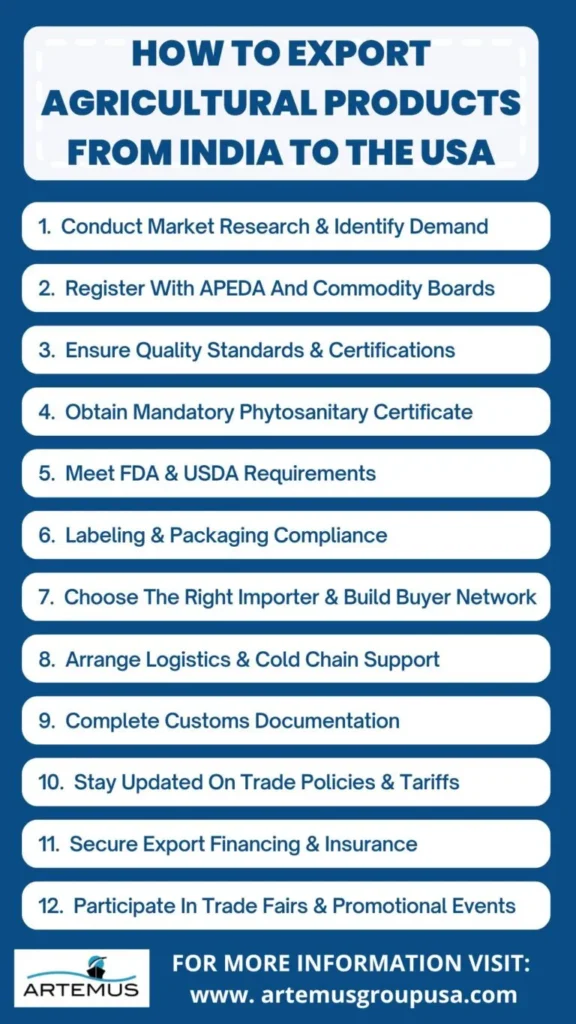
The U.S. is one of the most lucrative destinations for Indian agricultural exports, with rising demand for rice, spices, marine products, mangoes, and organic foods. However, the export journey is not just about finding buyers, it involves compliance with strict U.S. regulations, meticulous documentation, and strategic planning.
Below is a detailed, step-by-step guide to help Indian exporters successfully ship agricultural products to the United States:
The first step is to understand which Indian agricultural products are in demand in the U.S. Basmati rice, spices such as turmeric and chili, tea, coffee, seafood, and mangoes dominate the market, while new categories like millets, pomegranates, and herbal products are gaining traction.
Exporters can use resources like USDA trade reports, APEDA’s Agri Exchange portal, and international trade fairs to identify high-potential products and buyer preferences.
Every exporter must register with APEDA (Agricultural and Processed Food Products Export Development Authority) to obtain a Registration-Cum-Membership Certificate (RCMC). This certification is mandatory for exporting agri-products and also gives access to subsidies, buyer-seller meets, and government-backed market insights.
For specific commodities, exporters should also register with relevant boards such as the Spices Board, Tea Board, Coffee Board, or MPEDA, which provide product-specific support and promotional opportunities.
Compliance with U.S. quality standards is non-negotiable. Exporters must follow phytosanitary norms, obtain EIC certification for processed foods, and implement global standards like ISO, HACCP, and GMP to build buyer trust.
For organic products, exporters must secure certification directly from a USDA-accredited agency, since APEDA’s certification is no longer accepted. Without a valid NOP Import Certificate, organic shipments will not be cleared in the U.S. market.
Before shipment, every agricultural consignment to the U.S. must be accompanied by a Phytosanitary Certificate (PPQ Form 577) issued by the NPPO in India. This ensures that products meet U.S. plant health regulations. Certificates are tracked digitally via the PCIT system to prevent fraud.
Exporters should be extremely cautious, as even minor errors can result in rejections. For instance, in 2024, 15 shipments of Indian mangoes worth nearly $500,000 were rejected by U.S. authorities due to an error in PPQ203 paperwork.
The U.S. FDA and USDA enforce strict food safety standards. Exporters must ensure their facilities are FDA-registered and file a Prior Notice before each shipment. Compliance with the Food Safety Modernization Act (FSMA) is mandatory, which means exporters need to implement proper hazard controls and maintain hygiene in processing facilities.
USDA’s APHIS division inspects plant and animal products for pests, diseases, and contamination risks before clearance.
Accurate packaging and labeling are essential to meet U.S. import laws. All labels must be in English, clearly legible, and prominently placed. They should include the product name, country of origin, net weight, nutritional values, and allergen warnings.
Organic products must carry the USDA Organic seal, but only if certified by a USDA-recognized body. Improper or misleading labeling can lead to shipment detention at U.S. ports.
Exporting to the U.S. requires building strong relationships with importers and distributors. Many Indian exporters find success by connecting with buyers through APEDA’s trade delegations, export promotion councils, and major U.S. trade shows like the Summer Fancy Food Show in New York.
Online B2B platforms such as Import Genius and ThomasNet are also useful. Additionally, the large Indian diaspora in the U.S. creates steady demand for rice, spices, and ready-to-cook foods, making ethnic grocery chains strong potential buyers.
Logistics play a crucial role, especially for perishable goods. While air freight is preferred for fresh produce like mangoes and pomegranates, sea freight with refrigerated containers is more cost-effective for rice, seafood, and processed foods.
Exporters can take advantage of infrastructure upgrades like the Integrated Agri Export Facility at JNPT, Mumbai, which offers cold storage, testing labs, and faster customs clearance to reduce shipment delays.
Documentation is the backbone of successful exports. Exporters must prepare a commercial invoice, packing list, bill of lading or airway bill, certificate of origin, phytosanitary certificate, fumigation certificate (if required), and insurance documents.
Even a small error can lead to rejection or costly delays. This is why many exporters hire Customs House Agents (CHAs) who specialize in handling U.S.-bound shipments.
India-U.S. trade relations often shape the opportunities and challenges for exporters. In July 2025, trade talks between the two countries stalled over disagreements on farm market access, creating uncertainty for agri exporters.
Past tariff disputes, like Donald Trump’s 25% tariffs, have also highlighted the importance of staying updated on trade policies.
Currently, India expects that sensitive sectors such as agriculture, dairy, and genetically modified foods will remain protected in negotiations.
Exporting requires working capital, and Indian exporters can benefit from government-backed schemes. The Export Credit Guarantee Corporation (ECGC) provides protection against buyer defaults, while banks offer pre-shipment and post-shipment financing at subsidized rates.
Exporters are also eligible for incentives under schemes like RoDTEP (Remission of Duties and Taxes on Exported Products), which lowers export costs and improves competitiveness.
Finally, visibility is crucial. Exporters should actively participate in international food fairs and expos in the U.S., where APEDA often sets up India Pavilions to showcase agricultural products.
These platforms not only provide direct buyer connections but also help exporters understand evolving consumer trends in the American market.
Related: Exporting Mangoes From India To The USA: How To Ship?
In recent years, India’s agri-exports to the U.S. have surged, growing by approximately 24.1% from $2.80 billion (Jan–Jun 2024) to $3.47 billion (Jan–Jun 2025). Key commodities include rice, spices, marine products, cashews, coffee, tea, and select fruits and oilseeds. Here’s a closer look at each.
Rice leads India’s agricultural exports to the U.S., encompassing both aromatic basmati and more affordable non-basmati varieties. India contributes over 40% of the global rice trade.
Moreover, APEDA is enhancing export infrastructure; for instance, a new Basmati Export Centre in Pilibhit, UP, will boost quality control, farmer training, and testing capabilities.
India is the world’s top spice exporter, and the U.S. is a major market, especially for cumin (jeera), psyllium husk (isabgol), turmeric, chili, and others. These spices are prized for their flavor and health benefits. Tariffs recently imposed in the U.S. pose new challenges to trade.
Shrimp and other marine items remain vital to India’s agri-exports to the U.S., especially frozen shrimp, which holds about 26% of India’s seafood earnings. The U.S. is a top importer.
Indian cashew kernels are highly sought after in the U.S. In past years, the U.S. imported nearly 47,600 tonnes of cashew kernels from India, the largest single destination.
Goa’s specialty cashew (Goan cashew) recently earned Geographical Indication (GI) status, enhancing its premium value and potentially expanding its market appeal.
Both tea and coffee are important high-value exports. Coffee prices have surged, and tea is seeing a revival, giving India a unique edge in the U.S. specialty beverage market.
Mangoes, especially Alphonso and other premium varieties, are increasingly popular in the U.S. APEDA’s recent “juiciest diplomacy” event in Seattle showcased Indian mangoes and catalyzed export dialogue.
Pomegranates are also breaking new ground. APEDA and India’s NPPO facilitated India’s first trial shipment to the U.S., signaling a promising future for fruit diversification.
Though not dominant, India exports sesame seeds, groundnuts, and pulses (e.g., lentils, chickpeas) to the U.S., especially during surplus years. These items typically serve niche or diaspora-driven demand.
Beyond basic commodities, India ships a range of processed offerings, cereal preparations, pickles, chutneys, jaggery, confectionery, cocoa products, and beverages, fueled by the Indian diaspora’s demand and niche health-food markets.
Related: How To Export From India To USA? A 2025 Guide
India exports agricultural products to over 100 countries, but certain nations account for a significant share of these exports. The top 10 importers of Indian agricultural products are:
Related: What Is Global Trade Compliance & Its Key Components
Exporting agricultural food products from India requires meticulous documentation to ensure compliance with both Indian regulations and the import country’s rules. Proper paperwork not only prevents shipment delays but also ensures smooth customs clearance.
Below is a complete guide to the essential documents needed for Indian agri-exports.
The first essential document is the RCMC issued by APEDA or the relevant commodity board. This certificate verifies that your business is registered for exports and is eligible for government incentives and export promotion schemes. It is mandatory for all agri-product exporters.
The commercial invoice details the goods, their value, and terms of sale. It is used by customs to determine duties and taxes. The packing list provides specifics about the quantity, weight, and packaging of the consignment, helping customs and shipping agents handle the shipment accurately.
Depending on the mode of transport, either a Bill of Lading (for sea freight) or an Airway Bill (for air freight) is required. These serve as proof of shipment, a receipt from the carrier, and a document of title that allows the importer to claim the goods.
This document, issued by the Chamber of Commerce, certifies that the products were produced or manufactured in India. Many countries, including the U.S., require this to validate preferential tariff claims or trade agreements.
A Phytosanitary Certificate (PPQ Form 577) issued by the National Plant Protection Organization (NPPO) in India is mandatory for plant-based products. It ensures that the consignment is free from pests and complies with the importing country’s plant health standards.
Certain commodities, especially cereals and seeds, require fumigation certificates to ensure that the goods are free from pests. This document is issued after fumigation is performed according to the standards prescribed by the NPPO.
Depending on the product category, exporters may need additional certifications:
Certain commodities like meat, poultry, or specific spices may require export licenses or permits issued by relevant authorities before shipment.
While optional, insurance documents are highly recommended to protect shipments against loss or damage during transit. Many exporters take marine insurance for sea freight or air cargo insurance for perishables.
Exporters must submit customs declarations, including Shipping Bill, Declaration of Export Incentives (if availed), and any other documents required by Indian customs or the importing country. Accurate documentation ensures faster clearance and minimizes rejection risks.
Tip for exporters: Errors in paperwork are the leading cause of shipment delays or rejection. Using a Customs House Agent (CHA) can significantly reduce errors and streamline the process.
Related: 10 International Shipping Documents To Must Have In 2025
Exporting agricultural products from India to the United States can be highly lucrative, but it comes with a set of challenges. Understanding these hurdles and adopting practical solutions is essential for smooth, profitable trade.
The U.S. enforces rigorous standards through the FDA, USDA, and APHIS, including Food Safety Modernization Act (FSMA) compliance, labeling requirements, and plant/animal health checks. Non-compliance can lead to shipment rejection.
How to Overcome: Exporters should invest in training, certifications (ISO, HACCP, USDA Organic), and accurate labeling. Using consultants or Customs House Agents (CHAs) familiar with U.S. regulations can prevent costly errors.
Recent U.S. tariffs on products like shrimp, cumin, and psyllium husk have affected Indian exporters. Trade negotiations and policy changes can alter market access unexpectedly.
How to Overcome: Stay updated on trade policies, tariff notifications, and APEDA advisories. Diversifying export products and targeting multiple U.S. regions can reduce risk from sudden policy changes.
Even minor discrepancies in PPQ forms, pesticide residues, or packaging can lead to shipment rejection at U.S. ports. For example, in 2024, 15 mango shipments worth approximately $500,000 were rejected due to paperwork errors.
How to Overcome: Ensure all products are properly tested, documented, and certified. Use laboratory testing, pre-shipment inspections, and digital tracking systems to maintain compliance.
Perishable items like mangoes, pomegranates, shrimp, and seafood require efficient cold-chain management. Delays or temperature mismanagement can spoil shipments and lead to financial losses.
How to Overcome: Partner with reliable freight forwarders and leverage integrated export facilities with modern cold storage. Air freight for high-value perishables and reefer containers for sea shipments is recommended.
India faces stiff competition from countries like Thailand (shrimp), Vietnam (coffee/tea), and Pakistan (basmati rice). Price fluctuations and quality differences affect market share.
How to Overcome: Focus on premium products, organic certifications, and brand differentiation. Establishing long-term relationships with importers and distributors also helps maintain a competitive edge.
Exporting internationally involves risks such as delayed payments, currency fluctuations, and buyer defaults, which can affect cash flow.
How to Overcome: Use export financing, buyer credit insurance from ECGC, and negotiate secured payment terms (LC or advance payments).
Related: Exporting From Australia To USA: A Complete Guide
Exporting agricultural products from India is made easier through various government schemes and support programs. These initiatives aim to reduce costs, improve infrastructure, ensure compliance, and expand global market reach for Indian exporters.
The Agricultural and Processed Food Products Export Development Authority (APEDA) provides comprehensive support to agri-exporters:
The RoDTEP scheme reimburses exporters for unrefunded duties and taxes incurred in manufacturing and exporting agri-products. This reduces overall export costs, making Indian goods more competitive in international markets.
Government programs provide subsidies for freight, cold-chain development, and integrated export facilities. Initiatives like the Integrated Agri Export Facility at JNPT, Mumbai, improve handling, storage, and shipping efficiency, particularly for perishable commodities like fruits, spices, and seafood.
Financial assistance is available through:
Several commodity boards support exports with technical guidance, training, and promotional activities:
Exporters can access online tools and portals like:
Related: What Does Customs Clearance Completed Mean? Key Takeaways
India’s agricultural exports to the United States have shown promising growth, and the future outlook remains optimistic, driven by evolving trade dynamics, policy support, and shifting consumer preferences.
India’s agricultural exports to the U.S. have experienced significant growth. In the first half of 2025, exports surged by 24.1% compared to the same period in 2024, indicating a strong upward trajectory.
While traditional exports like basmati rice, spices, and shrimp continue to dominate, there is a notable diversification into high-value products. Commodities such as processed foods, organic produce, and specialty items are gaining traction in the U.S. market.
The Indian government has set an ambitious target to achieve $100 billion in agricultural exports over the next decade. This goal is supported by the Agriculture Export Policy, which aims to enhance value-added exports and improve infrastructure to facilitate smoother trade processes.
Both India and the U.S. are exploring avenues to bolster agricultural trade. Initiatives to improve market access and reduce trade barriers are paving the way for increased collaboration and mutual benefit in the agricultural sector.
Despite the positive outlook, challenges such as tariff impositions and market competition persist. India is adopting a dual-track approach, offering specific tariff concessions on select agricultural products while implementing structural reforms to enhance global competitiveness.
Related: Custom Clearance Documents Required In USA, India, & Japan
Artemus offers robust Importer Security Filing (ISF 10+2) and Automated Manifest System (AMS) software solutions designed to simplify compliance with U.S. Customs and Border Protection (CBP) requirements.
The ISF tool ensures accurate and timely submission of advance shipment data to avoid penalties, while the AMS platform efficiently handles manifest submissions for smoother border processing.
For freight forwarders and exporters, Artemus’ integrated software streamlines ISF, AMS, AES, and related filings, enabling error-free, cost-effective customs clearance through a single intuitive interface.
With its advanced trade-compliance suite, Artemus helps exporters stay compliant, minimize risks, and ensure smooth and reliable shipments to the USA, making the entire process more efficient and transparent.
Related: AMS Fee In Shipping: Overview & 5 Key Considerations
India’s major agricultural exports include basmati and non-basmati rice, spices, tea, coffee, marine products (shrimp/fish), cashews, mangoes, and processed foods. These products form the bulk of exports to markets like the USA, UAE, Bangladesh, and European countries.
Among vegetables, onions are the most exported from India, followed by potatoes, okra, and beans. These are in high demand in countries like the UAE, Bangladesh, and Nepal due to their culinary popularity.
Rice, particularly basmati rice, is the top exported crop from India, accounting for a significant share of global rice trade. Other important crops include wheat, pulses, and sugar, depending on seasonal production and international demand.
Exporting agricultural products from India to the U.S. presents huge opportunities for growth and profit. By understanding market trends, documentation, certifications, and government support, exporters can navigate challenges like compliance, tariffs, and logistics.
With rising demand for premium, organic, and processed products, the future of Indian agricultural exports to the U.S. looks promising. Following this 2025 guide will help exporters maximize opportunities, ensure smooth operations, and succeed in one of the world’s most lucrative markets.
Related: What Is Inbound Logistics & Outbound Logistics? A 2025 Guide

The United Kingdom is one of the world’s largest trading economies and a top exporter of services. Cars, machinery, pharmaceuticals,
Mexico became the United States’ number-one trading partner in 2024, surpassing both Canada and China. According to the Office of
Colombia is one of Latin America’s most active trading economies. Crude oil, coffee, coal, and cut flowers flow out. Machinery,