UK Imports & Exports: Trade Profile & Top Partners
The United Kingdom is one of the world’s largest trading economies and a top exporter of services. Cars, machinery, pharmaceuticals,


Understanding the difference between duties and tariffs is essential for businesses involved in international trade. Duties and tariffs impact the cost of imported and exported goods, while functioning differently and having distinct implications for compliance and pricing.
This blog explores key differences between duties and tariffs, types and calculation methods, impacts on international trade, common misconceptions, recent changes, and tips for importers to remain compliant. Software solutions that streamline reporting and filing processes are also discussed.
Artemus Transportation Solutions provides advanced ISF software, AMS software, and AES filing software to streamline the shipping process for businesses of all sizes. Tools offer real-time tracking, accurate filings, and compliance support for U.S. trade regulations.
Table Of Contents
In international trade, the terms duty and tariff are often used interchangeably but they aren’t quite the same. Both represent forms of taxes imposed on goods that cross borders, yet their purpose, application, and scope differ in important ways.
Understanding these distinctions is crucial for importers, exporters, and logistics professionals who want to ensure compliance and make informed financial decisions.
A tariff is a tax imposed by a government on imported (and sometimes exported) goods. It’s primarily a trade policy tool used to regulate international commerce, protect domestic industries, or generate revenue.
When goods enter a country, customs authorities apply tariffs based on the product type, value, and origin, as defined in that country’s tariff schedule.
Example:
If the U.S. imposes a 10% tariff on imported steel, every ton of steel imported will attract an additional 10% charge based on its declared value.
A duty is a tax levied on goods either imported, exported, or even produced domestically, and it can have various forms, customs duty, excise duty, anti-dumping duty, and more.
Unlike tariffs, which serve a broader economic or political function, duties are often administrative and revenue-generating in nature. They can apply not just to international goods but also to domestic products in specific cases.
Example:
When a car is imported into the U.S., it may attract a customs duty (a percentage of its declared value), in addition to tariffs and other fees.
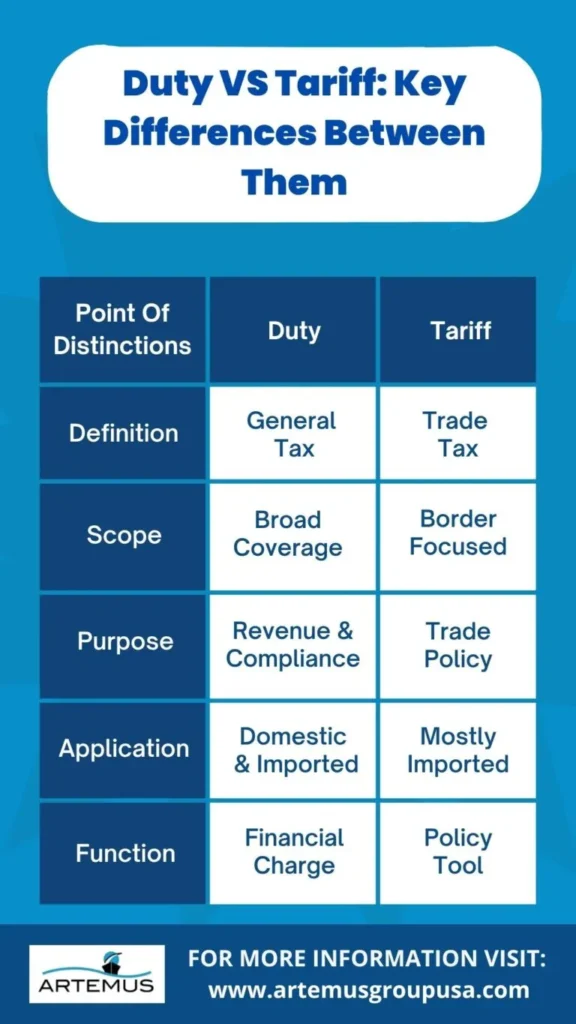
A duty refers to a tax imposed on goods that are imported, exported, or even produced domestically. It serves as a financial charge collected by the government under trade or taxation laws.
A tariff, on the other hand, is a specific type of tax applied mainly to imported (and sometimes exported) goods. It acts as a tool of trade policy designed to influence international commerce and protect domestic markets.
The scope of duty is much broader, encompassing various forms such as customs duty, excise duty, anti-dumping duty, and countervailing duty. Each serves a distinct function in revenue collection and market regulation.
Tariffs, however, are narrower in scope, primarily focusing on cross-border trade and international goods movement.
The main purpose of duties is to generate government revenue, promote fair competition, and ensure compliance with national tax and trade laws.
Tariffs, conversely, are implemented to shape trade policy. either by protecting domestic industries from foreign competition, adjusting the balance of trade, or responding to economic or political developments.
Duties can apply to both domestic and international goods. For instance, excise duties are charged on products manufactured within the country, while customs duties apply to imported goods.
Tariffs, in contrast, are typically imposed at the border and apply mostly to imported products, influencing their final market price.
In essence, a duty functions as a financial obligation, an amount payable under specific trade or taxation rules.
A tariff functions more as a policy mechanism, setting the rates and conditions that define how much duty should be charged and under what circumstances.
Related: Surety Bond VS Letter Of Credit For Contractors: 5 Key Differences

When importing or exporting goods, knowing the different types of tariffs and duties can save time and prevent unexpected costs. Understanding their distinctions helps businesses plan accurately and stay compliant with U.S. Customs regulations.
Tariffs are the framework that determines how duties are applied. They can vary depending on purpose or calculation method:
Duties are the actual taxes imposed under the tariff framework. While tariffs define how they are calculated, duties are what importers or exporters pay:
By comparing tariffs and duties side by side, it becomes clear that tariffs set the rules while duties are the taxes applied. Recognizing these types helps businesses avoid unexpected costs, comply with regulations, and optimize international trade strategies.
Related: 5 Must-Know Differences Between Supply Chain And Logistics
Tariffs and duties play a vital role in shaping the dynamics of international trade. While both serve as forms of taxation on cross-border goods, their effects differ in scope and intent. Understanding these impacts helps businesses plan costs, manage supply chains efficiently, and remain compliant with global trade regulations.
Viewed together, tariffs set the framework for trade policies, while duties represent their financial implementation. Both are critical in determining how goods move across borders, how prices are structured, and how nations maintain balanced trade relations.
Related: Ocean Freight Documentation For Imports: A Crucial Checklist
Understanding tariffs and duties together helps businesses avoid surprises at customs and plan costs accurately. Tariffs set the rules, while duties are the actual taxes you pay.
Related: How To Import A Car To The United States? 2024 Regulations
Although the terms duties and tariffs are often used interchangeably, they are not exactly the same. Understanding the difference is crucial for anyone involved in international trade.
Tariffs are essentially the rules or schedules that determine how taxes on imported or exported goods are applied. They set the rate, method, and type of tax to be charged, whether it’s a percentage of the product value (ad valorem), a fixed amount per unit (specific), or a combination of both (compound).
Duties, on the other hand, are the actual taxes paid based on the tariff rules. They are applied when goods cross the border and can vary depending on the type of tariff, product classification, and trade agreements. For example, a 10% ad valorem tariff on imported electronics results in a duty of $100 for a $1,000 shipment.
In simple terms:
Recognizing this distinction helps businesses estimate import and export costs accurately, remain compliant with U.S. Customs regulations, and avoid unexpected charges. While tariffs influence international trade strategy, duties directly impact your bottom line.
Related: OTI License Requirements, Costs, Renewal, & Regulations
Many people confuse duties and tariffs, leading to mistakes in cost estimation, compliance, and trade planning. Understanding the common misconceptions can help businesses avoid unnecessary issues.
By understanding these misconceptions, businesses can better navigate international trade, avoid costly mistakes, and ensure compliance with the U.S. Customs regulations. Recognizing the difference between tariffs and duties is essential for accurate cost planning and effective trade strategy.
Related: ISF Bond Cost Breakdown & Management For Import Success
Navigating tariffs and duties can be challenging for importers, but understanding the regulations helps avoid penalties, reduce costs, and ensure smooth customs clearance. Here are some key tips, discussed separately for duties and tariffs:
By following these tips, importers can effectively manage both tariffs and duties, reducing overall costs and ensuring compliance with U.S. Customs regulations. Understanding the distinction between tariffs (rules) and duties (actual taxes) is critical for accurate planning and smoother international trade operations.
Related: What Is A Customs Bond? A Guide For Importers & Others
Accurate reporting of tariffs and duties is essential for smooth U.S. trade compliance. Artemus’ ISF (10+2) web software helps importers and carriers file inbound cargo with CBP efficiently, offering real-time visibility and allowing global partners to input data at the origin, saving time and reducing errors.
For advanced cargo reporting, the AMS web software simplifies submissions with full EDI capabilities, customizable reports, and mobile access. It automates workflows, reduces manual entry errors, and ensures compliance with CBP regulations.
On the export side, AES filing solutions streamline Electronic Export Information (EEI) submissions, ensuring faster processing, accurate reporting, and regulatory compliance. Real-time tracking and flexible filing options help exporters manage duties and tariffs efficiently, keeping trade operations smooth and reliable.
Related: When Does ISF Need To Be Filed? Know The Deadline
No, import duties are the actual taxes paid on goods, while tariffs are the rules or rates that determine how those taxes are applied.
Yes, duty-free goods are exempt from tariffs and duties, usually under specific thresholds, trade agreements, or special programs.
Yes, tariffs set the rates or rules, which directly determine the amount of duties that must be paid on imported goods.
Domestic producers benefit from tariffs as they protect local industries from foreign competition, while governments gain revenue from collected duties.
Tariffs increase the cost of imported goods, often resulting in higher prices for consumers and businesses.
The importer of record is responsible for paying tariffs and duties to the customs authority when goods enter the country.
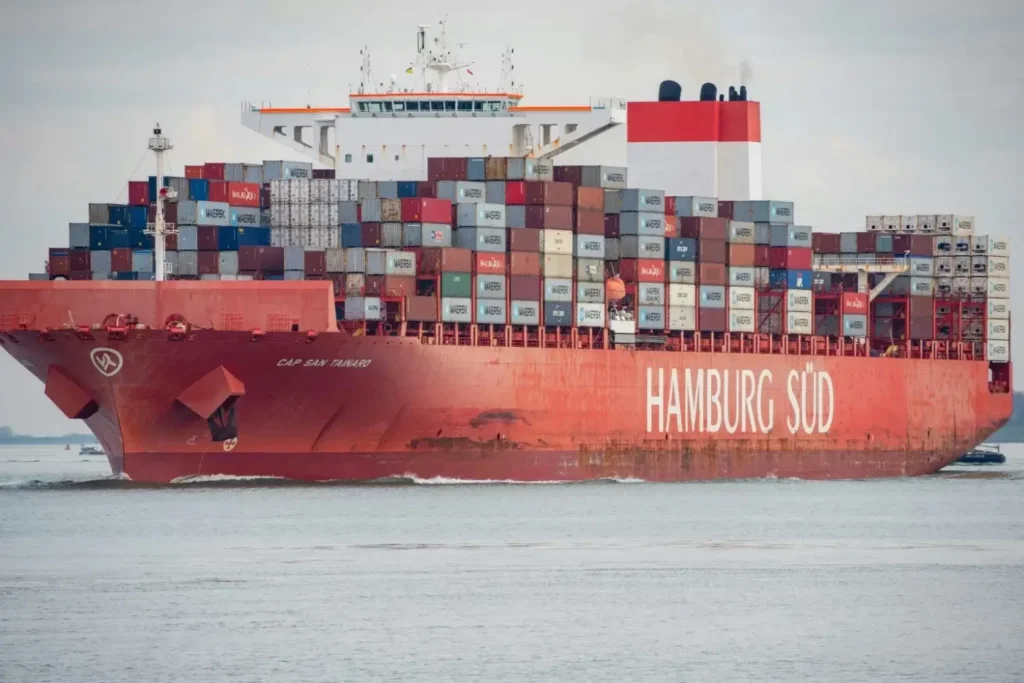
Mastering the Duty VS Tariff dynamic is essential for effective international trade. While tariffs set the rules and duties represent the taxes paid, understanding both helps businesses manage costs, ensure compliance, and make strategic decisions.
Awareness of the different types, calculation methods, and recent changes allows importers and exporters to plan ahead and avoid penalties. Staying informed about duties and tariffs ensures smoother operations, better cost control, and smarter decision-making in the global market.
Related: Continuous Bond Vs Single Entry: 6 Key Differences To Know

The United Kingdom is one of the world’s largest trading economies and a top exporter of services. Cars, machinery, pharmaceuticals,
Mexico became the United States’ number-one trading partner in 2024, surpassing both Canada and China. According to the Office of
Colombia is one of Latin America’s most active trading economies. Crude oil, coffee, coal, and cut flowers flow out. Machinery,