What Does The US Export To Switzerland? Trade Insights
International trade between the United States and Switzerland highlights the strong economic relationship between the two nations. With its highly




In today’s global economy, tariffs play a powerful role in shaping how nations trade, compete, and protect their interests. These taxes on imported goods are more than just financial instruments, they influence industrial growth, balance trade deficits, safeguard domestic industries, and even serve as tools for diplomacy and national security.
Understanding why tariffs exist and how they work is essential for anyone engaged in international trade. At Artemus Transportation Solutions, we help importers and exporters navigate this complex landscape with precision and compliance.
Our advanced software solutions, ISF for advance cargo filings, AMS for transmitting shipment data to the U.S. Customs, and AES for export declarations, streamline trade documentation, ensure accurate tariff reporting, and enable smooth customs clearance for efficient global operations.
Table Of Contents
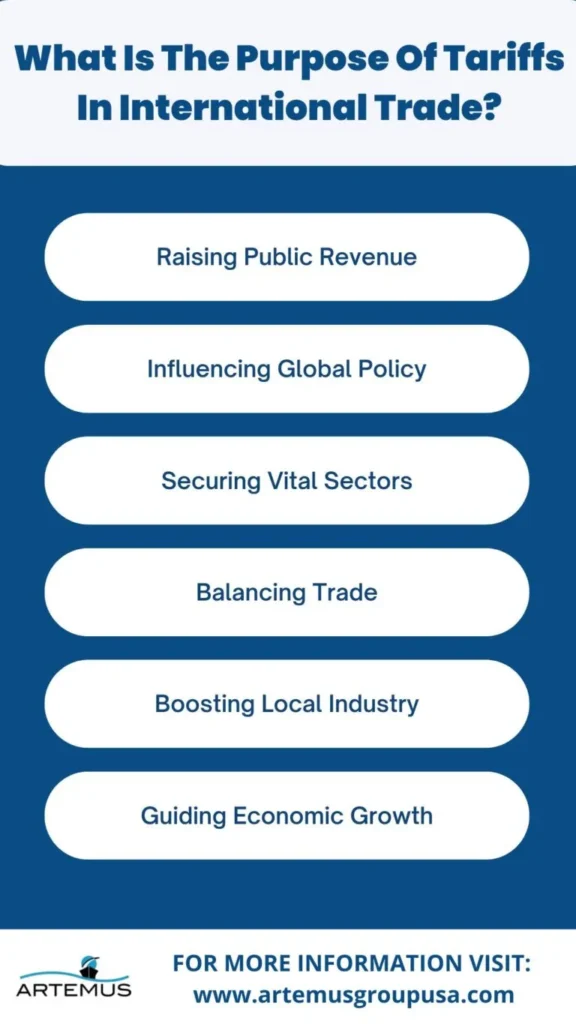
Tariffs play a defining role in how countries participate in global trade. By imposing taxes on imports, governments can protect local industries, guide economic growth, and influence trade relationships. Their purpose extends beyond economics, they are instruments of policy, strategy, and national interest.
Historically, tariffs were among the earliest forms of taxation, helping governments fund essential services and infrastructure. Before income taxes became standard, customs duties were a primary source of national income. Even today, many developing nations rely on tariff revenues to support public programs and stabilize their economies.
Tariffs often serve as a diplomatic tool. By imposing or adjusting tariffs, governments can gain leverage in trade negotiations, demand fair treatment from trading partners, or respond to unfair trade practices. This makes tariffs not just an economic measure but also a strategic instrument of international relations.
National security concerns often drive tariff policies. Governments use tariffs to protect industries that are essential to defense, energy, or technology. By ensuring local production of critical goods, a country reduces its dependence on foreign suppliers and strengthens its self-reliance during global disruptions.
When imports consistently outweigh exports, a country faces a trade deficit that can hurt local businesses and weaken its economy. Tariffs help reduce this imbalance by making foreign goods less competitive, encouraging consumers to buy domestically produced alternatives, and stimulating internal production.
Protecting domestic industries remains one of the most recognized purposes of tariffs. By increasing the cost of imported goods, tariffs give local manufacturers a better chance to compete. This protection supports employment, attracts investment, and allows developing industries to mature before facing full global competition.
Tariffs also help shape long-term development priorities. Governments can adjust tariff structures to promote emerging sectors, encourage innovation, and direct investment toward strategic areas of the economy. When applied thoughtfully, tariffs can serve as a policy tool to support sustainable industrial growth and national competitiveness.
Related: Do Tariffs Affect Shipping Costs? Key Facts & Insights
U.S. tariff policy has evolved through three main phases, each reflecting different national priorities. As noted by economist Douglas Irwin, tariffs historically served to raise revenue, protect domestic industries, and secure reciprocity in trade agreements. Two major turning points, the Civil War and the Great Depression, reshaped America’s approach to trade and policy goals.
Before independence, British Navigation Acts forced the colonies to route most exports through British ports. This reduced profits, especially for Southern tobacco planters, fueling resentment that later contributed to the American Revolution.
After independence, tariffs funded nearly 90% of federal revenue. They were simple to collect at ports and politically easier to enforce than direct taxes. President Jefferson’s Embargo Act (1807) briefly halted trade to avoid foreign conflicts but severely hurt the economy. Political divides also emerged: Northern Whigs supported higher tariffs for protection, while Southern Democrats pushed for low tariffs focused on revenue.
The Morrill Tariff of 1861 raised rates sharply to finance the Civil War. Though often debated, historians agree tariffs were not a main cause of the conflict. The war’s outcome shifted political power to the industrial North, setting the stage for decades of protectionism.
Post-war America entered its high-tariff phase under Republican dominance. Rates hovered around 40–50%, shielding manufacturers and reducing imports. While some credit tariffs for industrial growth, Irwin argues the boom was driven more by natural resources, immigration, and innovation than trade barriers.
The Great Depression ended protectionism after the failure of the Smoot-Hawley Tariff Act. The Reciprocal Trade Agreements Act of 1934 shifted policy toward negotiated tariff reductions, leading to cooperative systems like GATT and later the WTO.
Trade policy has long reflected regional and industrial interests. Northern states favored higher tariffs to protect factories, while the South and West preferred lower tariffs to boost exports. This regional divide continues to shape how Congress approaches trade issues today.
Related: Duty VS Tariff : Understanding The Key Differences
Tariffs have always been more than just taxes on imported goods. They serve as a bridge between economics and politics, shaping national strategies, influencing consumer markets, and defining global trade relationships.
While economists often view tariffs through the lens of efficiency and welfare, policymakers see them as tools of negotiation, protection, and power. Understanding both perspectives helps explain why tariffs continue to be one of the most debated instruments in global trade policy.
Economically, tariffs interfere with the natural flow of free markets by raising the price of imported goods. This increase also drives up the cost of similar domestic products, reducing overall consumer welfare. While domestic producers benefit from reduced foreign competition and governments gain tax revenue, the total welfare loss to society outweighs these gains. Consumers pay more and buy less, creating inefficiencies known as deadweight losses.
Some economists explore the idea of an optimal tariff, one that could maximize national welfare under certain conditions. However, in practice, such tariffs often backfire when trading partners retaliate with their own trade barriers. This escalation leads to reduced international trade and mutual economic losses. Thus, while tariffs may provide short-term advantages, they often undermine long-term growth and efficiency.
Politically, tariffs are powerful tools that reflect a nation’s priorities and identity. The U.S. Tariff Act of 1789, often called the “Second Declaration of Independence,” demonstrated how tariffs were used to strengthen national sovereignty and protect emerging industries. Throughout history, they have influenced elections, regional alliances, and even internal conflicts.
The Nullification Crisis of 1832 showed how tariffs could spark deep national divisions, while the 2002 U.S. steel tariffs illustrated how governments sometimes prioritize domestic political support over global trade harmony. In other nations too, such as Australia’s car tariff debates and Chile’s 1905 meat riots, tariffs have ignited public discontent and reshaped political agendas.
Ultimately, tariffs embody the intersection of economic reasoning and political intent. They protect some, burden others, and continually test how far nations are willing to go in balancing self-interest with global cooperation.
Related: What Is Bill Of Lading? A Comprehensive Overview
Tariffs, when used strategically, can strengthen a nation’s economy by supporting domestic industries, creating jobs, and ensuring long-term stability. While they often attract debate, their potential advantages are significant when applied in moderation and aligned with national goals.
Here are some key benefits tariffs can offer:
When applied thoughtfully, tariffs can do more than protect; they can help reshape an economy for resilience, competitiveness, and long-term growth.
Related: ISF Fees (Import Security Filing): When & How To Pay?
While tariffs are meant to protect local industries and balance trade, they often create broader economic problems. Their effects ripple through supply chains, raising prices, slowing growth, and straining global relationships.
Key Drawbacks & Challenges:
Related: Who Really Pays U.S. Tariffs? Importers, Not Foreign Nations
Accurate tariff and duty reporting is vital for seamless U.S. trade operations. Artemus offers specialized software solutions that simplify compliance, improve accuracy, and save valuable time for importers and exporters.
The ISF (10+2) web software enables importers and carriers to file inbound cargo data with CBP efficiently. It provides real-time shipment visibility and allows overseas partners to input data directly at the origin, reducing delays and documentation errors.
For cargo manifest reporting, the AMS web software automates the entire submission process with full EDI integration, customizable reporting, and mobile access. It minimizes manual entry, enhances data accuracy, and ensures CBP compliance while maintaining full operational transparency.
On the export front, the AES filing system streamlines Electronic Export Information (EEI) submissions for faster, more accurate processing. With real-time tracking, flexible filing options, and built-in compliance tools, exporters can manage duties, tariffs, and documentation efficiently, keeping trade operations compliant and dependable.
Related: Japan AFR Filing (Advanced Filing Rules) For Compliance
Tariffs can be both. They protect domestic industries and jobs in the short term but often lead to higher consumer prices, trade tensions, and slower economic growth over time.
Yes, tariffs can strengthen the U.S. dollar temporarily. When imports drop, demand for foreign currencies decreases, pushing the dollar’s value higher. However, a stronger dollar can hurt exports by making them more expensive abroad.
Partly. Tariffs increase the cost of imported goods, which raises prices for consumers and businesses. This contributes to inflation, especially when tariffs cover widely used products like steel, electronics, or consumer goods.
Importers pay tariffs. When goods enter the U.S., the importer is responsible for paying the tariff to U.S. Customs and Border Protection, though the added cost often passes to consumers through higher prices.
The U.S. charges tariffs on imports from many countries, including China, Mexico, Canada, and the European Union, depending on trade policies, product types, and ongoing trade agreements or disputes.
Tariffs are a crucial part of global trade policy, designed to protect domestic industries, balance trade, and generate government revenue. However, they also come with economic challenges such as higher consumer prices, reduced global competitiveness, and potential trade disputes.
Understanding both the benefits and drawbacks of tariffs helps policymakers, businesses, and investors make informed decisions in an interconnected global economy. In the end, finding the right balance between protection and open trade is key to sustaining long-term economic growth and stability.

International trade between the United States and Switzerland highlights the strong economic relationship between the two nations. With its highly
Cold Nordic waters, advanced engineering, and a strong maritime economy make Norway a powerful exporter despite its size. Many of
Trade between the United States and Canada is one of the largest bilateral trading relationships in the world. Understanding what
 Optimized by Seraphinite Accelerator