UK Imports & Exports: Trade Profile & Top Partners
The United Kingdom is one of the world’s largest trading economies and a top exporter of services. Cars, machinery, pharmaceuticals,


Non-tariff barriers (NTBs) have become one of the most influential tools in global trade today. While tariffs directly impose taxes on imports or exports, non-tariff barriers use regulations, quotas, and standards to control how goods move across borders.
Governments use these measures to protect domestic industries, ensure consumer safety, and uphold environmental or health standards. However, they can also make trade more complex by creating hidden restrictions that impact exporters and importers alike.
For businesses engaged in international trade, especially those dealing with U.S. import compliance, understanding non-tariff barriers is essential. This blog explores what non-tariff barriers are, why they matter, the different types and examples, and how organizations like the World Trade Organization (WTO) help regulate them.
It also highlights how Artemus Transportation Solutions supports traders with reliable ISF and AMS software, ensuring compliance and efficiency in cross-border operations.
Table Of Contents
Non-tariff barriers (NTBs) are trade restrictions that countries use to regulate the flow of goods across their borders without applying direct taxes or tariffs. Unlike tariffs, which are easily measurable and transparent, NTBs are often indirect and more complex. They take the form of rules, standards, quotas, embargoes, or administrative procedures that can restrict imports or exports.
Governments use non-tariff barriers to achieve a variety of goals, such as protecting domestic industries, maintaining national security, promoting environmental sustainability, or ensuring product quality and consumer safety. For instance, a country might impose strict labeling or packaging requirements on imported food products to guarantee consumer health standards.
While NTBs can serve legitimate policy purposes, they are often criticized for creating hidden obstacles to trade. Businesses must navigate these regulations carefully to remain compliant and competitive in international markets. Understanding non-tariff barriers is essential for importers, exporters, and logistics providers who aim to operate efficiently within the global trade system.
Related: What Is The Purpose Of Tariffs? Key Insights To Know
Non-tariff barriers play a central role in shaping global trade relationships. They influence how goods move, how countries compete, and how local markets develop. While they can restrict trade in certain cases, they also offer significant economic and social advantages when used responsibly.
Here are five key reasons why non-tariff barriers matter in international trade:
1. Protection Of Domestic Industries: NTBs shield local producers from excessive foreign competition. By limiting imports, governments can help emerging industries develop and strengthen before facing global rivals.
2. Consumer & Environmental Safety: Non-tariff measures ensure that imported goods meet national safety, health, and environmental standards. This prevents the entry of low-quality or hazardous products.
3. Encouraging Fair Competition: Through regulations and standards, NTBs can promote a level playing field by enforcing ethical production and fair labor practices.
4. Supporting Economic Stability: Import quotas and licensing systems help countries manage supply and demand, reducing the risk of market shocks caused by sudden surges in imports.
5. Strategic Policy Control: NTBs allow governments to use trade as a tool for diplomacy or policy enforcement. For example, restrictions can be applied to countries violating environmental or human rights norms.
Although NTBs offer several advantages, excessive or poorly designed barriers can harm trade relations, increase costs, and reduce global market efficiency. Striking a balance between protection and openness is key to sustainable trade growth.
Related: Do Tariffs Affect Shipping Costs? Key Facts & Insights
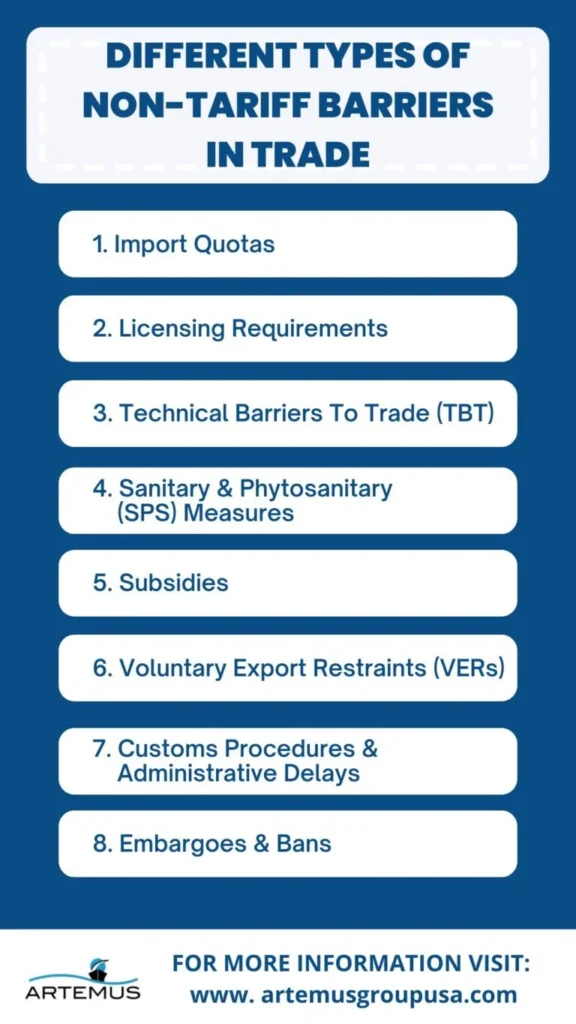
Non-tariff barriers appear in many forms, each serving a specific regulatory or protective purpose. Below are the major categories businesses encounter in international trade:
These restrict the quantity of a specific product that can be imported during a set period. For example, a country might cap the import of steel to protect its domestic steel industry.
Governments often require importers to obtain official permits or licenses before bringing certain goods into the country. This ensures that only approved products enter the market.
These include regulations about product quality, labeling, or packaging that goods must meet before they can be sold domestically. While intended to protect consumers, they can sometimes act as trade obstacles.
These focus on protecting human, animal, and plant health. For example, meat imports may be subject to strict veterinary inspections.
Governments may provide financial support to domestic industries, helping local producers compete more effectively against imported goods. This can indirectly restrict imports by making local alternatives cheaper or more appealing.
These are self-imposed limits by exporting countries, often negotiated under pressure from importing nations.
Complicated paperwork, lengthy inspections, and inconsistent customs practices can slow trade and increase costs.
These completely restrict trade with specific countries or products, often due to political or ethical reasons.
Each type of NTB serves a distinct purpose but can have far-reaching effects on trade efficiency, market access, and global competitiveness.
Related: Who Really Pays U.S. Tariffs? Importers, Not Foreign Nations
Non-tariff barriers (NTBs) are widely used across both developed and developing economies, often reflecting national priorities in areas like health, safety, environment, and consumer protection. However, these measures can also create challenges for international exporters. Here are some well-known examples:
The EU enforces rigorous sanitary and phytosanitary (SPS) standards for imported foods, requiring extensive testing, certification, and traceability. While these rules protect consumers and ensure food safety, they can limit market access for exporters from developing countries who may struggle to meet these complex requirements.
Japan maintains unique safety and emissions standards that differ from many global norms. Foreign automakers must undergo specific testing and certification processes, often leading to higher compliance costs and longer approval timelines.
The United States requires detailed labeling on consumer products — such as country-of-origin marks, nutritional information, and allergen disclosures. These rules enhance consumer transparency but can increase costs and administrative burdens for exporters.
India’s stringent drug approval and testing processes ensure that medicines meet domestic safety and efficacy standards. However, these lengthy regulatory procedures can delay the entry of foreign pharmaceutical products into the Indian market.
China often uses tariff-rate quotas (TRQs) to regulate imports of key agricultural commodities such as grains, sugar, and cotton. These measures help stabilize domestic markets and support local farmers but can restrict global trade flows.
These examples show that while non-tariff barriers are often used to achieve legitimate goals, they can also act as hidden trade restrictions that affect competitiveness and global supply chain efficiency.
Related: 10 International Shipping Documents To Must Have In 2025
The World Trade Organization (WTO) plays a key role in overseeing and regulating the use of non-tariff barriers. Its primary mission is to promote fair, transparent, and predictable global trade. Through various agreements and dispute resolution mechanisms, the WTO works to prevent the misuse of NTBs as tools of protectionism.
Two major WTO agreements address NTBs directly:
The WTO also monitors national trade policies through regular reviews and provides a platform for countries to settle disputes involving NTBs. Maintaining transparency and consistency helps create a level playing field where global trade can flourish while still allowing countries to pursue legitimate policy objectives.
Related: Custom Clearance Charges & Fees: A Complete Guide
The terms non-tariff measures (NTMs) and non-tariff barriers (NTBs) are often used interchangeably, but they carry different meanings in trade policy.
Non-tariff measures (NTMs) are all forms of policy actions, regulations, or requirements, such as safety standards or environmental rules, that can influence international trade. They may not always be restrictive and can serve legitimate purposes like protecting consumers or promoting sustainable practices.
Non-tariff barriers (NTBs), however, refer specifically to those measures that intentionally or unintentionally restrict trade. These barriers increase costs, limit imports, or distort competition.
In simple terms, all NTBs are NTMs, but not all NTMs are NTBs. Understanding this distinction is vital for exporters and importers, as it helps them navigate trade policies more effectively and prepare for compliance obligations in different markets.
Related: Duty VS Tariff : Understanding The Key Differences
Navigating non-tariff barriers and U.S. trade regulations can be complex, especially for importers managing multiple shipments. Artemus Transportation Solutions provides powerful digital tools designed to simplify this process.
Our Importer Security Filing (ISF) and Automated Manifest System (AMS) software ensure compliance with U.S. Customs and Border Protection (CBP) requirements. By automating documentation, validating data, and providing real-time filing updates, Artemus helps importers avoid costly delays and penalties.
The platform integrates seamlessly with supply chain operations, offering transparency and control at every stage of the import process. With built-in error detection, compliance reminders, and expert support, Artemus makes trade compliance efficient, accurate, and worry-free, allowing businesses to focus on growth and strategy rather than paperwork.
Related: ISF Filing: A Compliance-Related Guide & Software Solution
Almost every country uses non-tariff barriers to regulate trade. Governments apply them to protect domestic industries, ensure product safety, manage imports, or achieve environmental and policy goals.
Yes. The United States uses various non-tariff barriers such as safety standards, labeling requirements, import licensing, and environmental regulations. These measures help maintain product quality and protect national interests.
Non-tariff barriers can be beneficial when used fairly. They protect consumers, promote local industries, and uphold safety and environmental standards. However, excessive or unfair use can disrupt trade and raise costs for businesses.
Non-tariff barriers are an integral part of modern trade, influencing how goods move across borders and how nations protect their interests. While they help maintain quality, safety, and fairness, they can also complicate global trade operations if applied excessively.
For exporters and importers, understanding the types, impact, and global regulations around NTBs is critical to staying competitive. Organizations like the WTO work to ensure these measures remain transparent and justified, promoting balance in the global trading system.

The United Kingdom is one of the world’s largest trading economies and a top exporter of services. Cars, machinery, pharmaceuticals,
Mexico became the United States’ number-one trading partner in 2024, surpassing both Canada and China. According to the Office of
Colombia is one of Latin America’s most active trading economies. Crude oil, coffee, coal, and cut flowers flow out. Machinery,