
UK Imports & Exports: Trade Profile & Top Partners
The United Kingdom is one of the world’s largest trading economies and a top exporter of services. Cars, machinery, pharmaceuticals,



The economic partnership between Japan and the United States is a cornerstone of global trade. As of early 2026, Japan is amongst the top five trading partners of US, with annual bilateral trade in goods and services exceeding $319 billion.
For logistics professionals, importers, and exporters, staying up to date on “what does Japan export to the US” is critical. These shipments operate within a highly regulated environment, where accuracy, compliance, and timely filings are non-negotiable.
Artemus Transportation Solutions streamlines trade compliance in the USA by offering top-tier services such as Importer Security Filing (ISF), Automated Manifest System (AMS), Automated Export Filing (AES), & Japan AFR, facilitating the movement of imports and exports through the United States.
In this guide, we break down what Japan exports to the United States, why these exports matter to the U.S. economy, and the key trends shaping Japan–U.S. trade in 2026 and beyond.
Table Of Contents
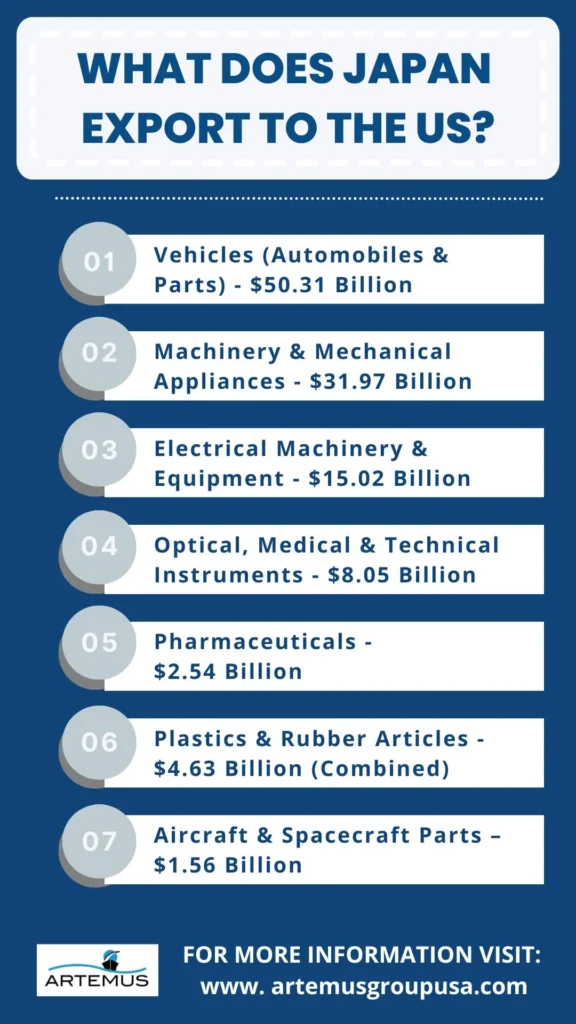
Japan’s export profile to the United States is broad but dominated by manufactured products that reflect the country’s industrial strengths. According to the latest data, the trade relationship between Japan and the United States is defined by high-value manufacturing and precision engineering.
In 2024, Japan’s exports to the U.S. reached approximately $141.52 billion, anchored by several key sectors that are integral to the American economy. Below is an in-depth look at the primary export categories based on the latest 2024-2025 trade data.
The automotive sector remains the cornerstone of Japanese exports. This category includes passenger cars, trucks, and the vast network of components required for American assembly lines.
This category encompasses heavy-duty industrial equipment, including nuclear reactors, boilers, and specialized manufacturing tools.
Japan provides the “high-tech guts” of modern electronics, ranging from integrated circuits to telecommunications gear.
Renowned for precision, Japan is a leading supplier of professional-grade equipment.
The pharmaceutical sector is a rapidly growing area of cooperation. Japan exports significant quantities of specialized medicaments and vaccines to the U.S.
Despite being a smaller category in total value, it is high in strategic importance.
Together, these products define the core of Japan’s exports to the U.S., with vehicles and automotive parts alone representing more than one-third of total export value. Japan’s bilateral trade surplus with the United States remains sizable, valued at about ¥8.6 trillion (~$56–58 billion) in 2024.
Related: How To Import A Car From Japan To USA? A 7-Step Process

The United States ranks among Japan’s most significant export markets, accounting for approximately 20% of Japan’s overall exports in 2024. Here’s why the U.S. matters so much to Japanese exporters:
Bilateral trade in goods and services between Japan and the U.S. exceeded $317 billion in 2024, with Japanese exports accounting for about $149 billion of that total.
U.S. manufacturers and consumers depend on Japanese vehicles, machinery, and electronic components. These imports feed into auto assembly, aerospace, tech manufacturing, medical devices, and more, making demand relatively stable and high.
Unlike some export markets that focus on raw materials or commodities, Japan exports capital and technology-intensive goods to the U.S., which tend to command higher values and margins.
For decades, Japan has consistently ranked among the top five trade partners of the United States. The relationship encompasses not only the trade of goods but also investment, integration of supply chains, and collaborative research and development, thereby strengthening economic connections.
Related: Japan Imports And Exports 2024: Top Products & Their Impact

While traditional exports like automobiles and machinery remain dominant, several emerging or high-growth segments are gaining traction:
Electrical machinery and equipment accounted for over $15 billion in exports in 2024. These include semiconductors, precision electrical parts, and sensor components used in tech sectors.
Exports of optical and medical instruments, such as imaging systems and diagnostic equipment, totaled roughly $8 billion. These products serve healthcare, research labs, and industrial measurement sectors.
Although smaller in aggregate, Japanese pharmaceuticals are increasingly important in the U.S. healthcare market, contributing over $2.5 billion to exports in 2024.
Japan’s exports of agricultural, fishery, and forestry products reached a record ¥1.701 trillion (~$10.9 billion) in 2025, driven significantly by U.S. demand for green tea and beef. Japan to U.S. Shipments to the U.S. increased 13.7 % in 2025, reinforcing the U.S. as a key growth region for Japanese food exports.
Related: Custom Clearance Documents Required In USA, India, & Japan

While the Japan – U.S. export relationship is robust, several challenges influence trade dynamics:
Certain products, including automobiles, steel, and electronics, may be affected by tariffs or changes in trade policy, which can disrupt pricing and export planning. The solution is to stay updated on trade agreements and tariff schedules, which helps exporters mitigate risks.
Port congestion, limited shipping slots, and rising freight costs can delay deliveries and increase operational expenses. Advanced logistics planning and reliable freight partners ensure smoother shipping cycles.
Exchange rate fluctuations (e.g., a stronger yen) and rising production costs can affect Japan’s export pricing competitiveness in global markets, including the U.S.
Global supply chain disruptions, from semiconductor shortages to geopolitical tensions, add pressure on exporters to maintain reliable delivery times while managing costs.
U.S. markets demand high-quality, precise, and technology-driven products, leaving little room for errors in manufacturing or documentation. Strict quality control and compliance checks ensure Japanese products meet U.S. expectations.
Related: What Does The US Export To Brazil? 2026 Overview
Exporting to the United States requires compliance with both Japanese export laws and U.S. import regulations:
Japanese exporters must prepare accurate export declarations, commercial invoices, bills of lading, certificates of origin, and other necessary documents that adhere to customs protocols in both countries.
Goods entering the U.S. must be correctly classified under the Harmonized Tariff Schedule (HTS) and comply with applicable tariff rates. Misclassification can lead to delays, penalties, or customs fines.
Certain products – such as medical equipment, pharmaceuticals, and controlled technology goods- require regulatory approvals from U.S. agencies (e.g., FDA for pharmaceuticals).
Exporters must ensure they do not ship goods to restricted entities or destinations and must comply with export control regulations from both governments.
Related: What Does Brazil Export To The US? Trade Insights For 2026
Japan’s export landscape to the United States is currently navigating a pivotal transition, shaped by the landmark 2025 bilateral trade agreement and a strategic shift toward high-tech industrial collaboration.
As the two nations recalibrate their economic ties under new tariff frameworks, Japanese exporters are moving beyond traditional automotive dominance to prioritize resilience in semiconductor supply chains, green energy technology, and defense systems.
Demand for high-tech components, especially in AI, robotics, and semiconductor manufacturing, is expected to grow as U.S. industries expand R&D and automation.
Record growth in Japanese agricultural exports, particularly food and specialty goods, suggests the U.S. will become an even larger market for premium Japanese consumables.
Ongoing negotiations and trade agreements could reshape tariff structures, potentially enhancing market access or offering incentives for technology and energy sectors.
Both Japan and the U.S. are investing in supply chain resilience, including semiconductor fabs, EV supply components, and advanced manufacturing, which may boost export volumes in future years.
Related: Who Really Pays U.S. Tariffs? Importers, Not Foreign Nations

Artemus Transportation Solutions delivers end-to-end trade compliance support for USA–Japan shipments through its advanced Importer Security Filing (ISF), Automated Manifest System (AMS), Automated Export System (AES), and Japan Advanced Filing Rules (AFR) solutions.
Designed for customs brokers, freight forwarders, and importers, Artemus ensures every filing is accurate, timely, and aligned with U.S. CBP and Japan Customs regulations, reducing risk, avoiding penalties, and preventing shipment delays.
With a compliance-first approach and automation-driven workflows, Artemus simplifies complex cross-border requirements for both inbound and outbound trade.
Whether managing ISF and AMS filings for Japanese imports into the U.S., AES filings for U.S. exports, or AFR submissions for cargo bound to Japan, Artemus provides a single, reliable platform to keep shipments moving smoothly and fully compliant in today’s high-stakes global trade environment.
Related: Japan AFR Filing (Advanced Filing Rules) For Compliance
Automobiles, Passenger cars, and vehicle parts dominate the trade relationship, accounting for approximately 30% of Japan’s total shipments to the U.S., valued at over $50 billion annually.
The surplus (approx. $47.5 billion in 2025) remains because Japan exports high-margin “finished” goods like robotics and luxury cars, while the U.S. primarily exports lower-margin commodities and energy to Japan.
It refers to Japanese labor reforms that capped truck driver hours. This caused a 10–15% rise in domestic transport costs within Japan, occasionally delaying the movement of goods from factories to international shipping ports.
A weak Yen (trading around 157 JPY/USD in early 2026) makes Japanese products cheaper and more competitive for American buyers, though it increases production costs for Japanese firms importing raw materials.
The U.S. automotive, electronics, semiconductor, healthcare, machinery, and advanced manufacturing industries rely heavily on Japanese imports.
The question of “what does Japan export to the US” is answered by a multi-billion dollar flow of cars, high-tech machinery, and medical innovations. As trade regulations become more complex with the introduction of reciprocal tariffs and stricter security filings, the need for robust compliance software has never been higher.
Artemus Transportation Solutions is here to help you navigate this landscape. Whether you need Customs Broker Software or expert Compliance Training, we ensure your trans-Pacific trade remains seamless and compliant.
Related: How To Export Agricultural Products From India To The USA?

The United Kingdom is one of the world’s largest trading economies and a top exporter of services. Cars, machinery, pharmaceuticals,

Mexico became the United States’ number-one trading partner in 2024, surpassing both Canada and China. According to the Office of

Colombia is one of Latin America’s most active trading economies. Crude oil, coffee, coal, and cut flowers flow out. Machinery,