UK Imports & Exports: Trade Profile & Top Partners
The United Kingdom is one of the world’s largest trading economies and a top exporter of services. Cars, machinery, pharmaceuticals,


Vietnam has emerged as a key player in global trade, and the United States is its largest and most dynamic export market, making what Vietnam exports to the US an important consideration for importers, exporters, and logistics professionals.
From high-tech electronics and machinery to textiles, footwear, and wood products, Vietnam’s exports provide essential goods that support American industries and meet consumer demand.
This blog explores Vietnam’s major export categories to the U.S., highlights the top exported products, examines trade agreements, and analyzes Vietnam-U.S. trade dynamics. It also covers import duties, trade compliance requirements, and common challenges in importing from Vietnam.
Efficiently navigating these processes requires the right technology. Artemus provides comprehensive ISF, AMS, and AES compliance software, helping businesses simplify filings, meet regulatory standards, minimize errors, and ensure smooth cross-border shipping operations.
Table Of Contents
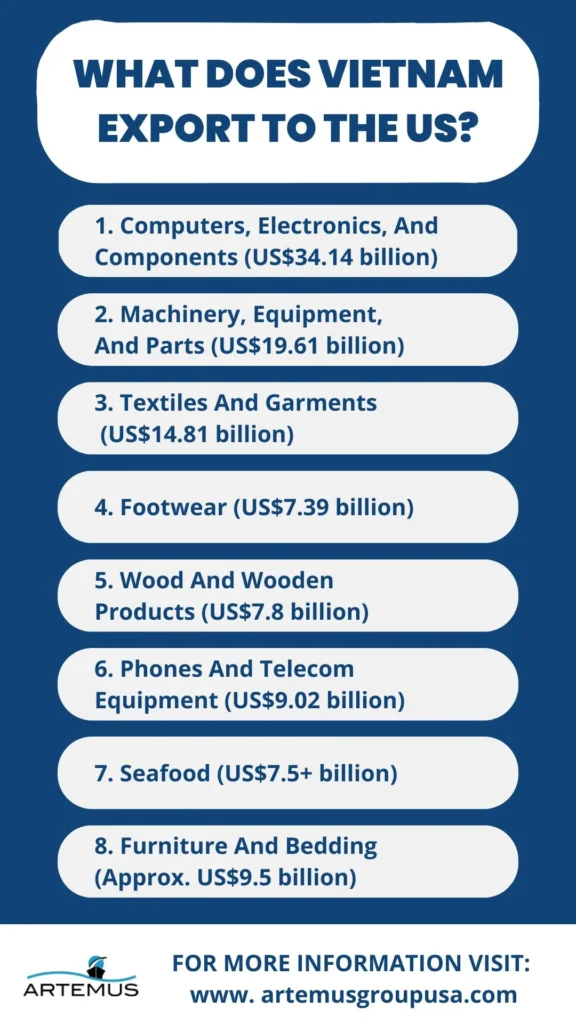
The United States is Vietnam’s largest export market and a major driver of its growth. Trade continues to expand as tariff pressures ease with the prospect of a new bilateral agreement. Vietnam’s exports reached a record US$126.16 billion in the first ten months of 2025, covering a wide range of goods from high‑tech electronics to traditional manufacturing.
The following sections highlight the main export categories and their role in Vietnam‑US trade:
Computers, electronics, and components dominate Vietnam’s exports to the United States, contributing US$34 billion in the first ten months of 2025. This category includes laptops, circuit boards, semiconductors, and other high-tech hardware that are in growing demand in the US market.
The strong growth in electronics is supported by Vietnam’s investment in modern assembly plants and its skilled labor, which attracts major multinational brands. Additionally, Vietnam is increasingly becoming a key hub for components used in AI servers, smart devices, and other emerging technologies, reflecting its strategic position in global supply chains.
Machinery, equipment, and parts represent US$20 billion of exports to the United States and cover a broad range of industrial tools, manufacturing machines, and mechanical components. These goods are essential for US factories and construction projects, making Vietnam a reliable supplier of mid- and high-tech machinery.
Investments in advanced production technology and quality control have helped Vietnamese exporters meet stringent US standards. As global supply chains diversify, demand for Vietnamese machinery continues to rise, positioning the country as a growing alternative to traditional suppliers.
Textiles and garments remain a strong traditional export sector, totaling US$14.8 billion in exports to the US in 2025. Vietnam produces a wide variety of clothing, including casual wear, work uniforms, and performance fabrics for global brands.
The sector benefits from efficient supply chains, skilled labor, and preferential trade agreements like the CPTPP and EVFTA, which help lower tariffs. Increasingly, Vietnamese manufacturers are adopting sustainable production practices to meet US consumer preferences, strengthening their competitive edge in the apparel market.
Footwear is a consistent and high-value export, generating US$7.4 billion for the US market. Vietnam produces sports shoes, casual shoes, and leather products for major global brands, benefiting from advanced production facilities and specialized labor.
Rising demand in the United States has encouraged Vietnamese companies to improve product quality, enhance design capabilities, and adopt international sustainability standards. Footwear exports also support a broad network of small and medium-sized enterprises in Vietnam, making this sector a key contributor to both trade and employment.
Wood and wooden products, including furniture, cabinets, and other interior goods, accounted for US$7.8 billion in exports to the United States. Vietnam has leveraged its forestry resources and manufacturing expertise to become a top supplier of high-quality furniture for American consumers.
Companies are increasingly adopting environmentally friendly practices, such as sustainable timber sourcing and certification, to meet US regulatory and consumer expectations. The growing preference for modular, export-ready furniture has also helped Vietnamese producers expand their presence in both retail and commercial segments of the US market.
Vietnam’s exports of phones and phone parts to the U.S. increased to around US$9.02 billion in the first ten months of 2025. This value is separate from the broader computers and electronics category and reflects Vietnam’s growing role in telecom assembly and component exports.
Seafood exports, including shrimp and pangasius, have rebounded and are estimated to exceed US$7.5 billion in exports to the U.S. in 2025, driven by renewed demand and lower inventories. While the source does not give an exact single figure, the rebound and rebound growth reported indicates a contribution at this level.
Trade statistics from industry and customs reporting indicate that furniture and bedding (HS 94) exports from Vietnam to the U.S. are substantial, with industry estimates around US$9.5 billion in 2025. These figures cover finished furniture items and related bedding products, reflecting Vietnam’s strength in this segment.
Vietnam’s goods exports to the US have surged in recent years, reaching $136.5 billion in 2024 and continuing to climb in early 2025.
This scale shows how deeply integrated Vietnam’s manufacturing and export sectors are with US consumer and industrial demand.
Related: What Does Brazil Export To The US? Trade Insights For 2026

Vietnam’s exports to the United States are led by technology products. In October 2025, the top exports were telephones (US$3.73 billion), computers (US$2.92 billion), and office machine parts (US$1.14 billion), highlighting the strong demand for Vietnamese electronics and related components in the U.S. market.
Related: What Does Japan Export To The US? A Complete Guide

The United States and Vietnam do not yet have a full free trade agreement, but they maintain strong trade relations. The Bilateral Trade Agreement (BTA) of 2001 and the Trade and Investment Framework Agreement (TIFA) of 2007 provide the foundation for tariff reductions and ongoing economic cooperation.
In late 2025, both countries agreed on a Framework for an Agreement on Reciprocal, Fair, and Balanced Trade, aiming to expand market access, reduce tariffs, and address non-tariff barriers. This framework also covers investment, digital trade, and intellectual property, signaling deeper economic ties.
While a full FTA is not yet in place, this framework shows Vietnam and the U.S. are moving toward stronger, more balanced trade relations, benefiting both countries’ exporters and importers.
Related: What Does The US Export To Brazil? 2026 Overview
The Vietnam–US trade relationship has grown rapidly, with two-way goods trade reaching about US$149.5 billion in 2024, including US$136.6 billion in Vietnamese exports. The US remains Vietnam’s largest export market, driven by strong demand for electronics, machinery, textiles, footwear, and wood products.
Vietnam also imports machinery, electronic components, raw materials, and agricultural products from the US, supporting its manufacturing and industrial sectors. Ongoing trade frameworks, including the Bilateral Trade Agreement (2001), TIFA (2007), and the 2025 reciprocal trade framework, aim to reduce tariffs, address non-tariff barriers, and improve market access.
US foreign direct investment in Vietnam, particularly in high-tech and industrial sectors, strengthens supply chains and technology transfer, enhancing the economic partnership. Overall, strong trade volumes, strategic policy engagement, and investment flows underline the growing and mutually beneficial economic link between Vietnam and the US.
Related: What Does The US Export To China? A Complete Guide

Yes, imports from Vietnam to the United States are subject to U.S. import duties, with rates varying by product type. The U.S. applies the Harmonized Tariff Schedule (HTS) to classify goods and determine applicable tariffs.
Major Vietnamese exports such as electronics, machinery, textiles, footwear, and wood products each carry different duty rates based on their HTS classification.
Vietnam does not have a comprehensive free trade agreement with the United States, so most goods enter under normal trade relations tariff rates. While the 2001 U.S.–Vietnam Bilateral Trade Agreement established this status, it does not provide blanket duty exemptions.
Current tariff treatment is shaped by U.S. trade policy and enforcement measures, including stricter origin verification and transshipment controls. As a result, only certain products may qualify for reduced or zero duties under limited exclusions.
In addition to tariffs, some imports are subject to licensing, regulatory approvals, and compliance standards. Importers must ensure accurate HTS classification, proper documentation, and full compliance with U.S. Customs and Border Protection requirements to avoid delays or penalties.
Related: How To Import Goods For Resale In The USA? A 2025 Guide
Exporting goods from Vietnam to the United States requires strict compliance with documentation, customs, and regulatory standards. Key requirements include:
Adhering to these requirements ensures smooth entry into the U.S. market, minimizes delays, and reduces the risk of penalties for Vietnamese exporters.
Related: What Does Canada Export To USA? A Complete Guide
Importing goods from Vietnam presents strong opportunities, but importers should be aware of several key challenges:
Accurate commercial invoices, correct HS classification, certificates of origin, and proper ISF/AMS filings are critical. Errors or inconsistencies can lead to customs delays, penalties, cargo holds, or seizures.
Freight rate volatility, port congestion, container shortages, and longer transit times, especially during peak seasons, can increase landed costs and disrupt delivery schedules.
Goods must genuinely qualify as Vietnamese origin. Improper transshipment or minimal processing may trigger U.S. anti-circumvention investigations, resulting in additional duties or retroactive penalties.
Shifts in U.S. trade policies, safeguard duties, or anti-dumping measures can impact pricing, competitiveness, and long-term sourcing strategies.
Compliance with FDA, USDA, CPSC, labeling, safety, and technical standards adds complexity, time, and cost, particularly for food, agricultural, textiles, and consumer goods.
Some Vietnamese exporters face limitations in consistent quality control, packaging standards, scalability, cold-chain infrastructure (for perishables), and global brand recognition compared to more established sourcing markets.
Related: When Does ISF Need To Be Filed? Know The Deadline
Artemus Transportation Solutions enables businesses to handle compliance seamlessly for shipments from Vietnam to the United States. Its Importer Security Filing (ISF 10+2), Automated Export System (AES), and Automated Manifest System (AMS) software automates import and export filings while ensuring full alignment with U.S. regulations.
The Importer Security Filing (ISF 10+2) tool helps businesses, importers, and freight forwarders submit accurate cargo information on time, providing real-time tracking and remote access to reduce errors, avoid penalties, and prevent clearance delays while importing to the USA.
The Automated Manifest System (AMS) module streamlines advanced cargo reporting, making manifest management, arrival notices, and compliance documentation fast, secure, and user-friendly.
Artemus Automated Export System (AES) software simplifies Electronic Export Information submissions for USA exporters, minimizing manual mistakes and keeping shipments moving efficiently.
By using Artemus, companies exporting from Vietnam to the U.S. gain greater control, lower compliance risks, and clear visibility across every step of the shipping and filing process.
Related: What Is NVOCC? Meaning & Details You Need To Know
Around 30% of Vietnam’s total exports are shipped to the United States, making it the country’s largest export market.
The United States runs a significant trade deficit with Vietnam, as Vietnamese exports to the US far exceed imports from the US.
Vietnam’s trade surplus results from its strong manufacturing exports, including electronics, textiles, and footwear, which outpace U.S. goods exported to Vietnam.
Yes, the United States is Vietnam’s largest export market, accounting for roughly a third of the country’s total export shipments.
No, the United States and Vietnam do not currently have a bilateral tax treaty, though both countries follow standard international tax and trade regulations.
Vietnam’s exports to the United States reflect a vibrant and growing trade partnership, spanning high-tech electronics, machinery, textiles, footwear, and wood products. These goods not only support American industries but also drive Vietnam’s economic growth and integration into global supply chains.
Navigating Vietnam–U.S. trade successfully requires careful attention to regulations, documentation, and compliance standards. With the right tools, such as Artemus’ ISF, AMS, and AES compliance software, businesses can streamline processes, reduce errors, and ensure efficient cross-border operations, making Vietnam–U.S. trade both profitable and reliable.
Related: Certificate Of Conformance (CoC): What Is It & Its Types

The United Kingdom is one of the world’s largest trading economies and a top exporter of services. Cars, machinery, pharmaceuticals,
Mexico became the United States’ number-one trading partner in 2024, surpassing both Canada and China. According to the Office of
Colombia is one of Latin America’s most active trading economies. Crude oil, coffee, coal, and cut flowers flow out. Machinery,