UK Imports & Exports: Trade Profile & Top Partners
The United Kingdom is one of the world’s largest trading economies and a top exporter of services. Cars, machinery, pharmaceuticals,



Switzerland plays a vital role in U.S. trade, supplying a wide range of high-value and specialized products. From pharmaceuticals and precision instruments to luxury watches and precious materials, understanding what does Switzerland export to the US offers clear insight into why this trade relationship remains so strong and strategically important.
In this blog, we explored Switzerland’s leading export categories, identified its biggest exports to the U.S., reviewed key trade statistics, and outlined the compliance requirements that govern Swiss shipments entering the American market. We also highlighted the major U.S. ports and airports that handle Swiss imports, showing how these goods move efficiently through global supply chains.
To support these trade flows, Artemus helps exporters manage AMS and AES compliance through a single, streamlined platform. By simplifying filings and reducing errors, Artemus ensures Swiss–U.S. shipments remain compliant and on schedule.
Table Of Contents
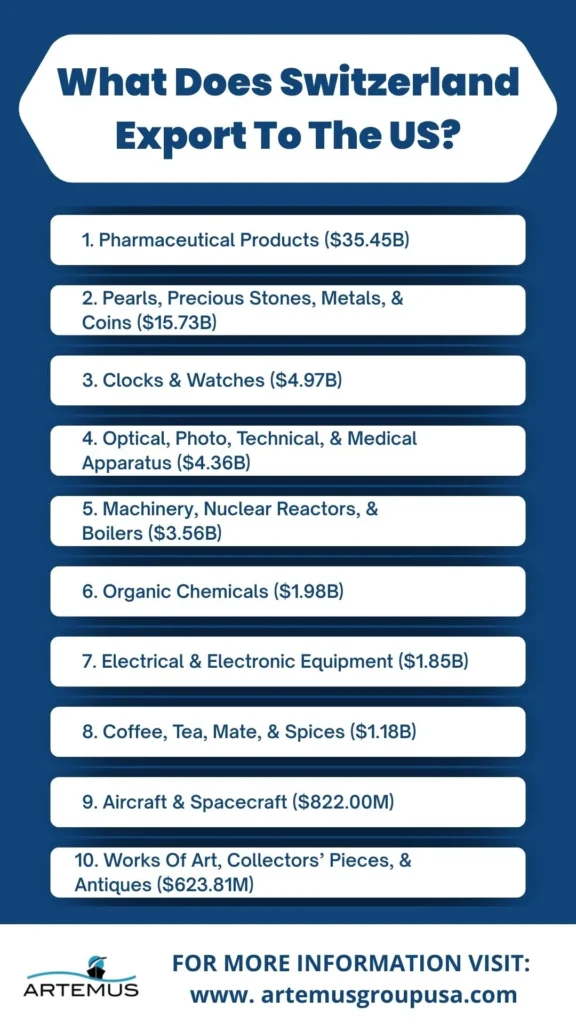
Switzerland is a leading exporter of high-value and specialized goods to the United States. In 2024, total Swiss exports to the U.S. amounted to $73.88 billion, highlighting the strength of trade between the two countries. Swiss exports are largely driven by pharmaceuticals, precious materials, precision instruments, and advanced industrial products.
Below are the top export categories from Switzerland to the United States, based on 2024 trade data:
Pharmaceutical products represent Switzerland’s largest export category to the U.S. In 2024, exports in this segment reached $35.45 billion, covering prescription medicines, vaccines, and advanced therapeutic products. Switzerland’s global leadership in life sciences underpins this strong performance.
Exports of pearls, precious stones, metals, and coins totaled $15.73 billion in 2024. Switzerland’s role as a global center for precious metal refining and trading significantly contributes to this category’s high value.
Swiss clocks and watches remain a key luxury export, with shipments to the United States valued at $4.97 billion in 2024. Strong brand recognition and craftsmanship continue to drive demand in the U.S. market.
Exports of optical, photographic, technical, and medical apparatus reached $4.36 billion in 2024. These products support U.S. healthcare, diagnostics, and research sectors.
Machinery exports to the U.S. totaled $3.56 billion in 2024. This category includes industrial machinery and equipment used across manufacturing and energy industries.
Swiss exports of organic chemicals amounted to $1.98 billion in 2024. These chemicals are essential inputs for pharmaceuticals and various industrial applications in the U.S.
Exports of electrical and electronic equipment were valued at $1.85 billion in 2024, supplying components and systems used in technology and industrial automation.
Exports of coffee, tea, mate, and spices reached $1.18 billion in 2024. Switzerland plays a major role in processing and distributing premium food and beverage products to the U.S.
Aircraft and spacecraft exports totaled $822.00 million in 2024, reflecting Switzerland’s contribution to specialized aerospace components and technologies.
Exports of works of art, collectors’ pieces, and antiques were valued at $623.81 million in 2024, supported by Switzerland’s well-established art and logistics markets.
Related: What Does The US Export To Europe? 2026 Guide & Key Stats

Switzerland’s biggest export to the United States is pharmaceutical products. In 2024, Swiss pharmaceutical exports to the U.S. totaled $35.45 billion, making this category the largest by a wide margin.
These exports primarily include prescription medicines, biologics, and advanced therapeutic products, reflecting Switzerland’s global strength in pharmaceutical research, manufacturing, and innovation.
Related: What Does The US Export To Norway? A Data-Driven Overview
The United States and Switzerland maintain a strong and expanding trade relationship across both goods and services. In 2024, total U.S.–Switzerland goods and services trade reached an estimated $188.0 billion, reflecting a 10.4 percent increase or $17.7 billion compared to 2023. This growth highlights deep economic ties and rising cross-border commercial activity.
U.S. total goods trade with Switzerland amounted to $88.4 billion in 2024. U.S. goods exports to Switzerland were valued at $25.0 billion, down 9.9 percent or $2.7 billion from the previous year. In contrast, U.S. goods imports from Switzerland increased sharply, totaling $63.3 billion, a 21.1 percent rise or $11.0 billion year over year.
As a result, the U.S. goods trade deficit with Switzerland widened to $38.3 billion in 2024, marking a 56.1 percent increase or $13.8 billion compared to 2023.
Services trade plays an equally important role in the bilateral relationship. In 2024, total U.S.–Switzerland services trade reached $99.7 billion. U.S. services exports to Switzerland rose to $64.7 billion, up 14.6 percent or $8.2 billion from 2023. U.S. services imports from Switzerland totaled $35.0 billion, reflecting a 3.6 percent increase or $1.2 billion year over year.
The U.S. recorded a services trade surplus of $29.7 billion with Switzerland in 2024, a 30.9 percent increase or $7.0 billion compared to the previous year.
Related: Exporting From Australia To USA: A Complete Guide

Swiss exporters shipping goods to the United States must comply with both Swiss export control laws and U.S. import regulations. Oversight is handled by Switzerland’s SECO and U.S. agencies such as Customs and Border Protection (CBP) and the Bureau of Industry and Security (BIS). Proper compliance helps avoid delays, penalties, and enforcement actions.
Under Switzerland’s Goods Control Act, exporters must assess whether products are classified as dual-use, meaning they have both civilian and military applications. Dual-use items may require export licenses and confirmation of the final end use before shipment to the U.S.
Accurate HS code classification is essential, as it determines licensing requirements, tariff treatment, and admissibility. Shipments must include complete documentation such as commercial invoices, packing lists, Certificates of Origin, and, where applicable, End-Use or End-User Certificates (EUC).
U.S. CBP requires timely and accurate customs declarations and proper country-of-origin marking. Certain products, including food, agricultural goods, pharmaceuticals, and medical items, must also comply with additional FDA or USDA regulations.
Swiss exporters must regularly screen customers, distributors, and logistics partners to comply with BIS regulations. Ongoing due diligence helps prevent violations involving restricted parties or prohibited end uses.
A November 2025 U.S.–Switzerland trade agreement is lowering tariffs and reducing non-tariff barriers. Under this framework, U.S. tariffs on many Swiss goods are capped at 15 percent, with mechanisms to reclaim excess duties already paid.
Related: How To Import Goods For Resale In The USA? A 2025 Guide

Imports from Switzerland mainly consist of high-value, time-sensitive goods such as pharmaceuticals, chemicals, precious metals, watches, and precision instruments. These shipments are concentrated at major East Coast seaports and key U.S. air cargo hubs that are equipped to handle premium and regulated cargo.
1. Port of New York and New Jersey: The busiest port in the U.S. East Coast and the primary ocean gateway for Swiss and European imports. It handles large volumes of high-value and time-sensitive Swiss cargo.
2. Port of Savannah: A fast-growing East Coast port that manages high-volume container traffic and supports a wide range of European imports, including Swiss goods.
3. Port of Los Angeles and Long Beach: Although primarily focused on Asia-Pacific trade, these ports also receive containerized Swiss cargo arriving through global and indirect ocean shipping routes.
4. Port Everglades (Florida): A recognized entry point for Swiss imports, particularly for specialized and high-value cargo serving the southeastern U.S.
Because many Swiss exports are high-value and low-weight, air freight is critical for U.S. imports.
1. JFK International Airport (New York): The leading U.S. air cargo hub for Swiss imports, especially pharmaceuticals and other high-value goods from Europe.
2. Los Angeles International Airport (LAX): A major West Coast gateway for Swiss air cargo, supporting rapid access to western U.S. markets.
3. Chicago O’Hare International Airport (ORD): A central air cargo hub used to distribute Swiss imports efficiently across the Midwest and inland regions.
Related: List Of 12 Largest Shipping Ports In The World

Artemus Transportation Solutions simplifies AMS and AES compliance for Swiss exports to the United States through a single, centralized trade compliance platform. The system reduces manual effort, improves data accuracy, and helps exporters meet U.S. regulatory requirements without unnecessary delays.
For Automated Manifest System compliance, Artemus provides a secure, CBP-compliant, web-based solution that supports electronic manifest submissions, updates, and confirmations. Exporters can manage shipment details, handle amendments, and track movements in real time, ensuring timely and accurate reporting to U.S. Customs.
For Automated Export System compliance, Artemus streamlines Electronic Export Information submissions using automated workflows and built-in validations. Real-time tracking and expert support help prevent errors, reduce compliance risk, and keep Swiss export shipments moving smoothly into the U.S.
Related: Ocean Freight Documentation For Imports: A Crucial Checklist
The United States accounts for roughly 16 to 17 percent of Switzerland’s total goods exports, making it Switzerland’s largest single-country export market.
Yes. The U.S. runs a goods trade deficit with Switzerland, driven largely by high-value pharmaceutical and precision product imports.
The United States is the largest foreign investor in Switzerland, with significant investments across pharmaceuticals, manufacturing, and financial services.
In 2024, the U.S. imported approximately $1.18 billion worth of coffee and related products from Switzerland.
Yes. The United States and Switzerland have a long-standing tax treaty designed to prevent double taxation and promote cross-border investment.
Switzerland’s exports to the United States are defined by high-value goods, strong regulatory oversight, and efficient global logistics. With a clear understanding of export categories, trade requirements, and key entry points, businesses can navigate Swiss–U.S. trade more confidently and support long-term growth.
As trade volumes continue to evolve, staying informed on compliance and market trends remains essential. A structured, proactive approach helps reduce risk while keeping cross-border operations smooth and reliable.
Related: Which Party Issues The Export Declaration Document?

The United Kingdom is one of the world’s largest trading economies and a top exporter of services. Cars, machinery, pharmaceuticals,

Mexico became the United States’ number-one trading partner in 2024, surpassing both Canada and China. According to the Office of

Colombia is one of Latin America’s most active trading economies. Crude oil, coffee, coal, and cut flowers flow out. Machinery,