
What Does Switzerland Export To The US? A Detailed Guide
Switzerland plays a vital role in U.S. trade, supplying a wide range of high-value and specialized products. From pharmaceuticals and


Australia’s imports and exports shape the country’s economy and influence global trade patterns. Importers bring in essential goods like machinery, vehicles, and pharmaceuticals to support industries and daily life, while exporters supply minerals, agricultural products, and energy resources that are in high demand worldwide.
Understanding these trade flows helps importers and exporters anticipate market trends, manage shipments efficiently, and navigate regulatory requirements. This blog explores what Australia imports and exports, highlights major trading partners, examines key products, and looks at the impact of trade policies.
Moreover, Artemus Transportation Solution provides advanced ISF, AMS, and AES software to support importers and exporters in managing compliance, streamlining documentation, and keeping shipments moving smoothly while minimizing delays and errors.
Table Of Contents
Australia’s trade in 2025 showcases its position as a major exporter of natural resources while relying on key imports to support domestic industries and consumer demand. The country continues to maintain a positive trade balance, reflecting strong export performance alongside growing imports.
Exports are largely dominated by iron ore, coal, liquefied natural gas (LNG), gold, and agricultural products, with Western Australia, Queensland, and New South Wales leading contributions. China remains the top export destination, followed by Japan, South Korea, the United States, and the Channel Islands. Some traditional markets, such as Japan, India, and Singapore, saw a decline in exports compared to the previous year.
On the import side, Australia focuses on vehicles, machinery, refined petroleum, electronics, and medical supplies, with major hubs in New South Wales, Victoria, and Queensland. Most imports come from China, the United States, South Korea, Japan, and Malaysia, with notable growth from China and several smaller markets.
By balancing strong resource exports with essential imports, Australia maintains a competitive edge in global trade while supporting domestic growth, infrastructure development, and industrial needs.
Related: Exporting From Australia To USA: A Complete Guide
Australia’s export economy is dominated by natural resources, with a few key commodities forming the backbone of its trade. Latest government data and forecasts highlight both the current performance and expected trends for these major exports:
Iron ore is Australia’s top export, earning A$ 137,939 million in 2023–24, primarily from Western Australia, with major destinations including China, Japan, and South Korea. Looking ahead, the Resources & Energy Quarterly (June 2025) forecasts that iron ore export earnings will decline to around A$ 104.8 billion in 2025–26 and further to about A$ 97 billion in 2026–27 due to easing global prices and weaker demand.
Coal remains a vital export, with combined earnings of A$ 91,358 million in 2023–24. Forecasts suggest metallurgical coal earnings will remain stable at approximately A$ 40–41 billion annually, while thermal coal is expected to decline from A$ 32 billion in 2024–25 to A$ 26 billion by 2026–27 due to the global energy transition.
Australia’s LNG exports totaled A$ 68,707 million in 2023–24, serving mainly Asian markets.
Earnings are forecast to fall from A$ 67 billion in 2024–25 to A$ 53 billion by 2026–27 as global prices soften.
Gold exports reached A$ 32,937 million in 2023–24, driven by both production and high global demand. Forecasts indicate earnings will rise to A$ 56 billion in 2025–26 before moderating to around A$ 52 billion in 2026–27.
Exports of aluminium ores, alumina, and aluminium products were A$ 10,373 million in 2023–24. These earnings are projected to reach around A$ 19 billion by 2026–27, with price fluctuations expected to moderate growth.
Copper exports stood at A$ 6,216 million in 2023–24. Forecasts suggest copper export earnings could increase to A$ 16.7 billion in 2025–26 and reach A$ 18.2 billion in 2026–27, supported by rising demand for electric vehicles, renewable energy, and low-emissions technologies.
Exports of other strategic minerals are becoming increasingly important. Forecasts show these could grow from around A$ 1.7 billion in 2024–25 to approximately A$ 4.8 billion by 2026–27, reflecting strong global demand for battery and energy-transition materials.
Related: Import Cars From Australia To USA: A 2024 Detailed Guide
Australia relies heavily on imports to meet its domestic needs across industries ranging from energy to technology. Here are the key imports to Australia, along with relevant statistics:
Refined petroleum is Australia’s largest import category, valued at approximately A$ 51.8 billion in 2023–24. These imports are critical for powering transportation, industrial operations, and electricity generation.
Australia imported around A$ 37.2 billion in passenger motor vehicles in 2023–24. Despite a small domestic automotive industry, the country depends on overseas manufacturers to supply cars for personal and commercial use.
Commercial vehicles, including trucks and vans, accounted for about A$ 18.9 billion of imports in 2023–24. These are essential for logistics, freight, and construction, highlighting Australia’s reliance on imported transport machinery.
Telecommunications equipment and parts were valued at approximately A$ 17.2 billion in 2023–24. These imports are crucial to maintain Australia’s digital infrastructure and connectivity for both businesses and consumers.
Australia imported around A$ 11.5 billion worth of computers, laptops, and related hardware in 2023–24. These products support education, business, and government operations, reflecting the growing digital economy.
Medicaments and veterinary medicines were imported to the value of A$ 8.9 billion in 2023–24. These imports are critical for human and animal health, ensuring consistent access to pharmaceuticals.
Electrical machinery and parts not elsewhere specified accounted for A$ 7.9 billion in imports. These components are widely used in appliances, industrial equipment, and high-tech devices.
Imports of civil engineering machinery and related parts were around A$ 8.0 billion in 2023–24. These support large-scale construction and infrastructure projects across the country.
Related: Importing Motorcycle From USA To Australia: A 2024 Guide
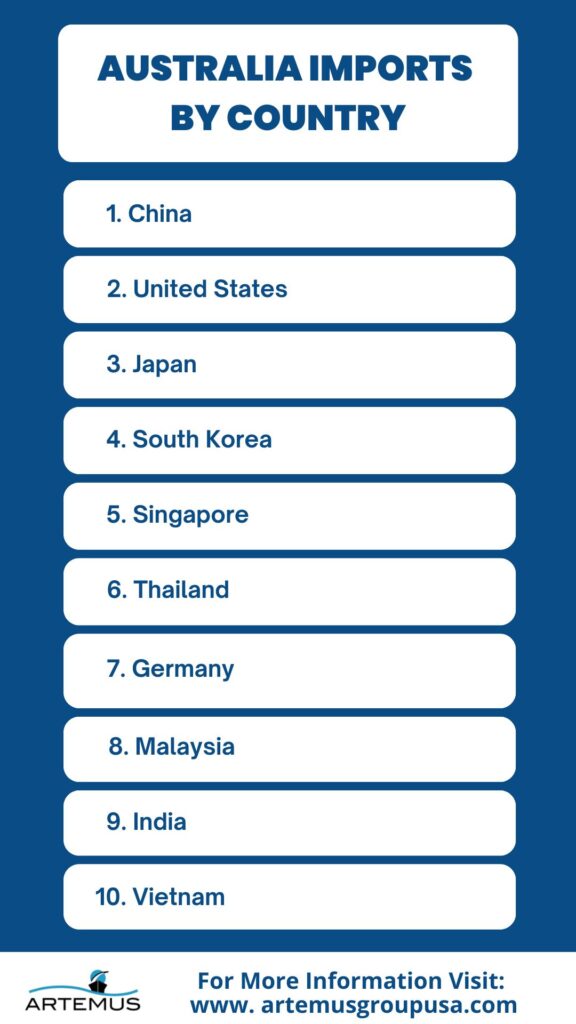
Australia’s imports are spread across a range of countries, with each playing a vital role in supplying goods and raw materials essential to the nation’s industrial, technological, and consumer sectors.
China is Australia’s largest import partner. It provides a wide array of products, including electronics, machinery, vehicles, and consumer goods. These imports are critical to Australia’s manufacturing, retail, and technology sectors.
The United States is Australia’s second-largest import partner. Key imports include aircraft, machinery, pharmaceuticals, and high-tech equipment. These goods support Australia’s industrial base and advanced technological infrastructure.
Japan supplies Australia with automobiles, machinery, and electronic components. These imports are important for Australia’s automotive industry, high-tech manufacturing, and precision equipment needs.
South Korea is an essential supplier of vehicles, petrochemical products, electronics, and machinery. These imports help sustain Australia’s industrial and manufacturing activities.
Singapore provides Australia with refined petroleum, machinery, and electrical equipment. These imports are critical to both energy and industrial sectors.
Thailand is a notable supplier of electronics, machinery, and automotive components. Australian businesses rely on these imports for manufacturing and consumer electronics production.
Germany exports high-tech machinery, automotive parts, chemicals, and pharmaceuticals to Australia. These imports are integral to Australia’s advanced manufacturing and industrial sectors.
Malaysia supplies Australia with electrical machinery, electronic components, and crude oil. These imports play an important role in both industrial production and energy needs.
India exports textiles, machinery, pharmaceuticals, and chemicals to Australia. These products support both industrial applications and consumer markets.
Vietnam provides Australia with electronics, machinery, textiles, and agricultural products. These imports contribute to Australia’s manufacturing, retail, and technological sectors.
These countries are critical to Australia’s import network, ensuring the steady supply of essential goods that support its economy, industry, and consumer markets.
Related: Poland’s Exports To USA: The Complete List For Opportunities
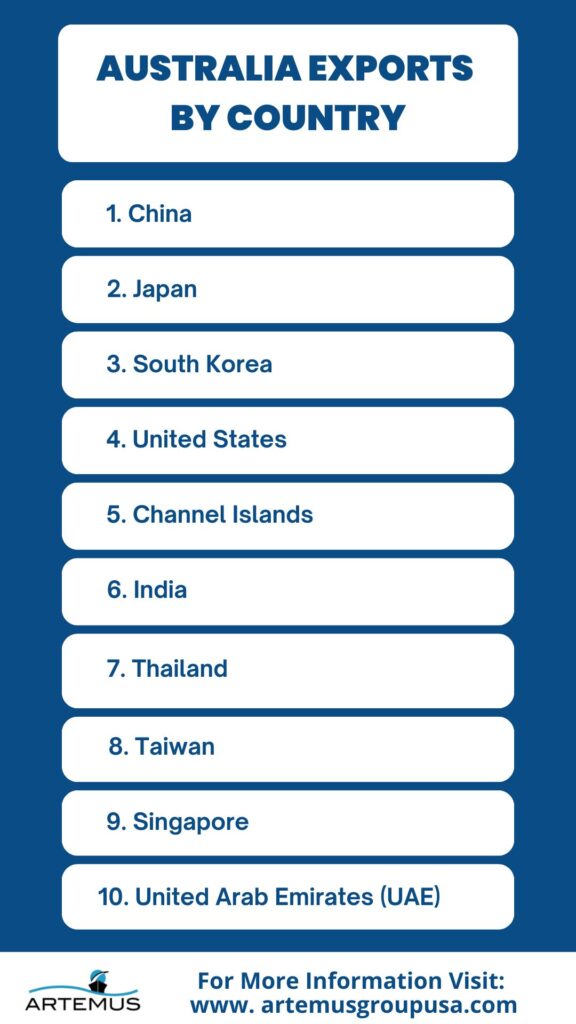
Australia’s exports are directed toward key trading partners, reflecting global demand for its natural resources, minerals, and agricultural products. Each country plays a strategic role in sustaining Australia’s trade and economic growth.
China is Australia’s largest export destination. The country imports iron ore, coal, natural gas, and agricultural products from Australia. These exports are vital for China’s industrial production, energy generation, and raw material supply chains.
Japan receives substantial quantities of coal, iron ore, and LNG from Australia. These resources are essential for Japan’s steel production, energy needs, and industrial manufacturing sectors.
South Korea imports coal, iron ore, LNG, and aluminium from Australia. These exports support its manufacturing, energy, and construction industries.
The United States is a major destination for Australia’s exports of gold, aluminium, and specialised minerals. These products are used in industrial applications, technology manufacturing, and financial investment commodities.
Australia exports gold and other precious metals to the Channel Islands. These exports contribute to financial and investment markets, supporting global trading and investment activities.
India imports coal, copper, and aluminium from Australia. These exports are critical for India’s energy generation, manufacturing, and infrastructure projects.
Thailand receives copper, coal, and LNG from Australia, which support its industrial and energy sectors.
Australia exports minerals such as coal and copper to Taiwan. These products are important for Taiwan’s industrial and technological sectors.
Singapore imports aluminium, petroleum products, and minerals from Australia, helping meet its industrial and energy requirements.
The UAE imports gold and other precious metals from Australia, supporting its financial markets and investment-driven sectors.
These countries form the backbone of Australia’s export strategy, ensuring strong demand for its key commodities and reinforcing its position in the global market.
Related: How To Export Agricultural Products From India To The USA?
Australia plays a significant role in global trade due to its abundant natural resources, agricultural products, and mineral wealth. Its exports and imports have far-reaching effects on international markets, supply chains, and industrial development.
Australia is a top global supplier of iron ore, coal, LNG, gold, and other minerals. These exports are crucial for industrial and energy sectors in countries like China, Japan, and South Korea, driving global manufacturing and infrastructure development.
As one of the world’s leading exporters of coal and natural gas, Australia significantly influences global energy prices and supply stability. Countries reliant on Australian energy exports benefit from a steady and reliable source of fuel for electricity generation and industrial processes.
Australia exports wheat, beef, wool, and other agricultural products to markets worldwide. This trade helps meet global food demand and supports the stability of international agricultural markets.
Imports from Australia, including minerals, metals, and chemical products, feed into high-tech manufacturing, electronics, and automotive industries globally. Australian resources are often a critical input for countries advancing in technology and infrastructure development.
Australia maintains strong trade relationships with key global economies, including China, Japan, South Korea, and the United States. These partnerships facilitate economic growth, market access, and mutual development opportunities, reinforcing global economic integration.
Australia’s position as a reliable supplier of essential raw materials and resources ensures stability in global supply chains. Disruptions in Australian exports can impact production and pricing in multiple industries worldwide.
Australia’s trade activities are therefore not only vital to its own economy but also have a ripple effect across global markets, emphasizing the country’s strategic importance in international commerce.
Related: What Is Global Trade Management? A Complete 2025 Guide
Australia’s trade policies and the global policies that interact with them significantly influence its import and export performance. Because Australia is a highly open, resource-driven economy, even small policy shifts can affect prices, competitiveness, and long-term trade stability.
When trading partners impose higher tariffs or stricter trade measures, demand for Australian exports can decline, especially in major sectors like iron ore, coal, LNG, and agricultural products.
However, Australia’s commodities are globally competitive and difficult to replace, so export volumes often remain stable, while prices tend to bear the larger impact. Similarly, Australia’s own tariff settings are generally low, support strong import flows, and international competitiveness.
Changes in global trade patterns can shift where Australia sources imports from.
Australia’s open market structure makes this adjustment process relatively smooth compared to more protected economies.
Australia’s floating exchange rate plays a central stabilizing role.
This automatic adjustment is a key reason Australia experiences fewer prolonged trade disruptions.
Different industries feel the effects of trade-policy changes differently:
Understanding sectoral exposure helps in assessing the risks associated with global policy swings.
Australia’s trade system is designed for resilience:
Related: What Is Global Trade Compliance & Its Key Components
Artemus offers specialized software solutions that help businesses manage trade compliance between Australia and the United States. The ISF, AES, and AMS platforms simplify import and export processes while ensuring accurate submissions and full regulatory compliance.
The ISF (10+2) software allows importers and freight forwarders to file inbound cargo information correctly, avoiding fines and delays. Real-time updates and global access let partners submit data from anywhere, streamlining the reporting process.
For exporters, the AES filing solution ensures the timely and precise submission of Electronic Export Information (EEI). It reduces errors, speeds up processing, and keeps shipments on schedule while maintaining compliance with all regulations.
The AMS software helps clients submit advanced cargo information efficiently. Its intuitive interface and automated workflows let users manage manifests, arrival notices, and reports easily, with secure access and customizable permissions.
By using Artemus’ software solutions, businesses can handle US and Australia trade compliance confidently. These tools improve efficiency, ensure accuracy, and provide clear visibility throughout the shipping and filing process, making international trade simpler and more reliable.
Related: HS Code VS HTS Code: 10 Differences You Need To Know
China is Australia’s largest importer, buying a significant share of minerals, energy, and agricultural products.
Iron ore remains Australia’s top export, contributing the most to its trade revenue.
Coal and aluminum are among Australia’s leading exports to the United States.
China is Australia’s biggest trade partner, both for imports and exports.
Australia’s trade plays a vital role in its economy and in the global market. Understanding what the country imports and exports, as well as its major trading partners, helps businesses and investors navigate opportunities effectively.
Monitoring trade trends and policies allows for better planning, reduces risks, and supports smoother international transactions. Staying informed about Australia’s trade patterns ensures that companies can make strategic decisions and maintain strong connections in the global marketplace.

Switzerland plays a vital role in U.S. trade, supplying a wide range of high-value and specialized products. From pharmaceuticals and

In 2026, the US-Europe trade relationship continues to power global commerce, driven by exports of energy, advanced machinery, and pharmaceuticals

The economic partnership between the United States and Norway is a sophisticated and evolving pillar of transatlantic commerce. U.S. exports