What Does The US Export To Switzerland? Trade Insights
International trade between the United States and Switzerland highlights the strong economic relationship between the two nations. With its highly


Embarking on the step-by-step journey of how to export from India to the USA opens up a world of opportunities for businesses seeking to expand their market reach. Navigating the intricacies of global trade can feel overwhelming without the right support and direction.
In this comprehensive guide, we’ll explore the step-by-step process of exporting from India to the USA, shedding light on essential documentation, regulations, and logistics involved.
Additionally, we’ll highlight the invaluable support provided by Artemus Transportation Solutions, a leading provider of ISF (Importer Security Filing) and AMS (Automated Manifest System) software solutions tailored for compliance in this transcontinental trade route.
Table Of Contents
The trade relationship between India and the USA is vital both economically and strategically. In 2024, total goods trade reached about $129 billion, with U.S. exports of $41.5 billion and imports of $87.3 billion, resulting in a trade deficit of around $45.8 billion for the U.S. Services trade was nearly $42 billion each way, with only a slight U.S. surplus.
The trajectory of this partnership is remarkable. Bilateral trade has grown from roughly $20 billion in 2000 to nearly $118 billion in 2024, and projections suggest it could reach $300 billion by 2026–27.
Trade fuels job creation, technology transfer, and innovation across sectors. The U.S. exports machinery, medical equipment, aircraft, and defense products to India, while India is a major supplier of IT services, pharmaceuticals, textiles, steel, and gems.
Increasing collaboration in digital services, renewable energy, and semiconductor manufacturing further highlights the future-oriented nature of this partnership.
Beyond commerce, U.S. & India trade enhances strategic and diplomatic ties, reinforcing their shared commitment to democracy, open markets, and regional stability.
As leading members of the Quad alliance, both countries are deepening cooperation on supply chain resilience, clean energy transition, and Indo-Pacific security, making trade not just an economic exchange but a pillar of a broader strategic partnership
Related: What Is Bill Of Lading? A Comprehensive Overview
India has emerged as one of the leading exporters to the U.S., with trade volumes growing steadily despite recent challenges. The U.S. continues to be India’s largest export destination, making this trade relationship crucial for both economies. Here are the key trends shaping exports:
The U.S. remains India’s top export partner, accounting for about 17.7% of total exports in FY 2024–25. Its high purchasing power and diverse consumer base make it a prime destination for Indian goods.
Indian merchandise exports to the U.S. stood at around $77.5 billion in FY 2024, with engineering goods, electronics, pharmaceuticals, gems & jewelry, and apparel among the top categories.
Digital platforms are enabling Indian exporters, especially SMEs and D2C brands, to connect directly with U.S. consumers. Online sales in categories like fashion, handicrafts, and specialty foods are expanding rapidly.
Beyond traditional items like textiles and gems, Indian exporters are focusing on value-added products from ready-to-eat foods and organic spices to high-end engineering goods to meet evolving U.S. demand.
U.S. buyers are increasingly prioritizing sustainably sourced, eco-friendly, and ethically produced goods. Indian exporters in textiles, handicrafts, and organic products are tapping into this trend to gain premium positioning.
With the U.S. tightening standards under FDA, FTC, FCC, and USDA regulations, compliance is no longer optional. Exporters must invest in quality certifications, traceability systems, and transparent labeling to ensure smooth market entry.
Related: What Is Freight Forwarder Vs Broker: 6 Key Differences
Exporting goods from India to the USA can be a lucrative endeavor that demands careful planning and compliance with both Indian and U.S. regulations. Whether you’re experienced or just beginning, here’s the step-by-step, government-guided process:
Begin by establishing your business (Proprietorship, Partnership, Company, etc.), opening a bank account eligible for forex transactions, and obtaining a Permanent Account Number (PAN).
Simultaneously, conduct market research to identify U.S. demand trends and select exportable products that are not restricted. Depending on the product, exporters may need to check U.S. tariff rates via the Harmonized Tariff Schedule (HTSUS).
An IEC is mandatory for any export from India. Apply online via the DGFT portal by submitting PAN, bank details, address proof, and other firm-specific documents. As of 2025, Aadhaar-based e-KYC is required for proprietors and sole traders, and the IEC must be confirmed annually between April 1 and June 30, or it may be deactivated.
To access export benefits and schemes under India’s Foreign Trade Policy, obtain an RCMC from the relevant Export Promotion Council or commodity board.
Register on the ICEGATE portal to electronically file shipping bills and customs documents. The process requires validation using your GSTN-linked mobile/email, PAN, IEC, and optionally a Digital Signature Certificate (DSC). Aadhar-based authentication may also be used.
Compile essential documentation such as commercial invoices, packing lists, shipping bills, bills of lading (or airway bills), certificates of origin, and any mandatory inspection certificates. Ensure HS codes are correctly assigned for customs and tariff purposes.
Ensuring compliance is a critical step in exporting from India to the USA. Exporters must adhere to both Indian export regulations and U.S. import standards, covering everything from customs duties and mandatory inspections to product-specific certifications.
Proper packaging and labeling not only safeguard goods during transit but also guarantee smooth entry into the U.S. market.
Package goods appropriately and arrange shipping via a freight forwarder. Secure marine or transit insurance to mitigate risk during transport.
Finalize payment terms with your buyer, using letters of credit, advance payments, or other secured methods. Consider export financing and risk mitigation via the Export Credit Guarantee Corporation (ECGC).
File shipping bills through ICEGATE, complete customs clearance, and receive acknowledgement and relevant document numbers for shipment.
Submit proof of export to your Authorized Dealer (AD) bank for realization of export proceeds under FEMA timelines (generally 9 months). Retain all documentation for incentives under schemes like RoDTEP (which replaced MEIS) or RoSCTL (for apparel and textiles).
Related: What Is HS Code In Shipping? The Harmonised System
Exporting from India to the USA involves steps governed by U.S. regulations. Here’s a concise, updated guide in 8 key points:
Analyze U.S. demand, pricing, and competition to identify suitable products. Study regulatory requirements for your sector, food, textiles, electronics, etc., to ensure compliance before shipping.
As per Indian regulations, exporters must obtain an IEC from DGFT before initiating exports. Without it, no cross-border shipment can be processed.
India no longer enjoys GSP benefits (withdrawn in 2019), so goods face Most-Favoured-Nation (MFN) tariffs under WTO rules. Use the U.S. International Trade Commission (USITC) Tariff Database or consult a customs broker to classify products under the HTSUS (Harmonized Tariff Schedule of the United States) and determine applicable duty rates.
Make sure your products meet all U.S. standards and labeling rules, FDA (for food, drugs), FCC (for electronics), USDA PPQ (for agricultural shipments), etc.
Coordinate with a freight forwarder or logistics provider. For ocean shipments, file the Importer Security Filing (ISF “10+2”) with U.S. Customs and Border Protection (CBP) at least 24 hours before vessel loading. Failure to do so can result in penalties and shipment holds.
Compile all required documents:
Entries are filed through the Automated Commercial Environment (ACE), CBP’s single-window platform for trade..
Most Indian exporters rely on a licensed U.S. customs broker, who acts on behalf of the Importer of Record (IOR). Brokers handle entry filing, duty/tax payments, and compliance with CBP and partner agencies (FDA, USDA, CPSC). Importers must also maintain a customs bond (single-entry or continuous) for shipments.
Once cleared, goods can be distributed through wholesalers, retailers, or e-commerce platforms. Exporters should maintain all import records for at least five years under CBP regulations.
They may also claim duty drawbacks or refunds for re-exported goods through ACE/ABI systems. Staying updated with product recalls, labeling changes, and safety alerts is essential for maintaining smooth market access.
Important Caution: In May 2025, at least 15 consignments of Indian mangoes were rejected by U.S. entry ports due to errors in the PPQ203 certificate, underscoring the critical importance of complete and accurate documentation
Related: 10 International Shipping Documents To Must Have In 2025
As the trade relationship between India and the USA flourishes, a diverse array of products has found its way from Indian shores to American homes and industries. From exquisite diamonds and artisanal handicrafts to flavorful spices and innovative pharmaceuticals, let’s explore the high-demand products that are shaping this vibrant trade partnership.
Related: How To Import Goods For Resale In The USA? A 2025 Guide
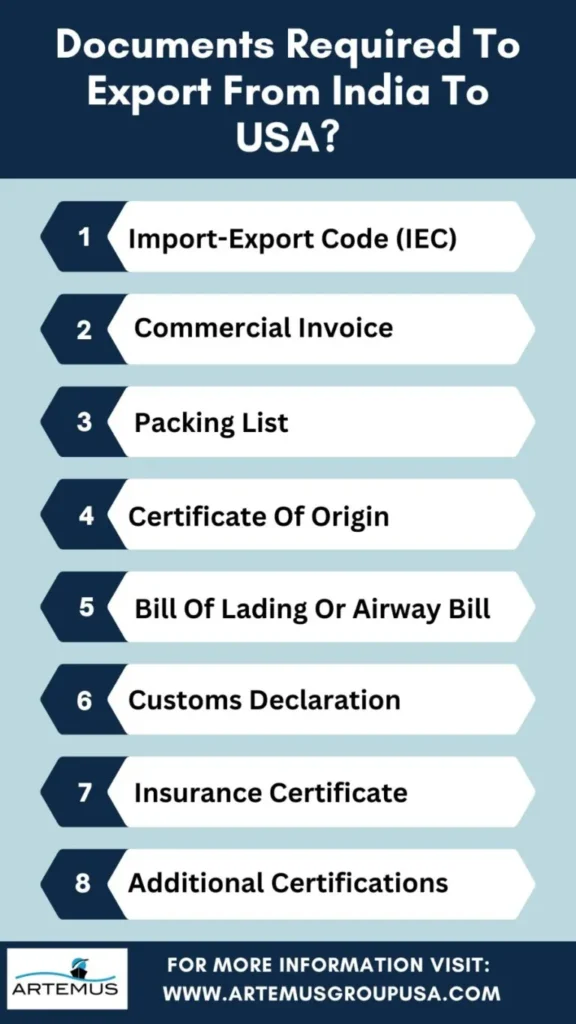
Exporting from India to the USA requires specific documentation to comply with regulations. Here’s a concise guide in 8 points:
The Import-Export Code (IEC) is a unique 10-digit number issued by the Directorate General of Foreign Trade (DGFT) in India. It is mandatory for all import/export transactions and serves as a key identification for customs authorities.
A commercial invoice is a legal document issued by the exporter to the importer, detailing the transaction between both parties. It includes essential information such as the description of the goods, quantity, unit price, total value, currency, terms of sale (Incoterms), and any applicable taxes or discounts.
A packing list provides a detailed inventory of the contents of each package being shipped. It includes information such as the item name, description, quantity, weight, dimensions, and packaging type (cartons, pallets, etc.). This document assists customs officials in verifying the shipment and facilitates the unloading and distribution process.
A Certificate of Origin is a document certifying the country of origin of the exported goods. It may be required to benefit from preferential tariff rates under trade agreements or to comply with import regulations in the destination country. This certificate can be issued by a Chamber of Commerce or authorized government agency.
The Bill of Lading (for sea shipments) or Airway Bill (for air shipments) is a crucial shipping document issued by the carrier or freight forwarder. It serves as a contract of carriage and provides details about the shipment, including the shipper, consignee, description of goods, quantity, weight, and destination. It also acts as a receipt of goods and can be used for obtaining payment.
Exporters must accurately complete customs declaration forms, providing information about the exported goods, their value, quantity, classification (HS Code), and other relevant details. This information helps customs authorities assess applicable duties, taxes, and regulatory compliance.
An insurance certificate confirms that the exported goods are covered by an insurance policy during transit. It provides details about the insurance coverage, including the insured value, risks covered, duration of coverage, and contact information of the insurance provider. Having insurance coverage protects the exporter against potential losses or damages during transportation.
Depending on the nature of the goods being exported, additional certifications or documents may be required.
For example, agricultural products may need phytosanitary certificates to ensure they meet plant health standards, while certain food items may require sanitary certificates to demonstrate compliance with health and safety regulations.
It’s essential to research and obtain any necessary certifications specific to the exported goods and the destination country’s requirements.
Related: Certificate Of Conformance (CoC): What Is It & Its Types
Export costs from India to the U.S. depend largely on the destination port, shipping method, and service provider. These charges typically include customs duties, freight rates, and handling or documentation fees, making it essential for exporters to work with reliable logistics partners and request detailed cost estimates.
U.S. customs duties are calculated based on the product’s HTS classification and declared value, including freight and insurance. While shipments under the $800 de minimis threshold are duty-free in most cases, some goods may still require formal clearance under recent CBP rules.
Freight charges vary significantly by mode of transport. Air freight ensures faster delivery, usually within 8–10 days, but at higher costs, while ocean freight is more economical for larger shipments, though transit times average 30–40 days.
Additional expenses may arise from documentation, packaging, insurance, and port-specific requirements such as inspections or ISF filings. Exporters can reduce costs by consolidating shipments, using efficient packaging, and staying updated on port regulations to avoid delays or unexpected surcharges.
Related: ISF Form (Import Security Filling): Elements & Top Practices
Artemus Transportation Solutions offers comprehensive ISF (Importer Security Filing) and AMS (Automated Manifest System) solutions to facilitate seamless compliance for businesses exporting from India to the USA. With a deep understanding of international trade regulations and a commitment to innovation, Artemus empowers exporters to navigate the intricate customs requirements efficiently and effectively.
Their ISF solution enables exporters to submit accurate and timely filings, ensuring compliance with U.S. Customs and Border Protection (CBP) regulations. By automating the filing process and providing real-time updates, Artemus helps businesses avoid penalties and delays, enhancing supply chain efficiency.
Additionally, Artemus’ AMS software streamlines the manifesting process, enabling exporters to transmit electronic cargo manifests to CBP before goods depart from India. This ensures compliance with advance cargo information requirements and facilitates smooth cargo clearance upon arrival in the USA.
Related: How To Choose A Freight Forwarder? 10 Critical Aspects
Yes, you need an Import-Export Code (IEC) to export from India.
Utilize online marketplaces, trade directories, and networking to find export customers.
To export goods from India to the US, obtain an Import-Export Code, comply with regulations, arrange shipping, and complete customs documentation.
The United States is India’s largest export partner, accounting for about 17–18% of India’s total exports in FY 2023–24. In terms of overall trade, China slightly surpasses the U.S., but for exports alone, the U.S. leads.
India mainly exports precious stones and jewelry, electronics, and pharmaceuticals to the U.S. These sectors consistently make up the largest share of India’s exports to America.
Pharmaceuticals are the most in-demand, with India supplying nearly 40% of U.S. generic drug needs. Gems, jewelry, and electronics also remain strong export categories.
In conclusion, navigating the process of exporting from India to the USA requires careful planning, attention to detail, and adherence to regulatory requirements. By following the steps outlined in this guide and leveraging available resources such as government agencies, trade associations, and international trade consultants, exporters can successfully navigate the complexities of international trade.
Related: OTI License Requirements, Costs, Renewal, & Regulations

International trade between the United States and Switzerland highlights the strong economic relationship between the two nations. With its highly

Cold Nordic waters, advanced engineering, and a strong maritime economy make Norway a powerful exporter despite its size. Many of
Trade between the United States and Canada is one of the largest bilateral trading relationships in the world. Understanding what