What Does Switzerland Export To The US? A Detailed Guide
Switzerland plays a vital role in U.S. trade, supplying a wide range of high-value and specialized products. From pharmaceuticals and


Navigating the complexities of international shipping can be challenging, which is why many businesses ask, how does freight forwarding work to simplify the process. Freight forwarding involves coordinating and managing the shipment of goods from one location to another, utilizing various transportation methods such as air, sea, rail, and road.
Acting as intermediaries between shippers and carriers, freight forwarders handle customs documentation, shipping regulations, and other logistical hurdles, ensuring that goods are transported efficiently and safely across borders.
Artemus Transportation Solutions is dedicated to simplifying the complexities of freight forwarding. Our state-of-the-art software for Importer Security Filing (ISF) and Automated Manifest System (AMS) ensures that your shipments meet all U.S. compliance standards with ease.
By automating and integrating these critical processes, we help freight forwarders align their filings perfectly with regulatory requirements, reducing errors and enhancing operational efficiency.
Table Of Contents
A freight forwarder, also called a forwarding agent, is a company or individual that organizes the movement of goods on behalf of a shipper. They act as intermediaries, liaising with carriers that transport cargo by sea, air, rail, or road, and often combine multiple modes for a single shipment. Importantly, freight forwarders do not physically move the goods themselves but serve as the “architects of transport,” as described by FIATA.
Freight forwarders handle a wide range of responsibilities, including freight consolidation, rate negotiation, shipment tracking, and preparing essential documentation. For international trade, they specialize in customs compliance, managing documents such as bills of lading, commercial invoices, and export declarations. Their expertise ensures goods meet the regulatory requirements of different countries and clear customs smoothly.
Modern freight forwarders increasingly provide end-to-end services, arranging shipments from the point of origin to the final destination. Beyond transportation, they may offer warehouse planning, cargo insurance, and customs brokerage, along with real-time tracking for greater visibility. Some forwarders also specialize in niche areas, such as rail freight or port-based collections and deliveries, adapting their services to specific industry needs.
Related: Freight Forwarders Arrange Transportation Only By Ocean Shipping
A freight forwarder plays a pivotal role in the global supply chain, offering a myriad of services to ensure the smooth movement of goods from origin to destination.
Below is a breakdown of the responsibilities of a freight forwarder:
Freight forwarders coordinate the logistics of shipping goods, including booking cargo space, selecting the most appropriate transportation modes (air, sea, road, or rail), and determining the optimal route for the shipment.
With growing regionalisation of trade networks, many now create specialized hubs near key cross-border zones, such as the U.S.–Mexico border, to streamline transit times.
They manage the extensive paperwork involved in international trade, including customs documentation, export/import permits, bills of lading, and certificates of origin. Today’s systems often integrate digital document filing, reducing errors and improving compliance speed.
Freight forwarders navigate the complexities of customs clearance procedures, ensuring that shipments meet all regulatory requirements and are cleared without delays. Many forwarders now use AI-powered compliance tools to anticipate potential bottlenecks and minimize clearance risks.
They offer cargo insurance services to protect shipments against loss, damage, or theft during transit. Digital claims processing is becoming more common, helping businesses resolve insurance matters faster.
Forwarders optimize efficiency by consolidating shipments, optimizing transportation routes, and leveraging their network of carriers to minimize costs and transit times. Predictive analytics is now being widely adopted to proactively reroute shipments in case of disruptions.
Some freight forwarders provide warehousing and distribution services, offering temporary storage facilities and managing last-mile delivery. In 2025, many warehouses are adopting automation and smart inventory tracking to boost speed and accuracy.
They provide real-time tracking and monitoring of shipments, enabling shippers to stay informed about the status and location of their goods. AI-driven dashboards and IoT devices now deliver predictive ETAs, helping businesses plan more effectively.
Freight forwarders help mitigate risks associated with transportation, such as delays and disruptions, by implementing contingency plans. The focus in 2025 has shifted toward building resilient and antifragile supply chains that not only recover from disruptions but emerge stronger.
They offer personalized customer support and guidance, assisting clients with any questions or concerns about their shipments. Many forwarders now complement human expertise with chatbots and CRM platforms to ensure 24/7 responsiveness.
Related: Ocean Freight Documentation For Imports: A Crucial Checklist
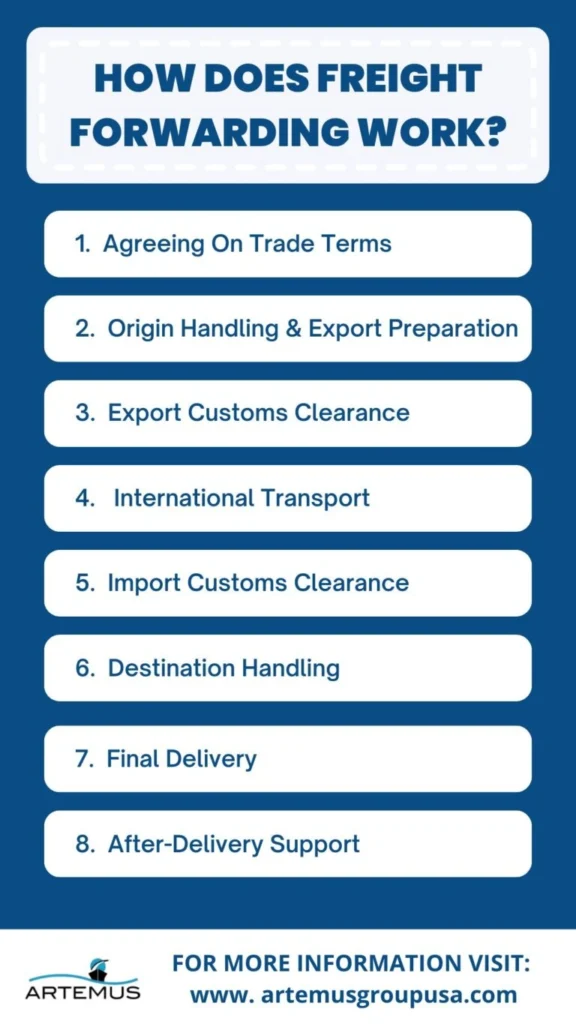
Freight forwarders act as intermediaries between shippers and carriers, using their network of trusted partners to secure the most efficient routes and competitive rates. Beyond simply moving goods, they take responsibility for documentation, customs clearance, and ensuring compliance with international trade rules.
Here’s how the process typically works:
The process begins when the importer and supplier finalize trade terms, often under Incoterms. These rules define who is responsible for costs, risks, and responsibilities at each stage of the journey.
Based on the Incoterms, the freight forwarder arranges pickup from the supplier and moves the goods to a port, airport, or consolidation hub. They also manage inspections, packaging checks, labeling, and prepare shipments for export. Smaller consignments may be consolidated into a larger load to optimize costs.
Before goods leave the origin country, the forwarder (or a licensed customs broker) ensures all required documents, such as the commercial invoice, packing list, and bill of lading/air waybill , are completed and filed with authorities. This is like giving the shipment its passport to travel legally.
Once cleared, goods are shipped via the chosen mode of transport, sea, air, rail, road, or a combination. The forwarder books carrier space, monitors schedules, and provides tracking updates. They may also arrange cargo insurance to safeguard against loss or damage.
Upon arrival, customs officials at the destination check paperwork and assess duties or taxes. A proactive freight forwarder prepares these documents in advance to prevent delays. This step may also involve compliance checks (e.g., health, safety, or quarantine requirements).
After clearance, the forwarder or their local partner oversees port or terminal handling. This can include deconsolidating shipments, arranging temporary warehousing, and scheduling final transport.
Goods are then delivered to the consignee, whether a warehouse, distribution center, retailer, or end customer. In some cases, a third-party logistics (3PL) provider manages storage and distribution on behalf of the business.
Many modern forwarders also provide ongoing support, such as handling claims for damaged or delayed cargo, analyzing freight costs, and recommending ways to optimize future shipments.
Related: What Is Ocean Freight? Everything You Need to Know
A freight forwarding company is a specialized logistics partner that helps businesses manage the complex process of transporting goods across borders and regions. Unlike carriers that own ships, trucks, or planes, freight forwarders focus on building a global network of trusted transport providers, warehouses, and customs agents to deliver flexible and cost-effective shipping solutions.
These companies act as strategic coordinators, tailoring services to each client’s needs, whether that involves multimodal transport planning, storage solutions, customs clearance, or cargo protection. They bridge the gap between importers/exporters and carriers, ensuring goods move efficiently, securely, and in compliance with international trade regulations.
In today’s supply chain environment, freight forwarding companies also leverage technology such as real-time tracking, AI-driven route optimization, and automated document filing. This allows them not only to move goods but also to provide visibility, reduce risks, and improve overall supply chain performance.
Related: What Is Freight Forwarder Vs Broker: 6 Key Differences
Partnering with a professional freight forwarder can simplify global trade and add significant value to your supply chain. From navigating customs regulations to leveraging global networks and advanced technology, freight forwarders bring expertise and efficiency that most businesses would struggle to achieve independently. Here are the key benefits:
International shipping is full of challenges, from complex regulations to unpredictable disruptions. By working with an experienced freight forwarder, businesses gain access to specialists who understand how to manage both full container loads (FCL) and less-than-container loads (LCL).
Their expertise ensures shipments follow the best routes, use the most cost-effective modes of transport, and comply with all requirements. Importers and exporters also benefit from having a dedicated professional who takes full accountability for each stage of the journey.
Well-established freight forwarders rely on an extensive international network of partners, including carriers, warehouse operators, ground handlers, customs agents, and financial brokers.
This worldwide reach allows them to offer end-to-end services, no matter the destination. Instead of being restricted to a limited set of routes, businesses gain flexibility and reliability when moving cargo across continents.
One of the biggest risks in international trade is errors in paperwork. Incorrect bills of lading, misapplied HS codes, or incomplete customs declarations can lead to delays, penalties, or goods being held at port.
Freight forwarders reduce this risk by managing all documentation on behalf of clients, ensuring compliance with international trade laws. Getting it right the first time not only saves money but also builds long-term trust with customs authorities.
Today’s freight forwarding services are supported by digital platforms that provide real-time cargo visibility. Shippers want quick answers to three key questions: Where is my shipment? When will it arrive? How much will it cost?
By using modern tracking tools, forwarders can provide accurate updates, price forecasting, and proactive notifications. This transparency improves reliability, helps businesses plan inventory better, and strengthens client-forwarder relationships.
Freight forwarders move large volumes of cargo every year, giving them purchasing power that individual shippers simply cannot match. By negotiating bulk space on vessels or flights, forwarders secure lower rates and better service conditions.
These savings are then passed on to clients, making international shipping more affordable whether goods move by sea or air. This “economies of scale” advantage is one of the clearest financial benefits of using a forwarder.
The logistics industry is fast-moving and unpredictable, delays, regulation changes, or sudden shifts in demand can happen at any time. Freight forwarders provide the flexibility to adjust plans quickly, whether it’s rerouting cargo, changing transport modes, or finding alternative warehousing solutions.
This adaptability minimizes disruption and gives businesses confidence that their shipments will continue moving smoothly, even when plans need to change.
Related: How To Become A Freight Broker With No Experience?
Freight forwarding is more than just logistics, it’s a strategic necessity in a volatile global trade environment. Forwarders bring resilience and adaptability to supply chains shaken by geopolitical tensions, labor shortages, and pandemics, helping businesses maintain efficient, transparent, and customer-focused operations.
Forwarders offer deep expertise in managing documentation, customs clearance, and cross-border regulations, especially critical in 2025 as trade rules continue to fragment across regions. Their up-to-date knowledge protects shipments from delays, financial penalties, and disruptions.
By leveraging volume-based contracts, consolidating shipments, and optimizing routes, freight forwarders help businesses reduce shipping costs and avoid extra fees such as storage or demurrage. Their access to multimodal options ensures continuity when disruptions occur.
Forwarders provide real-time shipment visibility powered by digital platforms and IoT technologies, enabling proactive handling of delays, theft, or damage. Combined with cargo insurance and contingency planning, they significantly de-risk logistics operations.
Sustainability is a growing business imperative. Forwarders can guide greener logistics strategies, such as intermodal transport, emissions tracking, and eco-conscious routing, while maintaining reliability. They also help build antifragile supply chains by diversifying routes, leveraging regional networks, and aligning with evolving environmental regulations.
Beyond shipment execution, forwarders act as strategic partners, delivering insights into market trends, tariff shifts, and regulatory changes. They enable businesses to make data-informed decisions on routing, risk strategies, and logistics innovation.
Related: How To Get A Freight Broker License?
Freight forwarding companies offer more than just moving goods from one place to another. They act as logistics partners, delivering a complete package of services that cover planning, transportation, compliance, storage, and even technology support. Here are the main services businesses can expect when working with a professional freight forwarder:
Navigating international regulations is one of the toughest parts of global trade. Freight forwarders simplify this by managing customs clearance on behalf of importers and exporters.
They prepare and submit declarations, arrange certificates of origin, secure customs bonds, and ensure HS codes are applied correctly. By working closely with customs brokers, forwarders help shipments move across borders without unnecessary delays or penalties.
Whether by air, sea, road, or rail, freight forwarding companies arrange international and domestic transport tailored to cost, speed, and reliability needs. They also handle multimodal shipping, making sure goods are moved seamlessly across different carriers and transit hubs.
This flexibility is especially valuable during peak seasons or when supply chains face disruptions.
Many freight forwarders extend their services beyond transport by offering warehousing and distribution solutions. Businesses can benefit from short-term storage, long-term facilities, inventory management, and even last-mile delivery.
Some providers also include reverse logistics, ensuring returned goods are handled efficiently.
Incorrect paperwork is one of the leading causes of shipment delays. Freight forwarders eliminate this risk by preparing essential documents such as the commercial invoice, packing list, bill of lading, letter of credit, and permits required by government agencies. With their expertise, businesses save time, avoid fines, and ensure smooth customs approval.
Forwarders also help safeguard goods during transit by arranging cargo insurance. This coverage provides financial protection against theft, loss, or damage, giving businesses peace of mind that their shipments are protected no matter what happens along the way.
Beyond shipping, freight forwarders provide additional logistics support such as cargo packaging, labeling, consolidation, and deconsolidation. They can mix and match different shipping modes and routes to keep supply chains moving, even under pressure from seasonal peaks or port delays.
Modern freight forwarders integrate digital solutions into their services. With tools like real-time shipment tracking, CRM platforms, and supply chain analytics, businesses gain better visibility and control over their cargo. This level of transparency helps optimize inventory planning, forecast costs, and strengthen customer satisfaction.
Related: How To Start A Freight Forwarding Business? 12 Easy Steps
As we move through 2025, the freight forwarding industry continues to evolve in response to technology, regulation, and shifting global trade patterns. While digitalisation, decarbonisation, and resilience remain key themes, new dynamics such as regulatory frameworks and e-commerce growth are shaping the way forwarders operate.
Here are the major trends driving the future of freight forwarding:
Technology adoption is transforming logistics at a rapid pace. Freight forwarders are leveraging AI, blockchain, and IoT to improve efficiency and transparency across supply chains. Predictive analytics helps anticipate disruptions, while real-time tracking boosts customer confidence.
Automation tools are also streamlining document handling and decision-making. With nearly one-third of supply chain leaders planning to reinvent operations using AI, the push toward a fully connected, digitised logistics ecosystem is stronger than ever.
Environmental responsibility is no longer optional , it’s a necessity. Forwarders are under increasing pressure to reduce greenhouse gas emissions by adopting cleaner fuels, optimising routes, and integrating energy-efficient technologies.
The EU’s new Emissions Trading System (EU ETS) and FuelEU Maritime regulations, which took effect in 2025, have intensified this shift by requiring stricter carbon compliance. While these policies raise costs, they also accelerate the adoption of innovative green solutions, paving the way for a more sustainable freight industry.
Recent years have proven that global trade is highly vulnerable to shocks such as geopolitical conflicts, extreme weather, and economic volatility. To counter these risks, freight forwarders are prioritising diversification , sourcing from multiple suppliers, using alternative trade routes, and incorporating multimodal transport.
Beyond resilience, many are adopting the principle of antifragility , designing systems that don’t just withstand disruptions but grow stronger because of them. This forward-looking mindset positions freight forwarders as proactive problem-solvers in uncertain times.
The rapid rise of e-commerce continues to reshape global logistics. Consumers in 2025 expect faster delivery times, greater transparency, and flexible shipping options. Freight forwarders are adapting by investing in smarter last-mile solutions, enhanced inventory management, and technology-enabled customer service.
Balancing speed, cost, and sustainability is now the ultimate challenge for companies serving the e-commerce-driven supply chain.
Globalisation remains important, but regionalisation is gaining momentum. Businesses are increasingly sourcing closer to their markets to cut costs, reduce risks, and improve delivery times.
Freight forwarders are responding by strengthening intraregional logistics networks, expanding local warehousing options, and building partnerships with regional carriers. This shift helps businesses remain agile while reducing exposure to international disruptions.
Related: How To Choose A Freight Forwarder? 10 Critical Aspects
Artemus delivers a powerful filing solution designed specifically for freight forwarders managing U.S. import and export requirements. The platform automates critical processes such as Importer Security Filing (ISF), Automated Manifest System (AMS), and Automated Export System (AES), ensuring businesses stay compliant with U.S. Customs and Border Protection (CBP) regulations.
By reducing manual data entry and offering real-time system updates, Artemus helps freight forwarders submit accurate filings on time, minimizing the risk of costly delays or penalties. The software is built with an intuitive interface, making it easy for teams to manage compliance without unnecessary complexity.
In addition, Artemus provides ongoing regulatory updates and expert support, so users can stay ahead of evolving customs requirements. Whether handling imports or exports, this automated manifest filing solution streamlines documentation, enhances efficiency, and supports smooth, uninterrupted trade operations.
Related: How To Become A Freight Forwarder: A Stepwise Guide
The freight forwarding process involves coordinating and managing the shipment of goods from one location to another, and handling logistics such as documentation, transportation, customs clearance, and warehousing to ensure timely and efficient delivery.
A freight forwarder arranges and coordinates the shipment of goods on behalf of exporters and importers, handling logistics, documentation, and regulatory compliance to ensure efficient and timely delivery.
The principle of freight forwarding involves coordinating and managing the shipment of goods from one place to another using various transportation methods, ensuring efficient, cost-effective, and timely delivery while handling all necessary documentation and regulatory compliance.
A freight forwarder is a company that arranges the transportation and logistics of goods on behalf of shippers, coordinating various carriers and handling documentation to ensure efficient and smooth delivery.
A concrete example is Artemus Transportation Solutions, a Virginia Beach–based provider of software services for freight forwarders. They support compliance with U.S. Customs and Border Protection (CBP) through tools for ISF, AMS, and e-Manifest, helping manage trade documentation and shipment visibility
A carrier physically moves goods, via truck, ship, plane, or train, while a freight forwarder coordinates and manages the shipment on behalf of the shipper, handling logistics, documentation, and carrier selection for seamless transport.
The freight forwarding sector is projected to grow steadily, propelled by surging e-commerce demand, digital transformation, and resilient logistics needs. Latest market studies anticipate the industry expanding to over USD 300 billion by 2030, with a compound annual growth rate (CAGR) around 4–5%.
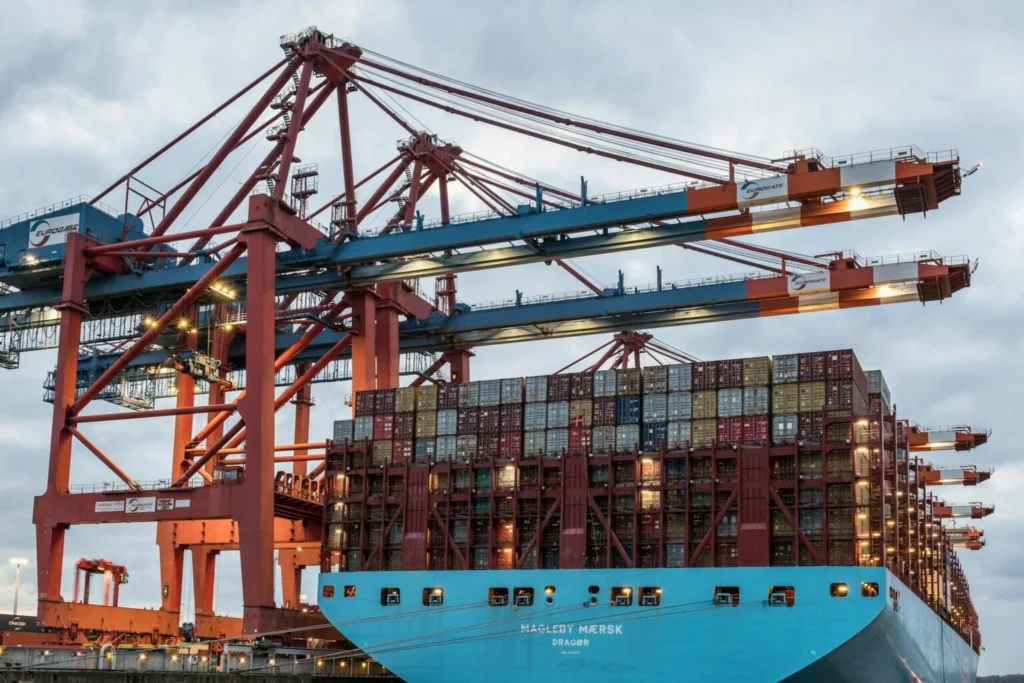
In conclusion, freight forwarding plays a pivotal role in global trade by acting as an intermediary between shippers and transportation services. By coordinating and managing the complex logistics of moving goods from one location to another, freight forwarders streamline the shipping process, ensuring that cargo is delivered efficiently and in compliance with regulatory requirements.
Their expertise in documentation, customs clearance, and route optimization not only simplifies shipping for businesses but also minimizes costs and risks associated with international trade. Ultimately, understanding how freight forwarding works is essential for businesses aiming to navigate the complexities of global logistics successfully.
Related: What Is A Freight Broker & How Do They Work In 2025?

Switzerland plays a vital role in U.S. trade, supplying a wide range of high-value and specialized products. From pharmaceuticals and
In 2026, the US-Europe trade relationship continues to power global commerce, driven by exports of energy, advanced machinery, and pharmaceuticals
The economic partnership between the United States and Norway is a sophisticated and evolving pillar of transatlantic commerce. U.S. exports