
What Does Norway Export To The US? Key Products & Trade Data
Cold Nordic waters, advanced engineering, and a strong maritime economy make Norway a powerful exporter despite its size. Many of


Cold Nordic waters, advanced engineering, and a strong maritime economy make Norway a powerful exporter despite its size. Many of its products travel thousands of miles to reach American industries and consumers. Understanding what Norway exports to the US reveals the key goods that drive this long standing trade connection.
This blog takes a closer look at Norway’s major exports to the United States, from seafood and petroleum products to machinery and high value industrial goods. It also explores trade statistics, export trends, and the U.S. ports that receive these shipments.
As these goods move through international supply chains, meeting U.S. customs requirements becomes essential. Artemus helps businesses handle ISF, AMS, and AES filings, supporting efficient and compliant shipments from Norway to the United States.
Table Of Contents
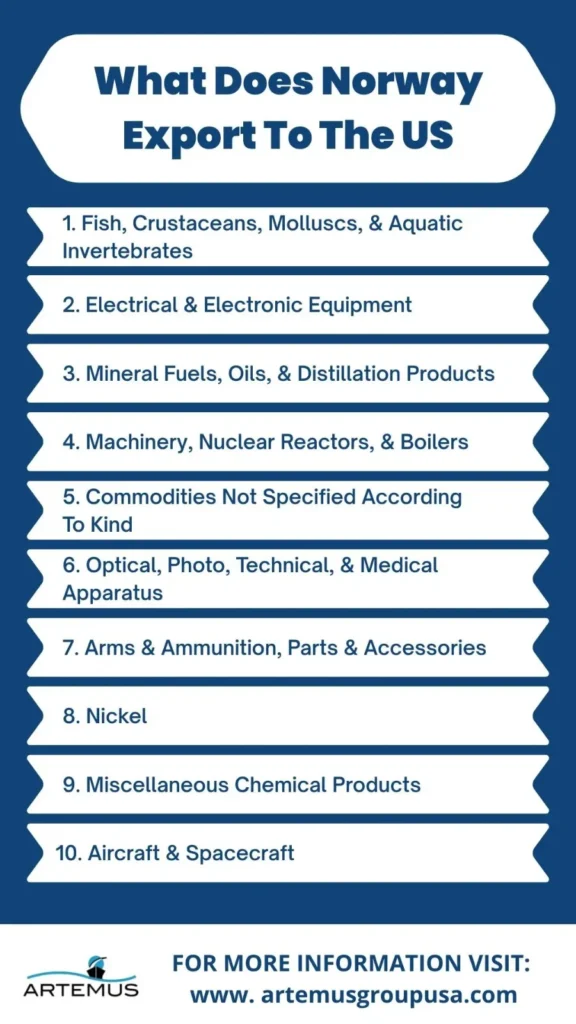
Norway exported about $6.77 billion worth of goods to the United States in 2025, reflecting a strong and diverse trade relationship.
Below are the key products Norway exports to the United States in 2025:
Seafood is Norway’s largest export category to the U.S., valued at $1.50 billion in 2025. Norwegian seafood, especially Atlantic salmon, cod, and shellfish, is widely consumed in the United States. The country’s advanced aquaculture industry and strict quality standards help maintain a reliable supply of premium seafood products for U.S. markets.
Exports of electrical and electronic equipment reached $1.15 billion in 2025. These products include industrial electronics, subsea technology, communication systems, and marine navigation equipment. Many U.S. industries rely on Norwegian technology for offshore energy operations and maritime infrastructure.
Norway exported $990.86 million in mineral fuels, oils, and distillation products to the United States in 2025. These exports mainly consist of refined petroleum products and energy-related materials used in industrial processing and energy production.
Industrial machinery exports totaled $575.17 million in 2025. Norway supplies specialized equipment used in offshore drilling, renewable energy projects, marine engineering, and heavy industrial operations. These machines are often designed for demanding offshore environments.
This category accounted for $505.80 million in exports in 2025. It includes goods that are not individually classified in standard trade categories, often due to confidentiality or mixed shipments containing multiple product types.
Norway exported $366.84 million worth of optical and medical equipment to the U.S. in 2025. These products include diagnostic medical devices, precision measurement instruments, optical tools, and advanced sensors used in healthcare, scientific research, and industrial monitoring.
Defense-related exports from Norway to the United States reached $278.29 million in 2025. This category includes ammunition components, weapon parts, and specialized defense equipment, reflecting ongoing defense cooperation between the two countries.
Nickel exports were valued at $172.59 million in 2025. Nickel is a key industrial metal used in stainless steel manufacturing, battery production, electronics, and aerospace applications, making it an important raw material for U.S. manufacturing sectors.
Norway exported $155.57 million in miscellaneous chemical products to the United States in 2025. These exports include specialty chemicals, industrial compounds, and materials used in manufacturing, pharmaceuticals, and environmental technologies.
Exports of aircraft and spacecraft components totaled $140.58 million in 2025. Norwegian companies supply precision aviation parts and aerospace materials that support global aircraft manufacturing and aviation technology industries.
Related: What Does The US Export To Norway? A Data-Driven Overview

Norway’s biggest export to the United States is refined petroleum products. According to data from the Observatory of Economic Complexity (OEC), Norway exported approximately $1.03 billion worth of refined petroleum products to the U.S. in 2024, making it the country’s top export to the American market.
Refined petroleum products include processed fuels such as diesel, gasoline, and other petroleum-based energy products used across transportation and industrial sectors.
After refined petroleum products, other major Norwegian exports to the United States include fish fillets valued at about $966 million and crude petroleum worth around $227 million.
Related: What Is Export Declaration? A Complete Overview
Trade between the United States and Norway remains steady across both goods and services. In 2024, total U.S. goods and services trade with Norway reached approximately $16.8 billion, marking a 3.7 percent increase ($596.4 million) compared to 2023.
U.S. goods trade with Norway totaled about $11.2 billion in 2025. Out of this:
As a result, the U.S. recorded a goods trade deficit with Norway of $2.1 billion in 2025, which represents a 1.2 percent increase ($25.4 million) compared to 2024.
Services trade also plays an important role in the economic relationship. In 2024, total U.S. services trade with Norway reached $5.6 billion.
The U.S. services trade surplus with Norway was $64 million in 2024, although this represented a 74.5 percent decline ($187 million) compared to the previous year.
Related: What Does Switzerland Export To The US? A Detailed Guide

In January 2026, several Norwegian products recorded notable year-on-year export declines to the United States, mainly in the energy and seafood sectors.
The largest decrease was in petroleum, petroleum products, and related materials, where exports fell by NOK 2.21 billion, a 92.6 percent decline compared to the same month the previous year. This sharp drop significantly impacted Norway’s overall exports to the U.S. during the period.
Exports of fish (excluding marine mammals), crustaceans, molluscs, and other aquatic invertebrates and related preparations also declined. Shipments in this category dropped by NOK 543 million, representing a 37.5 percent decrease year over year.
Another category that saw a reduction was miscellaneous manufactured articles, which fell by NOK 230 million or 66 percent compared to January of the previous year.
Related: What Does Vietnam Export To The US? Key Products & Insights
Norwegian exports to the United States typically arrive through several major U.S. ports that handle international cargo from Europe. These ports serve as key gateways for distributing Norwegian goods such as seafood, machinery, energy-related products, and industrial materials across the United States.
The Port of New York and New Jersey is one of the main entry points for Norwegian goods on the U.S. East Coast. Its large container terminals and strong inland transportation links make it an important hub for receiving and distributing imports from Northern Europe, including Norway.
The Port of Philadelphia plays an important role in handling imports arriving from the North Atlantic region. Its location on the U.S. East Coast allows efficient distribution of Norwegian goods to markets in the northeastern and mid-Atlantic states.
The Port of Houston is a major Gulf Coast gateway for international cargo. It supports trade flows between Norway and the United States by receiving shipments connected to industrial and energy-related supply chains.
The Ports of Los Angeles and Long Beach are the largest container ports in the United States and serve as key gateways for goods entering the West Coast. Norwegian exports destined for western U.S. markets often pass through these ports before being distributed inland.
The Port of Savannah is one of the fastest-growing container ports in the United States. Its modern facilities and strong logistics network make it an efficient entry point for Norwegian imports heading to businesses and consumers in the southeastern U.S.
Related: Top 10 Ports In The USA: The Busiest Hubs Driving US Trade

Norwegian exports such as seafood, machinery, and energy products shipped to the United States must comply with strict U.S. Customs filing requirements. Artemus Transportation Solutions helps exporters and logistics partners handle these requirements through its ISF, AMS, and AES compliance solutions.
The Automated Export System (AES) Filing system ensures accurate and timely submission of Electronic Export Information (EEI), helping exporters avoid delays, reduce filing errors, and stay compliant with U.S. regulations. The automated platform speeds up export processing while providing real time tracking and expert guidance.
For inbound cargo, Importer Security Filing (ISF 10+2) web software enables importers, freight forwarders, and carriers to submit accurate security filings to U.S. Customs and Border Protection. The platform offers global access, real time updates, and data accuracy to help prevent costly penalties.
Artemusalso provides Automated Manifest System (AMS) web software that simplifies the submission of advance cargo information to CBP. With automated workflows, EDI capabilities, and easy system access, it helps streamline shipment reporting for goods exported from Norway to the United States.
Related: AMS Filing Penalty Cost: Most Common Pitfalls & Solutions

The United States accounts for about 3–5% of Norway’s total exports, making it one of Norway’s important trading partners outside Europe.
Yes, Norway exports crude oil and refined petroleum products to the United States, although most Norwegian oil exports are primarily shipped to European markets.
Norway’s export economy is mainly driven by energy (oil and gas), seafood, maritime technology, industrial machinery, and metals.
In 2025, the United States recorded a goods trade deficit of about $2.1 billion with Norway, meaning the U.S. imported more goods from Norway than it exported.
Norway exports a wide range of products to the United States, led by seafood, electrical equipment, energy products, and industrial machinery. In 2025, these exports reflected Norway’s strengths in natural resources, advanced manufacturing, and maritime industries.
Trade between the two countries continues to remain steady, supported by strong logistics networks and major U.S. ports that facilitate cargo movement. As Norwegian goods enter the U.S. market, compliance with customs regulations such as ISF, AMS, and AES filings becomes essential for smooth shipment processing.
Understanding these export trends and compliance requirements helps businesses manage cross-border trade efficiently while maintaining reliable supply chains between Norway and the United States.
Related: AMS Fee In Shipping: Overview & 5 Key Considerations

Cold Nordic waters, advanced engineering, and a strong maritime economy make Norway a powerful exporter despite its size. Many of

Trade between the United States and Canada is one of the largest bilateral trading relationships in the world. Understanding what

Switzerland plays a vital role in U.S. trade, supplying a wide range of high-value and specialized products. From pharmaceuticals and