What Does Switzerland Export To The US? A Detailed Guide
Switzerland plays a vital role in U.S. trade, supplying a wide range of high-value and specialized products. From pharmaceuticals and


The economic partnership between the United States and Norway is a sophisticated and evolving pillar of transatlantic commerce. U.S. exports to Norway are primarily driven by high-value capital goods, machinery, energy-related products, and advanced technology.
Total goods exports reached approximately $4.6 billion, complemented by significant services trade, making Norway a strategically important market for U.S. exporters.
For logistics professionals and exporters, staying updated on “what the U.S. exports to Norway” is essential for navigating a market defined by high-tech industrial needs, energy sector collaboration, and the growing role of digital and automated trade processes.
Solutions like Artemus industry-leading Automated Manifest System (AMS) and ISF compliance software ensure your exports to Norway and beyond clear customs without friction.
Let’s take a closer look at what the United States exports to Norway, why this market is unique, and the trends shaping this trade in 2026.
Table Of Contents
In 2024, the United States exported approximately $4.55 billion worth of goods to Norway.
These exports represent a wide range of industrial, technological, and specialty products reflecting both longstanding trade ties and Norway’s demand for high-value U.S. manufactured goods.
While total export value dipped compared with previous years, the composition of U.S. exports remained diversified across machinery, energy-related products, aerospace, electronics, and chemicals.
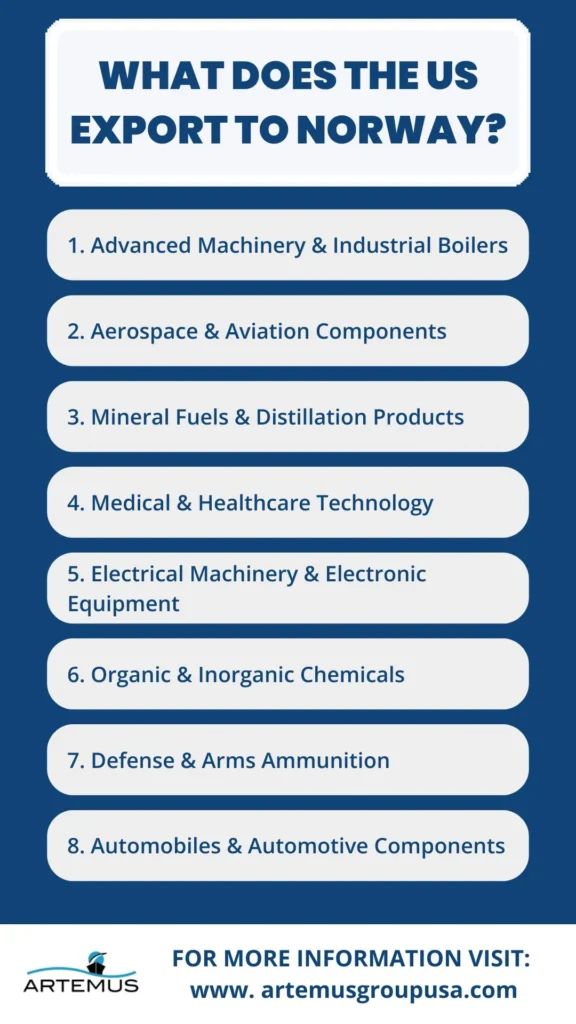
U.S. machinery remains the largest export category, valued at approximately $940 million. This includes high-performance pumps, liquid elevators, and specialized boilers used in Norway’s expanding onshore industrial facilities. As Norway automates its manufacturing sector, the demand for American-made smart machinery continues to climb.
With a valuation of roughly $685 million, aircraft and spacecraft parts are vital. Norway’s defense modernization and its fleet of Boeing P-8A Poseidon aircraft for maritime surveillance create a constant demand for U.S.-sourced maintenance components and avionics.
Despite Norway being a major energy producer, it imports specific U.S. refined oils and distillation products ($810 million+) for specialized industrial applications. These refined products are essential for the Norwegian chemical industry, which requires high-purity inputs not always available from North Sea crude.
Norway is a world leader in healthcare spending per capita. U.S. exports of medical apparatus and diagnostic equipment (approx. $340 million) are crucial. In 2026, American AI-driven diagnostic tools and surgical robotics will become standard in Norwegian regional hospitals.
This sector (valued at $460 million) covers everything from telecommunications hardware to integrated circuits. As Norway rolls out nationwide 6G testing and strengthens its data center infrastructure, U.S. tech firms provide the backbone of the hardware.
American chemical exports ($410 million+ combined) support Norway’s pharmaceutical and light metals industries. Specifically, isotopes and precious metal compounds from the U.S. are essential for Norway’s burgeoning cancer research and biotech hubs.
Given the current geopolitical climate in the Arctic, Norway has increased its intake of U.S. defense systems. Exports of arms and ammunition parts (exceeding $85 million) are part of a broader NATO-driven security framework aimed at protecting subsea infrastructure and Arctic territory.
U.S. exports of automobiles and automotive parts (estimated at $150–$200 million) support Norway’s high-tech vehicle market, including electric and hybrid vehicles. American-made engines, sensors, and EV components complement Norway’s focus on sustainable transportation and advanced mobility solutions.
Related: What Does The US Export To Brazil? 2026 Overview

Norway is a compelling and strategic market for U.S. exporters due to its wealth, economic stability, demand for advanced goods and services, and strategic positioning in Europe and the Arctic region.
As a highly developed economy with strong purchasing power, Norway offers U.S. companies a reliable and well‑regulated environment to grow exports and build deeper commercial ties.
Norway has one of the highest standards of living globally, underpinned by sustained prosperity from natural resources and disciplined fiscal management.
The Norwegian economy benefits from robust consumer demand for high‑quality and technologically advanced products across sectors such as machinery, medical devices, technology solutions, and industrial equipment. U.S. goods exports to Norway were estimated at around $4.6 billion in 2024, reflecting a significant commercial relationship.
Norway is home to the Government Pension Fund Global (GPFG), the world’s largest sovereign wealth fund with assets exceeding US $2 trillion. The fund’s global investment exposure, including substantial holdings in U.S. assets, underscores Norway’s deep financial ties to the U.S. economy and its capacity to support long‑term import demand for high‑value goods.
Although Norway is not an EU member, it participates in the European Economic Area (EEA), giving U.S. exporters a market that aligns closely with EU regulatory standards.
This makes Norway an effective entry point for U.S. businesses aiming to scale into the broader European market, as products compatible with EEA rules often face fewer barriers when entering other EU markets.
Norway occupies a strategic position in Northern Europe and the Arctic. As a key NATO ally with heightened focus on Arctic security, Norway’s demand for advanced defense systems, surveillance technologies, and dual‑use solutions has grown as geopolitical emphasis on the High North intensifies. This creates opportunities for U.S. exporters in defense, aerospace, and security sectors.
Norway is at the forefront of the global energy transition, with a high share of renewable electricity and ambitious clean technology investments. Sectors such as offshore wind, hydrogen technologies, carbon capture systems, and environmental solutions are priority areas where U.S. companies can compete and collaborate.
Trade between the U.S. and Norway is substantial and multifaceted, covering goods and services. While direct exports account for a portion of Norway’s trade, sectors such as technology, industrial equipment, and specialized manufactured goods offer ongoing demand for U.S. suppliers.
Related: What Does Japan Export To The US? A Complete Guide
U.S.–Norway trade continues to rely on industrial machinery, aerospace components, and electrical equipment, while services exports such as IT, consulting, and digital solutions are growing steadily.
Emerging opportunities exist in advanced technology, clean-energy solutions, and specialized industrial services, reflecting Norway’s focus on innovation, sustainability, and modernization, though hardware exports remain a significant share of trade.
Related: Exporting From Australia To USA: A Complete Guide

Navigating U.S.–Norway trade requires understanding key regulations, compliance requirements, and documentation standards. Here’s a clear guide to ensure smooth and lawful cross-border transactions.
Exports from the U.S. to Norway must comply with the Export Administration Regulations (EAR), overseen by the Bureau of Industry and Security (BIS). Items on the Commerce Control List (CCL) may require licenses, and exporters must screen against restricted parties lists to ensure compliance, especially for dual-use technologies or defense-related goods.
Norway is generally not under U.S. sanctions, but U.S. rules still require screening for sanctioned entities or end-users. OFAC regulations and other restrictions apply if Norwegian businesses engage with sanctioned third countries or products.
Norway requires certificates for regulated goods, including animal, plant, and seafood products. Health certificates, phytosanitary documents, and catch certificates ensure compliance with Norwegian and EEA rules, particularly for food, medicine, and restricted items.
Accurate documentation is essential for customs clearance. U.S. exporters must provide commercial invoices, packing lists, and licenses, while Norwegian authorities require proof of origin, customs declarations, and sometimes EORI registration for smooth entry.
Tariffs vary by product: industrial goods usually attract low duties, while agricultural or food products face higher rates. Both countries rely on HS codes for classification, and correct duty assessment is critical to avoid fines or shipment delays.
Products entering Norway must comply with EEA/EU technical standards, including safety, environmental, and consumer protection regulations. Electrical, mechanical, and environmental compliance may require testing or certification before market entry.
Businesses should maintain accurate classification, secure proper licenses, screen partners, and keep documentation complete. Partnering with local Norwegian experts and monitoring regulatory updates ensures smoother trade and mitigates risks of delays or penalties.
Related: What Is The Purpose Of Tariffs? Key Insights To Know
Exporting from the U.S. to Norway offers great opportunities, but businesses often face challenges ranging from tariffs and regulatory differences to logistics and currency fluctuations. Understanding these hurdles is key to smooth and successful trade.
1. Tariff Uncertainty & Market Access Risks – Recent U.S. tariff changes and “reciprocal” levies on Norwegian products have created market access unpredictability, forcing exporters to constantly adapt pricing and cost structures. This uncertainty can dampen demand and complicate long‑term planning.
2. Competitive Pressures From Third Markets – Higher tariffs and shifting costs make U.S. markets less competitive for exporters compared with countries facing lower duties, leading some Norwegian export sectors, like seafood, to lose ground to markets such as Poland, the Netherlands, and China.
3. Complex Tariff Classification & Compliance – Exporters often struggle with detailed tariff classification and ever‑changing duty regimes, which can increase administrative burdens and the risk of costly errors or delays at customs.
4. Regulatory And Standards Misalignment – Differences in regulatory standards between the U.S. and the EEA/EEA‑aligned Norwegian system can require duplicate testing, certification, or product adjustments, adding cost and time to market entry.
5. Logistics & Documentation Challenges – The requirements for export documentation, such as certificates of origin, export declarations, and health or phytosanitary permits (particularly for food products), continue to be intricate and must be meticulously aligned to prevent delays in clearance or potential rejections.
6. Currency & Price Volatility – Fluctuations in exchange rates, including a depreciated U.S. dollar, can erode exporter margins or make U.S. exports more expensive in Norway, reducing competitive pricing and contractual certainty.
Related: Export Documentation Requirements To Export From The USA

The U.S.–Norway trade relationship is expected to continue evolving, shifting gradually from traditional goods toward high-value services, advanced technology, and energy transition solutions.
While aerospace, machinery, and industrial equipment will remain important, emerging sectors like digital services, climate-tech, and defense offer promising growth opportunities for U.S. exporters.
Norway is expanding its focus on renewable energy, including offshore wind and subsea infrastructure. U.S. companies with expertise in floating wind platforms, subsea cables, and turbine maintenance solutions could play a significant role in Norway’s clean-energy transition, leveraging experience from offshore energy projects globally.
As Norway explores green hydrogen and other low-carbon energy solutions, demand for components such as electrolysis equipment and hydrogen storage technology is expected to rise. U.S. exporters of climate-tech and energy-transition solutions can capitalize on Norway’s initiatives to decarbonize industry and energy systems.
Norwegian businesses are increasingly adopting AI, machine learning, and software-as-a-service (SaaS) solutions to optimize operations and energy grids. U.S. digital service providers are well-positioned to benefit from this trend as services exports grow faster than traditional goods.
Geopolitical tensions in the Arctic are driving Norway to modernize its defense and surveillance infrastructure. U.S. exports in areas like unmanned aerial systems, satellite communications, and subsea monitoring technologies are expected to see steady demand.
Demand for high-tech industrial equipment, machinery, and components remains robust. U.S. exporters of specialized machinery and advanced manufacturing solutions can continue to meet Norway’s industrial modernization needs.
The trend toward services, including consulting, engineering, IT, and financial services, is likely to accelerate, with U.S. expertise complementing Norway’s knowledge-intensive economy. Services exports may surpass goods in growth rate, reflecting evolving trade dynamics.
While exact numeric forecasts are uncertain, the overarching trend is clear: diversification toward services, high-tech goods, and energy transition sectors will define the next phase of U.S.–Norway trade. Exporters that align with Norway’s sustainability, digitalization, and security priorities will find the greatest opportunities.
Related: Which Party Issues The Export Declaration Document?
Artemus helps exporters and importers simplify regulatory compliance through smart, web-based solutions aligned with the U.S. CBP. The Artemus Automated Export System (AES) tool enables fast, accurate EEI filings, reduces errors in HS codes, and protects your export privileges through timely submissions.
For ocean imports, Artemus ensures compliant ISF 10+2 filings well before vessel departure, helping you avoid costly penalties and improving data coordination with Norwegian partners. Artemus AMS solution supports seamless cargo reporting with full EDI capability, improving manifest accuracy and reducing port delays.
Related: The Products Can’t Be Exported From USA: Must-Know Rules
The primary exports include industrial machinery, aerospace components, refined petroleum products, and medical instruments. Increasingly, high-tech exports related to AI infrastructure and renewable energy systems are seeing significant growth.
Digitoll is Norway’s mandatory digital customs reporting initiative. As of February 1, 2026, all goods entering Norway must be reported digitally before arrival. By September 1, 2026, manual paper declarations will be fully phased out, requiring exporters to use advanced customs broker software for compliance.
Yes. Most goods are subject to a standard 25% Value Added Tax (VAT), known as MVA. For e-commerce items under 3,000 NOK, the VOEC (VAT On E-Commerce) scheme allows for simplified tax collection at the point of sale, though this excludes restricted items like food and alcohol.
Many electronic items, such as smartphones and laptops, are typically duty-free. However, textiles and clothing often carry duties (up to 10.7%). You can use a HSN code finder to verify the specific duty rates for your commodities.
To ensure transparency and manage recipient expectations, exporters should use real-time shipment tracking. This is especially critical given Norway’s strict new pre-border digital clearance requirements.
Under the new Digitoll regulations, non-compliance or incorrect data can result in significant delays at the border and fines of up to 50% of the goods’ value. Utilizing a reliable Automated Manifest System (AMS) or Importer Security Filing (ISF) helps mitigate these risks.
The U.S. has maintained a modest trade surplus with Norway, primarily driven by exports of machinery, aerospace products, and services exceeding Norwegian imports of U.S. goods.
Norway is a key strategic partner for the U.S., offering strong trade ties, energy collaboration, defense cooperation, and access to advanced technology and sustainable energy markets.
The United States exports a diverse range of goods and services to Norway, from industrial machinery and aerospace components to high-value services and digital solutions. As Norway’s economy continues to innovate in energy, technology, and defense, U.S. exporters are well-positioned to meet evolving demand, making this trade relationship both dynamic and strategically important.
Related: Top 10 Exports Of USA In 2024: Leading Export Categories

Switzerland plays a vital role in U.S. trade, supplying a wide range of high-value and specialized products. From pharmaceuticals and
In 2026, the US-Europe trade relationship continues to power global commerce, driven by exports of energy, advanced machinery, and pharmaceuticals
The economic partnership between the United States and Norway is a sophisticated and evolving pillar of transatlantic commerce. U.S. exports