What Does Switzerland Export To The US? A Detailed Guide
Switzerland plays a vital role in U.S. trade, supplying a wide range of high-value and specialized products. From pharmaceuticals and


In the dynamic world of international trade and shipping logistics, few documents hold as much significance as the Bill of Lading (BOL). Acting as a crucial cornerstone in the supply chain process, the BOL serves as both a receipt and a contract, documenting the journey of goods from the point of origin to the final destination.
But navigating the complexities of BOL compliance can often be daunting for businesses, which is where Artemus steps in. Artemus offers cutting-edge software solutions tailored for Importer Security Filing (ISF) and Automated Manifest System (AMS) requirements, ensuring seamless and successful compliance with regulatory mandates.
In this blog post, we’ll delve into the essential functions of the Bill of Lading and explore how Artemus’s ISF and AMS software solutions empower businesses to navigate international trade regulations with ease and efficiency.
Table Of Contents
A Bill of Lading (BOL) is a legally binding document issued by a carrier to a shipper, confirming the receipt of goods for transport. It acts as a shipment receipt, a contract of carriage, and, in many cases, a document of title that can be used to transfer ownership of the goods.
The Bill of Lading includes essential shipment details such as the type, quantity, packaging, origin, and destination of the goods. It also outlines the terms and conditions of carriage, establishing the carrier’s responsibility to deliver the shipment in the condition and to the destination agreed upon.
There are two primary types of Bills of Lading:
Today, electronic Bills of Lading (eBOLs) are gaining traction globally as part of the shipping industry’s digital transformation. Backed by organizations like the International Chamber of Commerce (ICC) and recognized under laws such as the U.S. Uniform Commercial Code (UCC) Article 7 and the UNCITRAL Model Law on Electronic Transferable Records (MLETR), eBOLs offer greater efficiency, security, and traceability compared to traditional paper documents.
In short, the Bill of Lading remains a cornerstone of international trade, ensuring transparency, legal protection, and smooth logistics operations from the point of origin to final delivery.
Related: How To Start A Freight Forwarding Business? 10 Easy Steps
A Bill of Lading (BOL) contains several essential components that define the shipment, the parties involved, and the terms governing the transportation of goods. Each element plays a vital role in ensuring transparency, traceability, and legal validity throughout the logistics process.
Every BOL carries a unique reference number used for tracking, record-keeping, and communication among the shipper, carrier, and consignee.
Lists the full name, address, and contact details of the shipper or exporter , the party responsible for dispatching the goods.
Identifies the recipient or buyer of the goods, including their full contact details, to ensure accurate delivery and customs clearance.
Specifies a third party (such as a freight forwarder, customs broker, or agent) to be informed upon the cargo’s arrival. This is especially relevant when the consignee differs from the party managing the import.
Identifies the carrier responsible for transporting the shipment, including the vessel name and voyage number (for ocean freight), or carrier SCAC code (for U.S. imports).
One of the most detailed sections of the BOL, this includes the type of goods, quantity, weight, number of packages, marks and numbers, packaging type, and any special handling instructions or hazardous material declarations.
Indicates where the goods are loaded onto and unloaded from the vessel or aircraft. These details are critical for routing and customs documentation.
Shows the shipment’s full route , from the point where the carrier takes custody of the goods (place of receipt) to the final destination or delivery point.
States whether freight is prepaid (by the shipper) or collect (payable by the consignee) and may list additional charges, surcharges, or accessorial fees.
Outlines the legal obligations and rights of all parties, referencing relevant international conventions (e.g., Hague-Visby Rules, Hamburg Rules) and trade terms such as Incoterms® 2020.
The BOL must be signed by the carrier or its authorized agent and often by the shipper. The date of issuance confirms when the goods were received and when the contract of carriage took effect. (The consignee typically does not sign.)
Specifies the document type, Original, Seaway Bill (non-negotiable), or Express Release , which determines how ownership is transferred and how cargo is released at the destination.
Related: ISF Form (Import Security Filling): Elements & Top Practices
A Bill of Lading (BOL) acts as the key document connecting the shipper, carrier, and consignee in international shipping. It’s issued by the carrier once the goods are received for transport, confirming shipment details and outlining the terms of carriage. From that point, it serves as proof that the carrier has taken custody of the cargo and is responsible for its safe delivery.
The process starts when the shipper hands the goods to the carrier, who then issues the BOL in paper or electronic form (eBOL). The document travels with the shipment and is used by customs officials, freight forwarders, and banks for clearance, financing, and insurance purposes.
At the destination, the consignee presents the original or authorized copy of the Bill of Lading to claim the goods. For negotiable BOLs, ownership can be transferred through endorsement, while non-negotiable or express BOLs are released directly to the named consignee.
Today, electronic Bills of Lading are becoming the industry standard, supported by frameworks like the UNCITRAL Model Law on Electronic Transferable Records (MLETR) and DCSA-approved platforms. eBOLs streamline documentation, reduce fraud risk, and make global trade faster and more efficient.
Related: ISF Declaration: Meaning, Purpose, Timeline, & Process
Authenticating a Bill of Lading (BOL) helps prevent fraud, confirm shipment accuracy, and ensure the document’s legal validity. Follow these steps to verify a BOL effectively:
Related: ISF Filing: A Compliance-Related Guide & Software Solution
In global trade, the Bill of Lading (BOL) is typically issued by the carrier or shipping line handling the goods. This entity oversees the physical transportation, issuing the BOL upon receipt of the cargo. It serves as a formal acknowledgment of receipt and outlines the terms of transportation. Occasionally, freight forwarders or intermediaries may also issue the BOL.
Regardless of the issuer, the BOL remains integral to international trade, facilitating the smooth movement of goods across borders.
Related: What Is Ocean Freight Forwarding & Its Process?
The Bill of Lading (BOL) fee is usually included in the shipping or freight charges and is generally paid by the shipper for prepaid shipments, covering transport and documentation costs. In collect shipments, the consignee may be responsible for paying the BOL and freight charges upon delivery.
Electronic Bills of Lading (eBOLs) streamline the process and reduce administrative costs but do not change who pays. Ultimately, the responsibility for BOL fees depends on the agreed Incoterms or sales contract between the shipper and consignee.
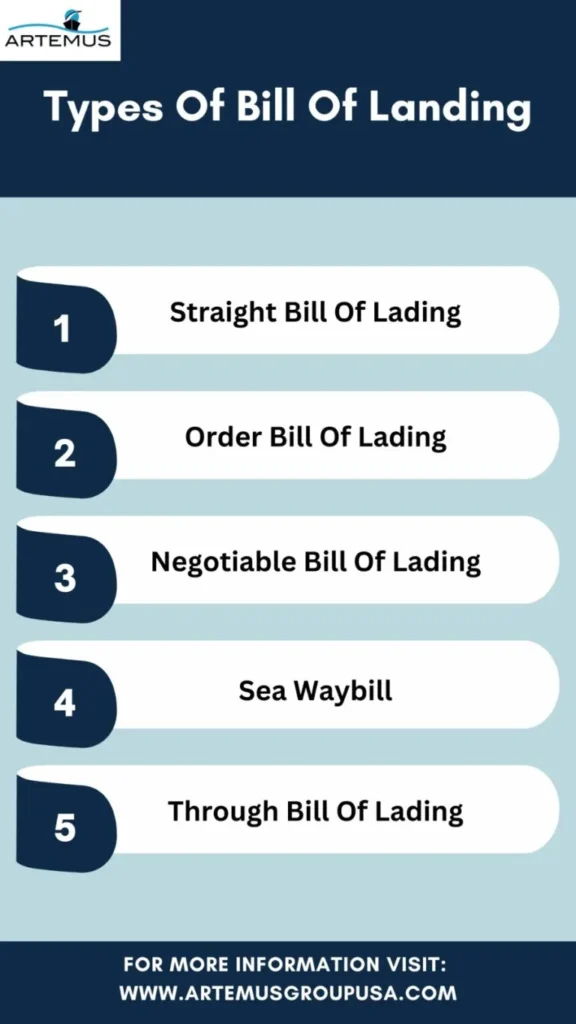
The Bill of Lading (BOL) comes in various types, each designed to meet specific needs and requirements in the realm of international trade and shipping. Here are some common types of Bills of Lading:
1. Straight Bill of Lading: Also known as a non-negotiable or consigned Bill of Lading, this type is issued to a specific consignee and is not negotiable. It means that the goods are to be delivered only to the named consignee and cannot be transferred to another party without the shipper’s consent.
Straight Bills of Lading are typically used in transactions where payment has been made in advance or where there is no need for the goods to be transferred to another party.
2. Order Bill of Lading: Unlike a straight Bill of Lading, an Order Bill of Lading is negotiable, meaning that it can be transferred to another party through endorsement. The consignee named on the Bill of Lading can transfer the title of the goods to another party by endorsing the document.
This type of BOL provides greater flexibility and convenience, allowing for easier transfer of ownership during transit. It’s commonly used in transactions involving letters of credit or where goods are sold on credit terms.
3. Negotiable Bill of Lading: This type of BOL is similar to an Order Bill of Lading in that it is negotiable and can be transferred to another party. However, unlike an Order Bill of Lading, a Negotiable Bill of Lading does not require endorsement for transfer of title.
Instead, the document itself serves as the title to the goods, and possession of the Bill of Lading is sufficient to claim ownership. Negotiable Bills of Lading are often used in transactions where the goods are intended to be sold or traded multiple times during transit.
4. Sea Waybill: Unlike traditional Bills of Lading, a Sea Waybill is not a negotiable document and does not confer title to the goods. It simply serves as a receipt of goods and evidence of the contract of carriage between the shipper and the carrier.
Sea Waybills are typically used for shipments where there is a high degree of trust between the parties involved, such as repeat customers or established business relationships.
5. Through Bill of Lading: This type of BOL is used for shipments involving multiple modes of transportation, such as sea, rail, and trucking. It covers the entire journey from the point of origin to the final destination and consolidates all transportation contracts into a single document.
Through Bills of Lading simplify the shipping process for shippers and recipients by providing a single point of contact and accountability for the entire shipment.
Related: How To Choose A Freight Forwarder? 10 Critical Aspects
The Bill of Lading (BOL) serves several critical functions in the realm of international trade and shipping, each contributing to the smooth and efficient movement of goods across borders. Here are five key functions of the Bill of Lading:
Related: How To Become A Freight Forwarder: A Stepwise Guide
Navigating international trade requires a solid understanding of the rules and regulations governing the Bill of Lading (BOL), a critical shipping document. Here are the key rules and regulations with the latest updates:
The carrier must ensure the BOL accurately reflects the condition of the cargo upon receipt and delivery, following updated international standards. Recent regulations under SOLAS 2020 (including Verified Gross Mass requirements) and the Rotterdam Rules reinforce carrier accountability for cargo safety, documentation accuracy, and timely delivery.
A BOL must include the shipper’s and consignee’s details, cargo description, shipping terms, and conditions to remain legally valid. Electronic Bills of Lading (eBOLs) are now widely accepted, with secure digital signatures and blockchain-based authentication improving traceability and compliance with international trade laws.
The BOL acts as a document of title, and modern regulations ensure proper endorsement and transfer procedures, especially for negotiable BOLs, reducing ownership disputes in global trade transactions.
Compliance with updated standards such as the IMDG Code 2024, SOLAS Verified Gross Mass, and ISO 9001:2015 guidelines for container transport is mandatory for hazardous or sensitive cargo. These rules enhance safety, prevent fines, and facilitate smooth customs clearance worldwide.
The BOL is governed by international and national laws, including the Hague Rules, Hague-Visby Rules, Hamburg Rules, and the Rotterdam Rules (latest amendments 2022–2025), which cover carrier liability, cargo claims, and dispute resolution. Following these regulations protects all parties involved in shipping and ensures global trade compliance.
Related: OTI License Requirements, Costs, Renewal, & Regulations
In today’s digital era, the Electronic Bill of Lading (e-Bill of Lading) revolutionizes international trade by digitizing essential shipping documentation. Serving as a digital version of the traditional paper-based Bill of Lading (BOL), an e-bill of Lading facilitates the swift exchange of crucial information electronically.
It records goods’ receipts, outlines carriage terms, and acts as a contract between shipper and carrier. Utilizing digital platforms or specialized software, e-Bills of Lading offer benefits like faster processing, reduced paperwork, enhanced security, and improved accessibility.
They seamlessly integrate with other electronic systems, streamlining global trade. However, their adoption requires addressing legal and regulatory considerations to ensure validity and enforceability in transactions.
Related: What Is Global Trade Compliance & Its Key Components
Artemus Transportation Solutions specializes in providing cutting-edge ISF (Importer Security Filing) and AMS (Automated Manifest System) software solutions tailored to ensure successful compliance for businesses engaged in international trade.
The ISF software solution simplifies the filing process for Importer Security Filings, helping businesses comply with U.S. Customs and Border Protection (CBP) regulations. By automating data entry, providing real-time updates, and facilitating communication with customs authorities, Artemus enables importers to meet ISF requirements seamlessly and avoid costly delays or penalties.
Additionally, Artemus offers AMS software solutions designed to streamline the submission of advance cargo information required by CBP through the Automated Manifest System. By integrating with existing transportation management systems, their AMS software ensures accurate and timely transmission of manifest data, facilitating smoother cargo clearance and reducing the risk of regulatory violations.
Related: 10 International Shipping Documents To Must Have In 2025
The Bill of Lading (BOL) is a document that serves as both a receipt and a contract for the shipment of goods, documenting their journey from the point of origin to the final destination.
The bill of lading is typically paid by the party responsible for arranging the shipment, which is often the shipper or exporter.
The four functions of the bill of lading are receipt, contract, title, and document of transfer.
The shipper is primarily responsible for filling out the Bill of Lading, providing accurate details of the goods, shipper and consignee information, and shipping terms. The carrier reviews and may verify the information before issuing the BOL.

The Bill of Lading (BOL) is a vital document in international trade, serving as a receipt, contract, and title for shipped goods. It ensures transparency and legal protection throughout the shipping process, highlighting its essential role in facilitating smooth commerce across borders. Whether in paper or digital form, the BOL remains indispensable, reflecting its enduring significance in the dynamic realm of global trade.

Switzerland plays a vital role in U.S. trade, supplying a wide range of high-value and specialized products. From pharmaceuticals and
In 2026, the US-Europe trade relationship continues to power global commerce, driven by exports of energy, advanced machinery, and pharmaceuticals
The economic partnership between the United States and Norway is a sophisticated and evolving pillar of transatlantic commerce. U.S. exports