What Does The US Export To Switzerland? Trade Insights
International trade between the United States and Switzerland highlights the strong economic relationship between the two nations. With its highly



In the intricate world of international trade, one essential ally stands out, a customs broker. These professionals are your navigators through the labyrinth of customs regulations, trade laws, and import-export complexities. Therefore in this blog, we’ll answer the critical question – How To Find A Customs Broker?
Whether you’re an experienced global trader or just stepping into the realm of international commerce, finding the right customs broker is a critical decision. They ensure your goods move smoothly across borders while staying in compliance with the ever-evolving trade landscape. But how do you go about finding the perfect customs broker to meet your specific needs?
Moreover, Artemus Transportation Solutions offers cutting-edge customs broker software designed to streamline compliance in the world of international trade. So, let’s embark on a journey to find your ideal customs broker and discover how technology can revolutionize your global trade experience.
Table Of Contents
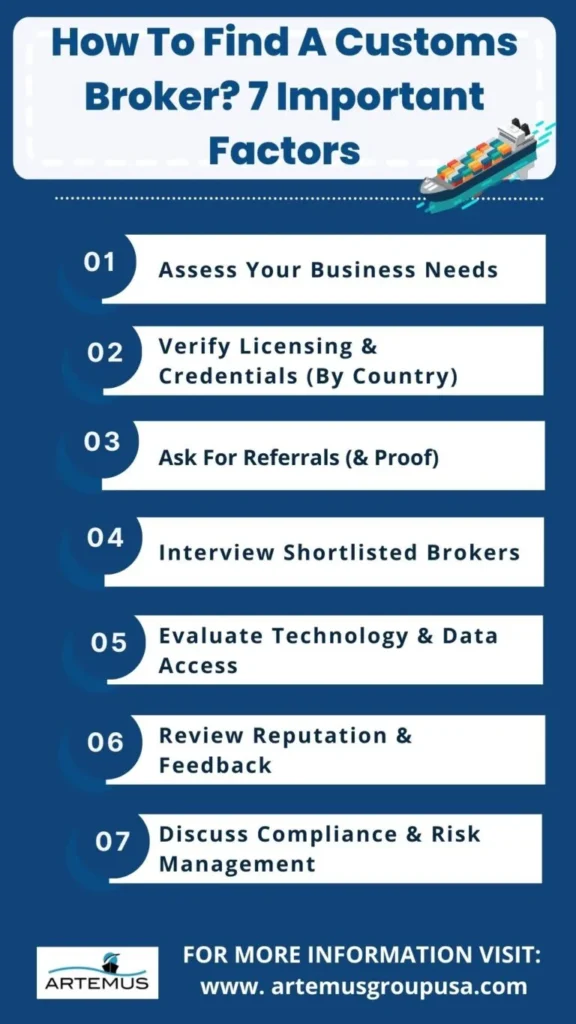
A customs broker plays a critical role in helping your imports and exports clear legally and efficiently. The right partner not only saves you time and money but also minimizes compliance risks. Below are seven key factors to consider:
The first step in selecting a customs broker is to assess your business needs. Every company has a different trade profile, depending on shipment volumes, origins and destinations, modes of transport, Incoterms, and the types of products being imported or exported.
For example, a small e-commerce seller handling occasional imports may require a different level of support than a large manufacturer with complex, regular shipments involving free trade agreements, valuation issues, or licensing requirements. Clearly defining your needs will help you identify a broker with the right expertise for your business.
Once your requirements are clear, ensure the customs broker is properly licensed and accredited. In the United States, brokers must be licensed by CBP under 19 CFR Part 111, and starting with the 2025–2027 triennial period, individual licensed brokers are required to complete 36 hours of Continuing Education every three years to maintain compliance.
In India, brokers must be licensed under CBLR 2018, with exams and licensing handled by NACIN and CBIC, and many also participate in the expanding AEO (Authorised Economic Operator) scheme.
In the United Kingdom, all declarations now go through the Customs Declaration Service (CDS) after CHIEF was fully phased out.
In Canada, customs brokers must be registered to use CARM, the CBSA’s new accounting and payment system, and they should be able to onboard clients into CARM while managing Release Prior to Payment (RPP) security.
Referrals can be one of the most reliable ways to find a customs broker. Ask industry peers or fellow business owners for recommendations and request case studies or examples of how a broker helped resolve compliance issues, reduced duty liability, or improved clearance times.
These first-hand accounts can reveal a broker’s strengths and weaknesses, giving you insight that goes beyond what is advertised.
After narrowing down your list, it is important to interview potential brokers directly. During these discussions, go beyond fees and clarify the scope of services, service-level agreements, and escalation paths. Ensure you have a clear picture of all charges, including line-item fees, disbursements, bonds or guarantees, and potential demurrage or storage costs.
Ask how documentation is handled and clarify who makes final HS classification decisions. A transparent broker who communicates effectively and responds quickly is more likely to be a reliable long-term partner.
Technology plays a key role in modern customs clearance. Brokers with strong IT systems offer client portals where you can view shipment status, duties, taxes, entry documents, and audit trails in real time.
Advanced brokers also provide API or EDI integrations with warehouse or ERP systems, ensuring data flows seamlessly across platforms.
In addition, they should be able to support the national customs platforms currently in use, such as ACE in the U.S., ICEGATE/Faceless Assessment in India, CDS in the UK, and CARM in Canada.
Customer feedback and professional reputation are important markers of quality. Look for reviews, testimonials, and trade association memberships that can provide assurance of credibility.
In the United States, it is worth noting that the CBP Broker License Exam remains extremely challenging, with consistently low pass rates. This emphasizes the importance of working with an experienced, proven broker who has successfully met such high standards.
Finally, it is essential to understand how a broker manages compliance and risk. Reliable brokers will have internal review processes for HS classification and valuation, use advance rulings where appropriate, and conduct post-entry audits to ensure accuracy.
They should have clear procedures for recordkeeping and error management, and be transparent about how they handle prior disclosures or disputes. Importantly, a strong customs broker will also help businesses qualify for and maintain participation in Trusted Trader or Authorised Economic Operator (AEO) programs, which can significantly reduce clearance times, inspections, and costs.
In India, AEO offers three tiers of certification for importers and exporters (T1, T2, T3) plus AEO-LO for logistics operators, each providing escalating benefits. In the EU, businesses can apply for AEOC (customs simplifications), AEOS (security and safety), or a combined authorization. These programs derive from the WCO SAFE Framework and are recognized worldwide for improving supply chain security and efficiency.
Related: What Does A Customs Broker Do? 10 Key Responsibilities
International trade is full of promise, but it also brings layers of complexity, from ever-changing regulations to documentation hurdles. Hiring a customs broker can transform that complexity into clarity and efficiency, particularly for newcomers. Below are the key advantages:
Customs brokers are formally licensed and regulated under Section 641 of the Tariff Act of 1930 (19 U.S.C. 1641) and 19 CFR Part 111, which authorize them to conduct “customs business” on behalf of importers.
This legal framework ensures that brokers are trained to manage classification, valuation, duty calculation, and entry procedures accurately. Their regulatory grounding helps businesses avoid costly mistakes and remain compliant with U.S. law.
Managing customs paperwork in-house is resource intensive. By delegating to a licensed broker, businesses can focus on core growth activities while ensuring that documentation and filing requirements are met. CBP emphasizes that brokers act as a vital link between importers and the government, saving companies both time and manpower.
Because brokers specialize in customs communication and document processing, they can minimize delays and help shipments clear faster. CBP’s modernization initiatives, including streamlined broker oversight and the requirement for direct importer communication, further reinforce their role in making clearance more efficient.
Brokers can identify opportunities to lower landed costs through proper tariff classification, use of free-trade agreements, and duty recovery programs. With compliance rooted in U.S. federal regulation, their guidance helps ensure duties and taxes are correctly applied, protecting importers from overpayments.
Compliance failures can lead to penalties, seizures, or audits. Brokers are required by law to adhere to CBP’s strict professional standards, and the 2022 rule on broker modernization introduced enhanced oversight, including a uniform national permit that ensures consistent compliance practices across the country.
Customs documentation can be overwhelming, from invoices to classification forms. Licensed brokers reduce these risks by handling the paperwork under regulated procedures.
According to CBP, there are currently 14,454 active licensed customs brokers in the United States, reflecting the scale of trusted professionals available to manage documentation securely.
Many brokers specialize in industries such as healthcare, automotive, or textiles. Their sector-specific knowledge enables them to provide tailored guidance that goes beyond documentation, ensuring smooth navigation of regulatory issues unique to each type of cargo.
Brokers maintain established lines of communication with CBP and other government agencies. This allows them to resolve issues quickly and represent importers effectively during inspections, audits, or disputes.
Perhaps the greatest benefit is peace of mind. With a licensed broker handling compliance under a robust federal framework, importers can focus on growth and strategy rather than regulatory concerns.
Businesses can also track U.S. trade and customs activity directly through CBP’s Public Data Portal, which provides open access to trade statistics, import duties, and other datasets.
Recent U.S. trade policy shifts have amplified the need for professional customs support. For example, tariff volatility has driven up demand for brokers, while the removal of the U.S. de minimis exemption for shipments under $800 from China and Hong Kong has led to a surge in formal customs entries.
These changes mean more documentation, higher compliance burdens, and rising broker fees, making their role more critical than ever.
Related: Customs Broker VS Freight Forwarder: 5 Key Differences
A customs broker’s responsibility goes beyond clearing shipments; they are trusted professionals who must follow a strict Code of Ethics to ensure integrity, compliance, and fairness in international trade.
At the heart of this code are honesty, trustworthiness, efficiency, and fair dealings. Brokers are expected to place public service above personal interest, making sure government revenues are protected and regulations are followed. They must avoid unfair competition, deceitful practices, or collusion with clients to commit fraud.
Customs brokers are also required to safeguard the funds, documents, and goods entrusted to them, while maintaining transparency in all transactions. Exploiting a client’s lack of knowledge, soliciting customers from fellow brokers through unethical means, or acting as a “dummy” for unlicensed operators is strictly prohibited.
Professionalism and respect for peers form another pillar of the code. Brokers must comply fully with customs laws, carry out their duties responsibly, and refrain from making statements that unfairly damage the reputation of other brokers.
Above all, every customs broker is guided by the principles of justice, fairness, and truthfulness, ensuring that their work strengthens both client trust and the credibility of the profession.
Related: Customs Broker Exam Registration: In-Person & Remote CBLE

To ensure you make an informed choice, here are some essential questions to ask potential customs brokers during the selection process:
This is a fundamental question. Verify that the customs broker possesses the requisite licenses and certifications for lawful operation.
Ask about their industry experience and how many years they have worked in the field. More experience often means a better understanding of the complexities of customs and trade regulations.
Ask for references from past clients. Speaking with businesses they’ve worked with can offer insights into their performance and reliability.
Determine if the customs broker has experience in your specific industry. Industry-specific knowledge can be a valuable asset.
Customs regulations can change frequently. A good customs broker should have a system in place to stay updated on the latest changes and how they might impact your operations.
Understand their fee structure and any additional costs. Having transparent pricing is crucial for effective budgeting.
Inquire about their approach to managing customs audits. You want a customs broker who can assist in these situations.
In today’s digital age, technology plays a significant role in customs brokerage. Inquire about the software and tools they utilize in their operations.
Understanding their approach to ensuring compliance with customs and trade regulations is crucial for avoiding fines and penalties.
Effective communication is key. Find out how they keep clients informed and address inquiries and concerns.
Ask the customs broker to walk you through the entire process, from handling documentation to customs clearance. This will provide you with a clear comprehension of what you can anticipate.
Delve into their problem-solving abilities. How do they manage unforeseen challenges or unexpected delays?
A reliable broker should provide clear expectations for response times to client queries. Quick responses are crucial to avoid shipment delays and resolve issues efficiently.
Every business has unique needs, so ask how the broker adapts their services to fit your operations. Tailored solutions ensure smoother trade processes and stronger client support.
It’s important to know if the broker has faced legal or compliance issues. Pending lawsuits or violations may signal risks to your business relationship.
Related: Can A Customs Broker Be The Importer Of Record Legally?
Here are five essential tips to help you negotiate with customs brokers successfully:
Before negotiations, clearly define your requirements. Identify the services you need, such as tariff classification, document preparation, or bonded warehousing, and outline the results you expect. Understanding your shipping volume, frequency, and complexity will give you a stronger position in negotiations.
Customs brokers may charge flat fees, per-transaction fees, or add extra charges for document handling, after-hours service, or special requests. Request a detailed breakdown of costs and negotiate for a transparent pricing model. If your shipping volume is consistent, explore flat-rate or bundled packages that can lower expenses.
Strong communication is essential in international trade. Agree on how frequently you’ll receive updates and through which channels (e.g., email, phone, or online portals). Setting clear expectations ensures prompt updates, faster problem resolution, and better overall collaboration.
Avoid confusion by establishing a clear division of labor. Specify what the customs broker will handle, like compliance checks and documentation, and what responsibilities remain with your team. Clear boundaries prevent delays and ensure smooth operations.
Carefully examine the broker’s service agreement. Pay attention to dispute resolution procedures, termination clauses, service levels, and liability limits. Don’t hesitate to negotiate adjustments so the agreement fully aligns with your business needs.
Before finalizing a broker, gather references from their clients to learn about their reliability and negotiation style. Also, compare offers from multiple brokers, not only for pricing but also for service quality and responsiveness.
Related: Customs Broker Exam (CBLE): A Comprehensive 2024 Overview
A customs broker contract is a vital agreement that sets the terms for the relationship between an importer/exporter and their chosen customs broker. It outlines roles, responsibilities, and expectations. Key components include:
Begin the contract by clearly identifying the parties involved, including the importer/exporter and the customs broker. Provide full contact details for easy reference.
Detail the scope of the customs broker’s services. Specify the specific tasks and responsibilities the customs broker will handle, such as customs clearance, documentation, compliance, and communication with relevant authorities.
Define the contract’s start date and duration. Specify whether it is a one-time engagement for a specific shipment or an ongoing, long-term arrangement.
Clearly outline the customs broker’s fee structure, including any fixed fees, transaction-based fees, or other charges. Include terms for billing, payment deadlines, and any applicable late payment penalties.
Specify the methods and frequency of communication between both parties. Effective communication is essential for addressing issues, updates, and concerns in a timely manner.
Address how data and documents will be managed and secured. Ensure that there are safeguards in place to protect sensitive information and maintain confidentiality.
Include provisions that detail the customs broker’s commitment to ensuring compliance with all relevant customs regulations and laws.
Outline the process for resolving disputes or disagreements that may arise during the partnership. This section can include mediation, arbitration, or any other agreed-upon resolution method.
Detail the circumstances in which either party can end the contract. Include notice periods and any related obligations upon termination.
Address the extent of liability and indemnification for each party in the event of losses, damages, or legal actions related to the customs broker’s services.
Related: What Are The Likely Customs Broker Exam Pass Rate For 2024?
Artemus is your gateway to a streamlined and efficient customs brokerage experience. Our high-end customs broker software is meticulously designed to ensure seamless compliance with ever-evolving regulations. With Artemus, you can confidently navigate the complex world of international trade, leveraging cutting-edge technology to stay up-to-date with the latest customs requirements.
The software’s user-friendly interface simplifies the often intricate process, empowering customs brokers and businesses alike to save time and resources while maintaining the highest standards of compliance. Artemus adapts to the changing landscape of international trade, ensuring that your business remains in full compliance while minimizing the risk of costly errors.
Related: Custom Broker Fees Explained: The Figures You Need To Know
If you’re involved in international trade, a customs broker can simplify compliance, expedite customs processes, and help avoid costly mistakes.
Customs clearance charges are fees incurred for processing and managing the import or export of goods through customs.
A customs broker is also known as a customs agent or import/export broker.
Yes, hiring a customs broker is worth it because they handle complex regulations, paperwork, and compliance, saving businesses time and reducing costly errors. They also help speed up customs clearance and minimize risks of fines or shipment delays.
The core values of customs brokers include honesty, trustworthiness, fairness, professionalism, and strict compliance with trade laws. They prioritize public service, client trust, and ethical business practices in all dealings.
Penalties for customs brokers can include fines, license suspension, or permanent revocation if they violate customs laws or engage in fraudulent practices. In serious cases, legal action or criminal charges may also apply, depending on the jurisdiction.

In conclusion, finding the right customs broker is an essential step in ensuring a smooth and compliant international trade experience. By following the tips outlined in this guide, you can simplify your search and narrow down the options to identify the customs broker that best suits your business needs. Remember to consider their expertise, track record, and responsiveness to your specific requirements.
Whether you’re an experienced importer or a newcomer to global trade, a dependable customs broker can serve as a valuable ally in maneuvering the intricacies of customs regulations, ultimately saving you valuable time and resources. So, take your time, do your research, and make an informed decision that sets you up for success in your international business endeavors.

International trade between the United States and Switzerland highlights the strong economic relationship between the two nations. With its highly
Cold Nordic waters, advanced engineering, and a strong maritime economy make Norway a powerful exporter despite its size. Many of
Trade between the United States and Canada is one of the largest bilateral trading relationships in the world. Understanding what
 Optimized by Seraphinite Accelerator