
What Does The US Export To Switzerland? Trade Insights
International trade between the United States and Switzerland highlights the strong economic relationship between the two nations. With its highly



Colombia is a key trading partner of the United States, supplying a diverse range of exports that fuel industries and consumer markets across the country. From oil and coffee to flowers and textiles, Colombia’s export sector plays a crucial role in international trade. Understanding the main exports to the U.S. provides valuable insights into market trends, trade agreements, and economic opportunities.
However, navigating U.S. trade compliance regulations can be complex for exporters. That’s where Artemus Transportation Solutions comes in. With cutting-edge Importer Security Filing (ISF), Automated Manifest System (AMS), and Automated Export System (AES) solutions, Artemus helps businesses simplify compliance, avoid penalties, and streamline their shipping processes.
In this blog, we’ll explore Colombia’s top exports to the USA and how companies can ensure smooth trade operations with the right compliance strategies.
Table Of Contents
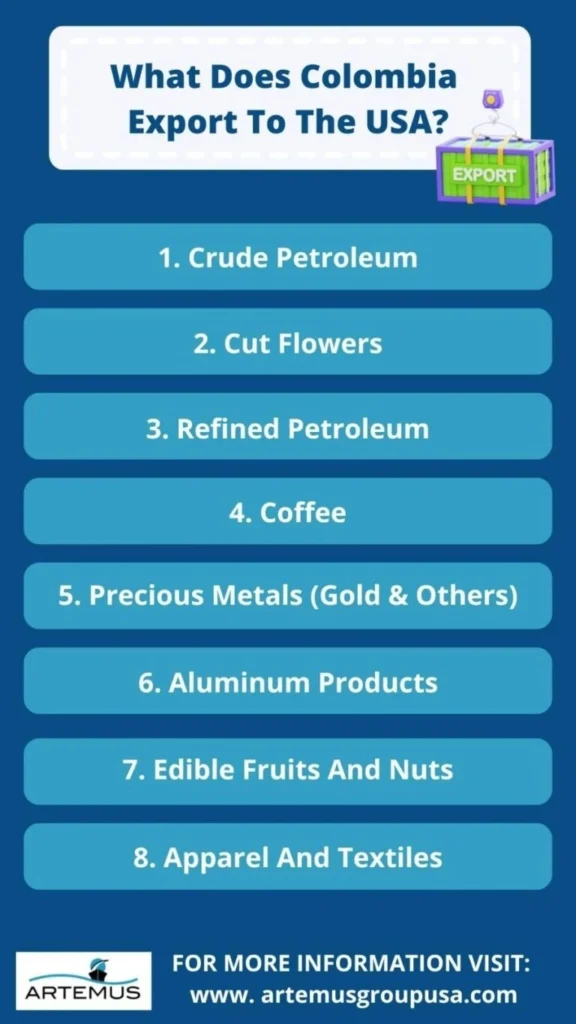
Colombia is a key trade partner of the United States, exporting a variety of natural resources, agricultural products, and manufactured goods. In 2023, Colombia’s exports to the U.S. were valued at approximately $14.8 billion, highlighting its strong economic ties with the U.S.
Below is a detailed breakdown of Colombia’s top exports to the U.S.:
Colombia is one of the top oil-exporting countries in Latin America, and crude petroleum is its largest export to the U.S. In 2023, Colombia exported approximately $4.65 billion worth of crude oil to the United States. The U.S. refines and processes this oil into gasoline, diesel, and other petroleum-based products. Colombia’s oil industry is a significant contributor to its economy, providing employment and government revenue.
The U.S. relies on Colombian oil to diversify its energy sources, reducing dependency on Middle Eastern suppliers. Additionally, Colombia benefits from the U.S.-Colombia Free Trade Agreement (FTA), which allows petroleum exports to enter the U.S. with reduced tariffs.
Colombia is the second-largest exporter of fresh cut flowers globally, with the U.S. as its main buyer. In 2023, Colombia shipped approximately $1.62 billion worth of flowers to the U.S., making up about 80% of total floral imports into the U.S.
The country’s favorable climate and high-altitude regions, such as Bogotá and Medellín, provide ideal growing conditions for roses, carnations, and chrysanthemums. Colombian flowers are particularly popular during Valentine’s Day and Mother’s Day, when demand spikes significantly. The flower industry also employs over 140,000 people in Colombia, many of whom are women, providing crucial economic support to rural communities.
While Colombia primarily exports crude oil, it also exports refined petroleum products such as gasoline, jet fuel, and diesel. In 2023, refined petroleum exports to the U.S. were valued at approximately $1.44 billion. The U.S. imports refined petroleum from Colombia to meet energy demands and supply various industries, including aviation, transportation, and manufacturing.
Colombia’s refining capacity is centered around its main facilities, including the Barrancabermeja and Cartagena refineries. The energy sector’s strong ties between the two nations reinforce economic stability and strengthen bilateral trade relationships.

Colombian coffee is internationally recognized for its high quality, smooth flavor, and rich aroma. The U.S. is the top destination for Colombian coffee, with exports totaling about $1.2 billion in 2023. Colombia’s coffee-growing regions, including Antioquia, Huila, and Tolima, benefit from fertile volcanic soil and ideal altitudes, producing premium Arabica beans.
The National Federation of Coffee Growers of Colombia helps maintain quality standards, ensuring consistency in exports. Major coffee brands, including Starbucks and Nestlé, source Colombian coffee due to its superior taste and ethical production practices. The coffee industry employs nearly 500,000 farmers in Colombia, making it a crucial part of the country’s agricultural economy.
Colombia is a key exporter of gold and other precious metals, with exports to the U.S. valued at around $1.45 billion in 2023. The country’s gold mining industry is significant, with mines located in Antioquia, Chocó, and Tolima. The U.S. imports Colombian gold for use in jewelry, electronics, and financial reserves.
Artisanal and industrial mining play vital roles in Colombia’s economy, but illegal mining remains a challenge, prompting increased regulation and compliance measures. Ethical sourcing initiatives, such as the Fairmined certification, aim to ensure responsible mining practices. The demand for Colombian gold is driven by investment trends and industrial needs in the U.S.
Aluminum exports from Colombia to the U.S. were valued at approximately $706.61 million in 2023. Colombia produces aluminum sheets, bars, and alloys used in the automotive, construction, and aerospace industries. The U.S. relies on Colombian aluminum for manufacturing vehicles, packaging materials, and household appliances.
Colombia’s aluminum sector benefits from the FTA, which allows duty-free exports to the U.S. This trade helps Colombia develop its industrial base while supporting U.S. companies that need high-quality aluminum imports. Sustainable production practices are also being promoted to reduce the environmental impact of aluminum processing.
Colombia is a major exporter of tropical fruits, including bananas, avocados, and mangoes, with total exports to the U.S. reaching approximately $302.10 million in 2023. Colombian bananas, primarily from the Urabá and Magdalena regions, are among the most widely imported fruits in the U.S.
Avocado exports have surged due to increasing consumer demand, with Colombian Hass avocados gaining popularity in American supermarkets. Nuts, including macadamia and cashews, also form part of the exports. The agricultural industry employs thousands of farmers, contributing to rural economic development. Colombia’s geographical diversity allows for year-round fruit production, ensuring a steady supply to the U.S.
The U.S. imports a variety of Colombian textile products, including knit and non-knit apparel, with exports totaling approximately $172.56 million in 2023. The Colombian textile industry is known for producing high-quality cotton, synthetic fabrics, and performance wear. Many U.S. fashion brands and retailers source clothing from Colombia due to its competitive production costs and skilled workforce.
Medellín, often referred to as the “Fashion Capital of Latin America,” houses numerous textile manufacturing hubs. Colombia’s textile industry is also investing in sustainable practices, including eco-friendly dyes and recycled materials. The duty-free benefits under the U.S.-Colombia FTA make Colombian apparel more attractive to American buyers.
Related: Export Documentation Requirements To Export From The USA
Colombia and the United States have maintained strong commercial ties for decades. The U.S. is Colombia’s largest trading partner, and Colombia is among the top three South American suppliers of goods to the United States.
The bilateral trade is heavily influenced by geographic proximity, complementary markets, and a robust trade agreement in place. The goods exported from Colombia help support American industries and consumers alike, while also fostering economic development in Colombia through job creation and revenue generation.
As of recent data, Colombia exported over $11 billion USD in goods to the U.S. annually, representing a significant portion of its total exports.
Related: How To Import Goods For Resale In The USA? A 2025 Guide
The U.S.–Colombia Trade Promotion Agreement (CTPA), which entered into force on May 15, 2012, marked a significant milestone in deepening bilateral economic ties between the United States and Colombia.
Designed to create a more open, transparent, and secure environment for trade and investment, the agreement provides a mutually beneficial framework for Colombian exporters and U.S. businesses. Below are the key provisions that define the CTPA:
One of the most impactful elements of the CTPA is the immediate elimination of tariffs on the majority of goods traded between the two countries. Upon implementation, over 80% of U.S. exports of consumer and industrial products to Colombia became duty-free, with remaining tariffs scheduled to be phased out over a 10-15 year period.
Conversely, over 99% of qualifying Colombian exports to the U.S. already benefited from duty-free access under previous trade preferences (such as the Andean Trade Preference Act), but the CTPA made these benefits permanent and more predictable.
The CTPA significantly improved agricultural market access on both sides. U.S. exporters gained preferential access to Colombia’s market for key products such as wheat, corn, soybeans, dairy, pork, and poultry—many of which faced tariffs prior to the agreement.
At the same time, Colombian agricultural exports—including coffee, cut flowers, bananas, and tropical fruits—continued to enjoy duty-free access to the U.S., helping sustain Colombia’s rural economy and supporting U.S. demand for seasonal imports.
The agreement opened Colombia’s services market to U.S. providers under favorable and transparent conditions. It includes commitments on non-discrimination, regulatory transparency, and national treatment for U.S. firms in sectors such as telecommunications, financial services, legal services, distribution, and insurance.
This provision enhances market access for U.S. companies while strengthening Colombia’s integration into the global services economy.
The CTPA contains comprehensive commitments to modernize customs procedures and promote efficient and transparent trade operations. These include provisions for advance rulings, expedited clearance of goods, risk management, and electronic processing.
Both countries also committed to cooperate in combating counterfeit goods, trade fraud, and corruption, improving enforcement and legal coordination between customs authorities.
The agreement establishes a stable and transparent legal framework for foreign investment. It guarantees national and most-favored-nation treatment for investors, protects against expropriation without compensation, ensures the free transfer of capital, and provides access to neutral, international arbitration in the event of disputes.
These safeguards have helped attract U.S. investment in Colombia’s infrastructure, energy, finance, and technology sectors.
Related: What Does The US Export To China? A Complete Guide
Trade between the U.S. and Colombia not only facilitates the exchange of goods but also strengthens bilateral economic development. Colombia benefits from:
For the U.S., the reliable import of Colombian goods supports supply chain diversity and helps control consumer prices.
Related: Top 10 Ports In The USA: The Busiest Hubs Driving US Trade
While Colombia’s traditional exports—such as crude oil, coffee, flowers, and gold—continue to anchor its trade relationship with the United States, several emerging sectors are gaining momentum and reshaping the future of Colombia–U.S. trade.
These new areas offer promising opportunities for diversification, innovation, and increased competitiveness in the global marketplace.
Colombia is rapidly becoming a regional hub for technology, IT services, and Business Process Outsourcing (BPO). With a skilled, bilingual workforce and competitive operational costs, the country has attracted major interest from U.S. companies looking to outsource services such as software development, customer support, data processing, and digital marketing.
Cities like Bogotá, Medellín, and Cali are now recognized as tech-forward destinations with strong digital infrastructure and government support for innovation. This sector not only adds value to Colombia’s export portfolio but also positions it as a partner in the digital economy.
Beyond fresh produce, Colombia is making headway in the processed foods industry, exporting a growing range of snack items, sauces, beverages, and packaged consumer goods to the U.S.
These products are increasingly found in U.S. grocery chains and ethnic food aisles, especially in areas with large Latin American communities. The rise in demand for authentic, flavorful, and culturally diverse foods has opened new doors for Colombian brands looking to expand internationally.
As consumer preferences in the U.S. shift toward organic, ethical, and eco-conscious products, Colombian exporters are responding with a new wave of sustainable goods. These include organic coffee, biodegradable packaging, handmade crafts, and natural skincare products made with locally sourced ingredients.
Colombian producers are also tapping into fair trade certifications and sustainable farming practices, giving them a competitive edge in niche U.S. markets that prioritize environmental and social responsibility.
Colombia has made significant investments in its transportation infrastructure, port modernization, and customs efficiency—all of which are critical for facilitating smoother trade with the U.S. Improved logistics have made it easier for mid-sized and regional Colombian businesses to enter the export market and compete globally.
With enhanced digital trade tools and compliance platforms like Artemus, these businesses can now manage complex documentation, meet U.S. regulations, and reduce shipping delays.
These emerging sectors not only reflect Colombia’s evolving economic landscape but also signal the country’s ability to adapt to global trends and meet the demands of modern U.S. consumers.
As trade ties deepen, these industries are expected to contribute significantly to bilateral growth, job creation, and innovation in both Colombia and the United States.
Related: How To Get Import And Export License In USA: Quick Overview
The U.S.–Colombia Trade Promotion Agreement (TPA), effective since May 15, 2012, is a comprehensive free trade agreement designed to enhance economic ties between the United States and Colombia.
The agreement encompasses several key provisions aimed at eliminating trade barriers, promoting investment, and ensuring the protection of intellectual property and labor rights.
Upon implementation, the TPA immediately eliminated tariffs on over 80% of U.S. exports of consumer and industrial products to Colombia, with the remaining tariffs set to phase out over ten years.
This reduction significantly increased U.S. exports in sectors such as agriculture, construction equipment, aircraft and parts, auto parts, fertilizers, information technology equipment, medical devices, and wood products.
The agreement provided immediate duty-free access for more than half of U.S. agricultural exports to Colombia, including products like wheat, barley, soybeans, high-quality beef, bacon, and nearly all fruit and vegetable products.
Tariffs on most remaining agricultural goods were scheduled for elimination within 15 years, facilitating increased market opportunities for U.S. farmers and ranchers.
The TPA opened Colombia’s $166 billion services market to U.S. companies, ensuring they could compete on equal footing with local providers.
This encompassed sectors such as telecommunications, financial services, and e-commerce, prohibiting discriminatory treatment and fostering a more predictable operating environment for U.S. service suppliers.
The agreement established a stable framework for U.S. investors in Colombia, guaranteeing treatment equivalent to that of domestic or other foreign investors. It prohibited unlawful expropriation without compensation and ensured the free transfer of investment-related funds.
Additionally, the TPA provided access to neutral, binding international arbitration for dispute resolution, enhancing investor confidence.
Strengthening intellectual property protections, the TPA authorized the seizure, forfeiture, and destruction of counterfeit and pirated goods, along with the equipment used to produce them.
It also empowered customs officials and prosecutors to initiate enforcement actions without requiring formal complaints from rights holders, bolstering the defense against intellectual property violations.
Incorporating robust labor provisions, the agreement mandated adherence to core labor standards, including the right to organize and the elimination of forced labor.
An accompanying Action Plan addressed concerns such as violence against labor union members and impunity for perpetrators, reflecting a commitment to improving labor conditions in Colombia.
The TPA included commitments to enforce environmental laws and refrain from lowering standards to attract trade or investment. Both nations agreed to cooperate on environmental issues, promoting sustainable development and conservation efforts.
Related: Poland’s Exports To USA: The Complete List For Opportunities
For Colombian exporters, complying with U.S. import regulations like ISF, AMS, and AES can be complex and time-consuming. These systems are essential for secure and lawful trade but often pose a chmaallenge for businesses unfamiliar with U.S. customs procedures.
Artemus is a trade compliance platform designed to simplify this process with customs broker software, NVOCC software, & freight forwarder software. It offers accurate filing of import/export documents, real-time shipment tracking, and ensures compliance with U.S. Customs and Border Protection (CBP), helping exporters avoid delays and penalties
Colombia’s top exports to the U.S. include crude petroleum, coffee, fresh flowers, gold, and fruits like bananas and avocados.
Yes, the U.S.–Colombia Trade Promotion Agreement (TPA) allows most Colombian goods to enter the U.S. duty-free, promoting smoother and fairer trade.
Colombian coffee is prized for its smooth flavor, high quality, and consistent production, making it a top choice for American coffee drinkers.
Yes, Colombia supplies most of the fresh-cut flowers to the U.S., especially during holidays like Valentine’s Day and Mother’s Day.
Exporters face challenges such as poor infrastructure, complex regulations, high competition, and logistical hurdles that can delay or limit market access.
The agreement eliminates or reduces tariffs on most goods, giving Colombian exporters better access to U.S. markets. It also streamlines customs procedures, reduces trade barriers, and creates more stable export conditions.
Bananas, avocados, limes, and pineapples are among the top fruit exports. The U.S. market values Colombia’s tropical produce, especially during seasons when domestic supply is low.
Yes, thanks to duty-free access under the TPA, Colombian clothing and textile products are gaining popularity for their quality and competitive pricing.
Exporters must comply with U.S. import regulations such as ISF, AMS, and AES filings. They also need to meet safety, labeling, and quality standards set by agencies like the FDA and CBP.
Businesses can invest in certifications, logistics partnerships, and trade compliance tools like Artemus. Participating in U.S. trade shows and building relationships with American importers also helps increase visibility.

Colombia’s exports to the United States reflect a diverse and evolving trade relationship grounded in both natural resources and expanding industrial capabilities. From the country’s iconic coffee and vibrant flowers to high-demand commodities like oil, coal, and gold, Colombia continues to serve as a key supplier to U.S. markets.
Additionally, value-added sectors such as apparel, processed foods, and medical instruments are gaining traction, showcasing Colombia’s growing manufacturing base and global competitiveness.
Related: 10 International Shipping Documents To Must Have In 2025

International trade between the United States and Switzerland highlights the strong economic relationship between the two nations. With its highly

Cold Nordic waters, advanced engineering, and a strong maritime economy make Norway a powerful exporter despite its size. Many of
Trade between the United States and Canada is one of the largest bilateral trading relationships in the world. Understanding what
 Optimized by Seraphinite Accelerator