IEEPA Tariff Refunds: A 2026 CAPE Filing Guide
Roughly $166 billion in IEEPA tariffs were collected from US importers between February 2025 and February 2026. The Supreme Court



When it comes to international trade, the United States is home to some of the busiest and most important ports in the world. These ports serve as critical gateways for goods flowing in and out of the country, supporting global supply chains and contributing significantly to the U.S. economy.
From the bustling West Coast to the strategic East Coast, each port has its unique capabilities and strengths. In this blog, we’ll explore the top 10 ports in the USA, highlighting their importance in shipping and logistics.
Additionally, Artemus Transportation Solutions plays a vital role in ensuring seamless compliance for imports and exports, offering advanced solutions for ISF, AMS, and AES filings that help streamline the shipping process and maintain regulatory standards.
Table Of Contents
The United States features an extensive array of ports that are essential to its economy, enabling the transportation of goods on both domestic and international levels. These ports differ in terms of size, cargo capacity, and specialization.
Presented below is a summary of the ten largest and most active ports in the U.S., accompanied by important metrics that underscore their importance.
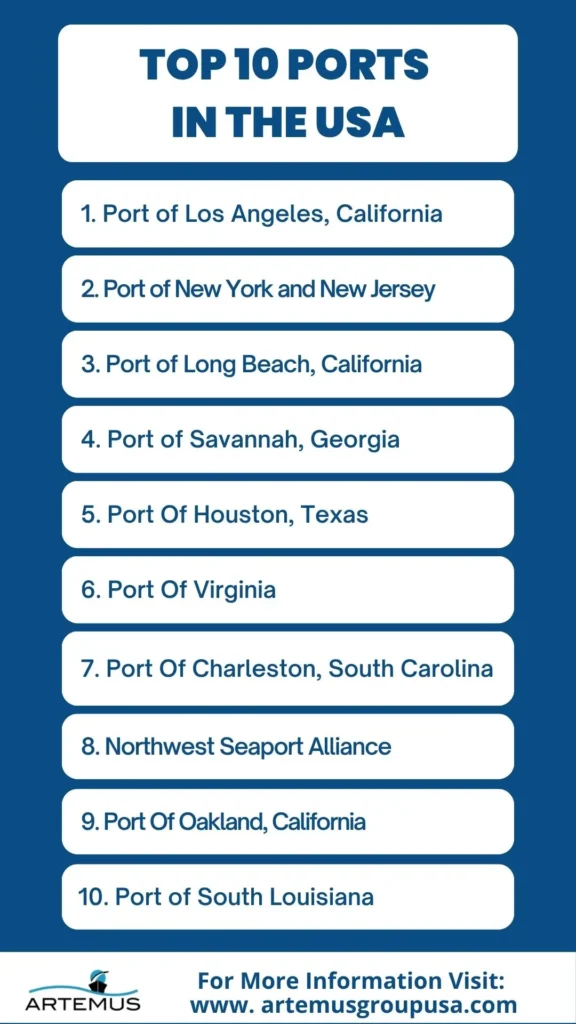
The Port of Los Angeles, often called “America’s Port,” is the busiest container port in the United States and a major gateway for international trade, particularly with Asia. Located in San Pedro Bay in Southern California, the port plays a vital role in global supply chains due to its strategic location, modern infrastructure, and strong rail and trucking connectivity.
The Port of New York and New Jersey is the largest port on the East Coast of the United States and a major gateway for global trade. Located at the entrance of the Hudson River, the port connects international shipping routes with major markets across North America through strong rail and highway networks.
The Port of Long Beach is one of the busiest ports in the United States, located next to the Port of Los Angeles in Southern California. It serves as a major gateway for trade with Asia and plays a key role in global supply chains thanks to its deep-water harbor and modern cargo-handling facilities.
The Port of Savannah is one of the fastest-growing ports in the United States, serving as a major East Coast gateway for global trade. Located along the Savannah River, the port is known for its large container terminals and strong rail and highway connections that support efficient cargo movement across the country.
The Port of Houston ranks among the largest and most active ports in the United States. It is located along the Houston Ship Channel and plays a crucial role in international trade, especially for energy products, chemicals, and container cargo. The port connects the U.S. It encompasses over 200 countries and serves as a significant hub for imports and exports within the Gulf Coast area.
The Port of Virginia is a major U.S. The East Coast trade gateway features a deep harbor and contemporary terminals. In 2022, it managed approximately 3.7 million TEUs and facilitated over 397,000 jobs, establishing itself as one of the most significant ports for international shipping in the United States.
The Port of Charleston is a major U.S. East Coast port handling 2.8 million TEUs annually. It supports global trade for manufacturing, agriculture, and retail goods and is an important economic driver for South Carolina and the Southeast U.S.
The Northwest Seaport Alliance, which combines the Port of Seattle and Port of Tacoma, is a major U.S. West Coast trade gateway. It handled about 3.4 million TEUs in 2022 and plays a key role in U.S.–Asia trade and Pacific Northwest logistics
The Port of Oakland is a major West Coast container port serving Northern California and international trade with Asia. It handled about 2.3 million TEUs in 2022 and plays a key role in U.S. agricultural exports and global logistics.
The Port of South Louisiana holds the title of the largest port in the United States. port by cargo tonnage, handling about 230–260 million tons annually. Located on the Mississippi River, it is a major hub for grain, petroleum, and bulk cargo exports.
These ports are integral to the U.S. economy, facilitating the import and export of goods, creating employment opportunities, and supporting various industries. Their strategic locations and infrastructure investments.
Related: Export Documentation Requirements To Export From The USA

The United States has a vast network of seaports that play a critical role in international trade and commerce. In total, there are approximately 360 commercial ports across the country. These ports are located along the Atlantic Coast, Pacific Coast, the Gulf of Mexico, the Great Lakes, and Alaska, forming one of the largest maritime port systems in the world.
These ports vary widely in size, capacity, and specialization. Some ports primarily handle containerized cargo, while others focus on bulk commodities, petroleum products, automobiles, or agricultural goods. This specialization allows ports to efficiently support different sectors of global trade.
Several ports rank among the busiest in the world, including the Port of Los Angeles, Port of New York and New Jersey, and Port of Houston. These major deep-water ports handle millions of containers annually and serve as key gateways for trade between the U.S. and international markets.
In addition to these major hubs, the country also has numerous smaller ports and terminals that facilitate regional shipping and specialized cargo operations. Together, this extensive network of ports supports millions of jobs, strengthens the U.S. economy, and enables the efficient movement of goods worldwide.
Most U.S. ports are managed by local or regional port authorities, often operating as public entities that oversee port infrastructure, operations, and regulatory compliance. Thanks to this expansive and well-developed system, the United States remains one of the world’s leading maritime trading nations.
Related: Ocean Freight Documentation For Imports: A Crucial Checklist

A port’s level of activity and the volume of cargo it handles depend on a wide range of interconnected factors. From physical infrastructure to digital technologies and sustainability initiatives, each element plays a crucial role in determining a port’s efficiency, reliability, and competitiveness in global trade.
The geographic location of a port is one of the most important factors influencing its activity. Ports located near major industrial hubs, large population centers, or key maritime trade routes naturally attract higher volumes of cargo traffic.
Efficient access to highways, rail networks, and airports further strengthens a port’s logistics capabilities by enabling faster movement of goods between inland regions and international markets.
Successful ports are well integrated with multiple transportation modes. Strong intermodal connectivity, including rail terminals, trucking corridors, and inland container depots, allows cargo to move seamlessly between ships, trains, and trucks.
This integration reduces delays, improves supply chain efficiency, and ensures timely cargo delivery.
A port’s infrastructure directly affects how efficiently it can handle cargo. Facilities such as deep-water berths, modern terminals, storage yards, and docking equipment determine the types and volumes of vessels a port can accommodate.
Ports with deep channels and large turning basins are better equipped to handle modern mega-container ships and increasing trade volumes.
Operational efficiency is a key driver of port productivity. Ports that invest in advanced equipment and streamlined workflows can handle cargo faster and more accurately.
Technologies such as automated cranes, container tracking systems, and real-time logistics management tools help reduce bottlenecks and increase cargo throughput.
Digital transformation is becoming increasingly important in port operations. The use of data analytics, artificial intelligence (AI), and cloud-based logistics platforms improves visibility across the supply chain.
These technologies enable predictive planning, optimize resource allocation, and allow ports to respond quickly to changes in global trade.
Despite increasing automation, human expertise remains essential for efficient port operations. A well-trained and reliable workforce ensures smooth cargo handling, accurate documentation, and safe equipment operation.
Skilled labor also helps minimize operational disruptions and maintain a port’s reputation for reliability.
Government policies and regulatory frameworks significantly influence port activity. Customs procedures, tariffs, trade agreements, and labor laws can either streamline or complicate cargo movement.
Ports operating within efficient and transparent regulatory environments are more attractive to international shipping companies and global traders.
Environmental responsibility is becoming a priority for modern ports. Many ports are adopting green initiatives, such as electrified cargo-handling equipment, renewable energy sources like solar and wind power, and waste reduction programs.
These sustainability practices help ports comply with environmental regulations and appeal to eco-conscious businesses.
Port security is critical for maintaining smooth and reliable operations. This includes both physical security measures, such as cargo inspections, surveillance systems, and controlled access, and cybersecurity protections for digital infrastructure.
Effective risk management helps ports prevent disruptions, protect cargo, and ensure safe trade operations.
Related: What Is Global Trade Management? A Complete 2025 Guide
Choosing the right port in the United States is a critical step in your shipping strategy. It impacts not just costs and transit times but also your cargo’s security and the efficiency of your entire logistics operation. Below are the key factors to consider when selecting the most suitable U.S. port for your shipment.
The port’s location significantly affects transportation costs and delivery timelines. Selecting a port closer to either the cargo’s origin or final destination can help reduce transit distance, fuel expenses, and handling risks, leading to a more cost-effective and efficient supply chain.
Efficient access to highways, rail lines, and airports ensures smooth movement of goods from the port to inland destinations. Ports with strong intermodal connections reduce bottlenecks and support faster last-mile delivery or onward distribution.
The quality of a port’s infrastructure, including deep-water berths, modern cranes, storage yards, and container-handling equipment, determines how quickly and securely your cargo can be processed. Well-equipped ports handle large volumes with fewer delays.
Some U.S. ports are better suited for specific cargo types, such as Ro-Ro (automobile) shipments, perishables, hazardous goods, or breakbulk. Choosing a port with expertise in your cargo category ensures better compliance, safety, and handling efficiency.
Ports with streamlined customs clearance procedures, electronic filing systems, and experienced Customs Brokers can reduce clearance delays. Efficient regulatory practices help avoid penalties and speed up your cargo’s release.
Look into the port’s historical performance data, such as vessel turnaround times, truck turn times, and dwell periods. High-performing, low-congestion ports help keep your shipping schedule on track and reduce demurrage and detention charges.
Port-related costs, including handling charges, storage fees, documentation fees, and demurrage, can vary widely. Understanding the complete cost breakdown helps ensure that the port you choose aligns with your shipping budget.
Cargo security is essential. Opt for ports with robust security measures such as surveillance, access control, and cargo inspection systems. Also, check for emergency preparedness plans, especially in areas prone to extreme weather.
Digitally advanced ports offer features like real-time cargo tracking, automated scheduling, and electronic data interchange (EDI). These tools enhance transparency, reduce manual errors, and improve supply chain coordination.
If sustainability is a core value for your business, consider ports with green initiatives, such as electrified equipment, clean energy usage, shore power, or waste reduction programs. These practices also support compliance with evolving global environmental regulations.
Related: Duty VS Tariff : Understanding The Key Differences
Technology is rapidly reshaping the maritime industry, and ports across the United States are leading this transformation. By adopting advanced digital systems, automation, and smart infrastructure, modern ports are becoming more efficient, secure, and environmentally sustainable. These innovations are helping ports handle increasing trade volumes while improving operational performance.
One of the most significant changes is the adoption of automation and robotics. Automated cranes, guided vehicles, and smart cargo-handling systems reduce manual effort and minimize human error. This allows ports to speed up loading and unloading processes while improving overall efficiency.
Data analytics and artificial intelligence (AI) are also playing a crucial role. AI-driven platforms analyze large volumes of shipping and logistics data to predict cargo flows, optimize vessel scheduling, and improve resource allocation. These insights help port operators make faster, data-driven decisions.
Digitalization and blockchain technology are simplifying documentation and customs processes. By digitizing shipping records and cargo transactions, ports can increase transparency, reduce paperwork delays, and enhance supply chain security.
The Internet of Things (IoT) further strengthens port operations by connecting sensors and monitoring devices across port infrastructure. These sensors provide real-time information on cargo location, equipment performance, and environmental conditions, enabling quicker responses to operational issues.
Security is another area benefiting from technological advancements. Agencies such as U.S. Customs and Border Protection rely on advanced digital monitoring systems and cybersecurity protocols to protect port infrastructure and maintain safe trade operations.
In addition, many ports, including the Port of Los Angeles and the Port of Long Beach, are investing in sustainable technologies such as electric cargo equipment, shore power for vessels, and renewable energy systems. These initiatives help reduce emissions and support environmentally responsible port operations.
Overall, technological innovation is transforming U.S. ports into smart logistics hubs that combine speed, security, and sustainability, strengthening the country’s position in global maritime trade.
Related: How To Get Import And Export License In USA: Quick Overview
The ranking of major ports in the United States is determined using a combination of performance, infrastructure, and economic indicators.
These factors help evaluate how efficiently a port operates and how important it is in global trade. Below are the key criteria commonly used to rank major ports.
1. Container Volume (TEUs) – Container volume is one of the most important metrics used to measure a port’s activity. It is typically calculated in Twenty-Foot Equivalent Units (TEUs), which represent the standard size of shipping containers. Ports that handle higher container volumes are generally considered more significant players in global trade.
2. Port Throughput Efficiency – Throughput efficiency measures how quickly and effectively cargo moves through the port. Factors such as vessel turnaround time, cargo handling speed, and container dwell time are considered. Ports with lower dwell times and faster processing are viewed as more operationally efficient.
3. Container Handling Capacity – Container capacity refers to the port’s ability to manage large volumes of containerized cargo. This includes the number of available berths, cranes, container yards, storage facilities, and cargo-handling systems that support smooth port operations.
4. Intermodal Connectivity – Efficient transportation links are crucial for moving goods inland. Ports that are well connected to highways, railroads, and airports provide seamless cargo transfers and improve supply chain efficiency.
5. Technology and Infrastructure – Modern ports rely heavily on advanced infrastructure and digital systems. Ports that use automated terminals, smart logistics platforms, and advanced cargo-handling equipment are typically ranked higher due to improved efficiency and operational reliability.
6. Geographic Location and Accessibility – A port’s location significantly affects its importance in trade. Ports located near major population centers or along key international shipping routes tend to attract higher cargo traffic and shipping lines.
7. Economic Impact – Large ports contribute significantly to both local and national economies. Their impact is measured through job creation, support for logistics and manufacturing industries, and the generation of trade-related revenue.
8. Environmental Sustainability Practices – Sustainability is becoming an increasingly important factor in port rankings. Ports that implement emission-reduction programs, adopt renewable energy, and promote environmentally responsible operations are gaining greater recognition.9. Capacity for Future Expansion – Ports with room for infrastructure expansion and scalable facilities are better prepared to handle future increases in cargo demand. Expansion capacity ensures long-term competitiveness in global trade.
Related: Air Freight VS Sea Freight: Factors That Matter Most
Artemus offers a comprehensive ISF (Importer Security Filing), AMS (Automated Manifest System), and AES (Automated Export System) filing solution, designed to streamline the compliance process for U.S. imports and exports.
With the complexities of international trade regulations, these filing systems are essential for ensuring that shipments comply with U.S. Customs and Border Protection (CBP) requirements.
Artemus’s solution automates the filing process, helping businesses avoid delays, penalties, and potential disruptions in their supply chains. By providing accurate and timely submissions for ISF, AMS, and AES, Artemus ensures that shipments are cleared smoothly and in accordance with U.S. customs regulations, offering peace of mind and enhancing operational efficiency.
Related: Top 10 Exports Of USA In 2024: Leading Export Categories
Ports play a critical role in global commerce by serving as entry and exit points for goods moving between countries. They facilitate the efficient transportation of imports, exports, and transshipment cargo, helping connect international markets and support economic growth.
The Port of Los Angeles is the busiest container port in the United States, consistently handling the highest container volume, particularly for goods arriving from Asia.
U.S. ports are regulated by federal agencies such as U.S. Customs and Border Protection and the Federal Maritime Commission, along with state and local port authorities that oversee safety, security, and environmental compliance.
The Port of New York and New Jersey is the largest port on the U.S. East Coast, handling a significant share of containerized cargo and serving as a key gateway for international trade.
The Port of Houston is widely known for handling large volumes of oil and petrochemical products, making it a major hub for the U.S. energy industry.
Ports contribute billions of dollars to the economy by enabling international trade, creating employment, and supporting industries such as logistics, manufacturing, transportation, and retail.
A port authority is a government or public agency responsible for managing port operations, infrastructure development, and regulatory compliance while ensuring efficient and secure cargo movement.
Deepwater ports are designed to accommodate large cargo vessels with deeper drafts. These ports typically feature extensive docking facilities, large cargo terminals, and advanced equipment to handle high volumes of containerized and bulk shipments.
The Port of New York and New Jersey is among the closest major U.S. ports to Europe and serves as an important gateway for transatlantic trade.
Port operations can impact the environment through emissions from ships, cargo equipment, and land transportation. However, many ports are adopting sustainability initiatives, including cleaner fuels, electrification, and green port technologies to reduce environmental impact.
The Port of Los Angeles is widely considered the most well-known U.S. port due to its size, cargo volume, and importance in international trade.
There are approximately 360 commercial ports across the United States, located along the Atlantic Coast, Pacific Coast, Gulf of Mexico, and the Great Lakes.
Some of the world’s largest deep-sea ports include the Port of Shanghai, Port of Singapore, Port of Ningbo-Zhoushan, Port of Shenzhen, and Port of Hong Kong, all known for handling massive cargo volumes.
The state of Texas has several major ports, including the Port of Houston, Port of Corpus Christi, and Port of Beaumont, each playing a significant role in U.S. trade.
Most U.S. ports are owned and operated by public port authorities or local government agencies. Private companies may operate specific terminals or logistics services within the ports.
One of the earliest ports in American history was established in Jamestown in 1607, marking the beginning of organized maritime trade in North America.
The largest container ports in the world include the Port of Shanghai, Port of Singapore, Port of Ningbo-Zhoushan, Port of Shenzhen, and Port of Hong Kong.
Texas has more than 10 commercial ports, with major ones including the Port of Houston, Port of Corpus Christi, and Port of Beaumont.
Among U.S. ports, the Port of Los Angeles typically ranks the highest in global container port rankings due to its high cargo throughput and strategic location.
The Port of Los Angeles is located in Los Angeles, California, along the Pacific coast, adjacent to the Port of Long Beach.
The Port of Los Angeles is the largest container port in the United States, handling millions of TEUs each year and serving as a major gateway for global trade.
The top ports in the United States play a crucial role in supporting both the national economy and global trade. Major hubs like the Port of Los Angeles and the Port of New York and New Jersey handle massive cargo volumes each year, connecting U.S. businesses with international markets.
With strategic locations, advanced infrastructure, and strong logistics networks, these ports remain essential gateways for efficient shipping and long-term economic growth.
Related: 12 Supply Chain Best Practices For Global Trade In 2026

Roughly $166 billion in IEEPA tariffs were collected from US importers between February 2025 and February 2026. The Supreme Court

The United Kingdom is one of the world’s largest trading economies and a top exporter of services. Cars, machinery, pharmaceuticals,

Mexico became the United States’ number-one trading partner in 2024, surpassing both Canada and China. According to the Office of
 Optimized by Seraphinite Accelerator