
What Does The US Export To Switzerland? Trade Insights
International trade between the United States and Switzerland highlights the strong economic relationship between the two nations. With its highly




What Does Canada Export To USA? This question is key to understanding one of the most important trade relationships in the world. Canada is the United States’ largest trading partner, with exports surpassing $400 billion annually, accounting for a significant share of U.S. imports.
From energy and automotive products to agricultural goods and raw materials, Canada’s exports are vital to the smooth functioning of American industries, infrastructure, and daily life.
As trade between the two nations grows increasingly complex, individuals & businesses engaged in cross-border commerce need to remain compliant and efficient. Artemus simplifies this process with advanced Freight Forwarding Software, NVOCC Software, and Customs Broker Software, ensuring smooth filing and compliance with ISF, AMS, and AES regulations.
Table Of Contents
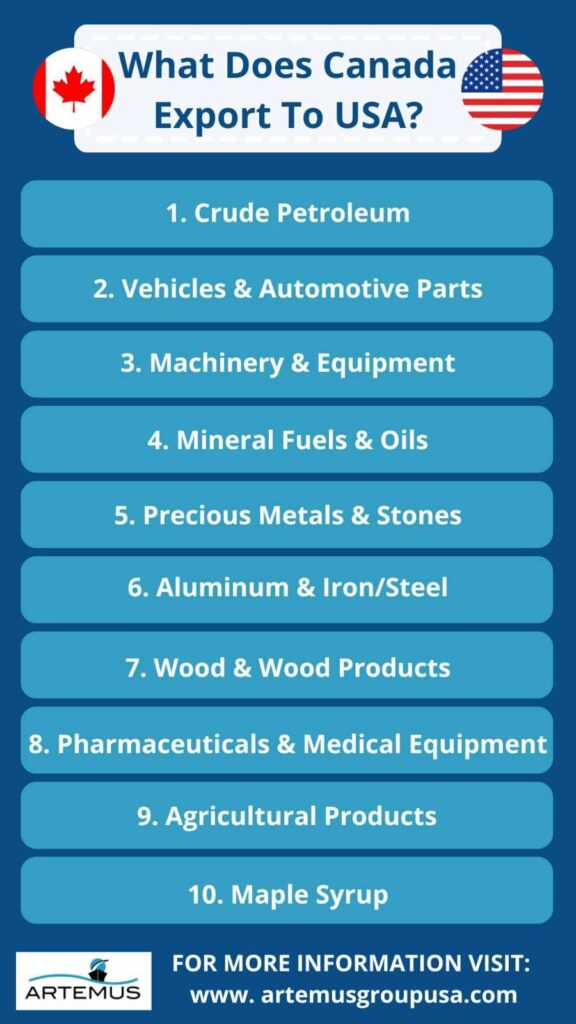
Canada and the United States maintain one of the most robust bilateral trade relationships globally. In 2024, Canada’s exports to the U.S. totaled approximately $434.26 billion USD, underscoring the depth of economic integration between the two nations.
Crude petroleum stands as Canada’s most significant export to the U.S. In 2023, exports in this category reached $128.51 billion USD, reflecting Canada’s pivotal role in supplying energy to its southern neighbor.
The completion of the Trans Mountain Expansion Project in 2024 enhanced pipeline capacity, facilitating increased oil exports. Notably, in July and September 2024, Canada exported over 4.3 million barrels per day to the U.S., marking a substantial rise from previous years. Wikipedia
The automotive sector is a cornerstone of Canada-U.S. trade. In 2023, Canada exported $58.21 billion USD worth of vehicles (excluding railway and tramway) to the U.S., highlighting the integrated nature of North American automotive manufacturing. Trading Economics
Major automotive manufacturers operate assembly plants across Canada, particularly in Ontario, producing vehicles and parts destined for the U.S. market. This sector not only supports significant employment but also underscores the importance of seamless cross-border supply chains.
Canada’s machinery exports to the U.S. amounted to $33.75 billion USD in 2023. This category encompasses a wide range of products, including industrial machinery, nuclear reactors, and boilers.
The demand for Canadian machinery is driven by the U.S. manufacturing and construction sectors, which rely on high-quality equipment for various applications. Canadian manufacturers benefit from proximity to the U.S. market and shared standards, facilitating trade in this sector.
Beyond crude oil, Canada exports significant quantities of refined petroleum products and natural gas to the U.S. In 2023, exports of refined petroleum products were valued at $12.8 billion USD, while petroleum gases accounted for $12.4 billion USD.
These exports are crucial for meeting the energy demands of various U.S. regions, particularly in the Midwest and Northeast. Canada’s extensive energy infrastructure and reserves position it as a reliable energy partner for the U.S.

In 2023, Canada exported $12.43 billion USD worth of precious metals and stones to the U.S., including gold, silver, and diamonds. These exports support the U.S. jewelry industry and are also significant for investment purposes.
Canada’s mining sector is renowned for its high standards and ethical practices, making its precious metals and stones highly sought after in international markets. The stability and reliability of Canadian sources are particularly valued by U.S. importers.
Canada is a key supplier of aluminum and iron/steel products to the U.S. In 2023, aluminum exports were valued at $11.36 billion USD, while iron and steel products contributed $8.51 billion USD.
These materials are essential for various U.S. industries, including automotive, construction, and aerospace. The close proximity and integrated supply chains between the two countries facilitate efficient trade in these heavy industrial goods.
Canada’s vast forest resources make it a leading exporter of wood and related products. In 2023, exports in this category to the U.S. totaled $11.53 billion USD.
These exports include lumber, pulp, and paper products, which are vital for the U.S. construction and publishing industries. Sustainable forestry practices in Canada ensure the long-term viability of this trade sector.
In 2023, Canada exported $6.75 billion USD worth of pharmaceutical products and $5.16 billion USD in optical, photographic, and medical apparatus to the U.S.
These exports support the U.S. healthcare system, providing essential medications and medical devices. Canada’s strong regulatory framework and commitment to quality make its pharmaceutical and medical products highly trusted by U.S. partners.
Canada’s agricultural exports to the U.S. are diverse and substantial. In 2023, exports included cereals and preparations worth $6.47 billion USD, meat and edible meat offal at $4.13 billion USD, and fish and seafood products totaling $3.14 billion USD.
These exports are crucial for the U.S. food supply, particularly in regions where certain products are not produced domestically. The integrated nature of North American agriculture ensures a steady flow of goods across the border.
A symbol of Canadian heritage, maple syrup remains a notable export. In 2023, Canada exported $376 million USD worth of maple syrup to the U.S. This sweet export is cherished by consumers and represents the cultural ties between the two nations.
Understanding the composition and dynamics of Canada’s exports to the U.S. is crucial for stakeholders involved in international trade, policy-making, and economic development. As the trade landscape evolves, staying informed and compliant will remain key to capitalizing on opportunities within this robust bilateral relationship.
Related: What Does Colombia Export To USA? Key Products & Insights
In 2023, Mexico emerged as the United States’ top goods trading partner, with total two-way goods trade reaching $807 billion, surpassing both Canada and China. This significant trade volume underscores the deep economic ties between the two nations.
Mexico is a major supplier of automobiles, machinery, agricultural products, and electronics to the U.S. while importing machinery, electrical equipment, and agricultural goods from the U.S. The United States–Mexico–Canada Agreement (USMCA), which replaced NAFTA in 2020, has been instrumental in facilitating this trade by reducing tariffs and promoting fair trade practices.
The integration of supply chains, particularly in the automotive and manufacturing sectors, has led to increased efficiency and competitiveness. Additionally, initiatives like the U.S.–Mexico High-Level Economic Dialogue (HLED) have fostered collaboration on economic development, innovation, and workforce training.
However, challenges persist, including disputes over water rights under a 1944 treaty, which have become a point of contention in recent trade negotiations. Despite these issues, the overall trade relationship remains strong, with both countries benefiting from mutual economic growth and cooperation.
In summary, the Mexico–US trade relationship is a cornerstone of economic activity in North America, characterized by significant trade volumes, integrated supply chains, and ongoing efforts to address challenges and enhance cooperation.
Related: What Does Mexico Export To The US? Trade Insights
As of 2023, approximately 17.5% of total U.S. exports were shipped to Canada, highlighting the country’s status as the United States’ largest single export market.
In 2024, U.S. goods exports to Canada totaled $349.4 billion, reflecting a 1.4% decrease from the previous year. This substantial trade volume underscores the deep economic ties between the two nations, facilitated by agreements like the United States–Mexico–Canada Agreement (USMCA).United States Trade Representative
The robust trade relationship between the U.S. and Canada encompasses a wide range of sectors, including automotive, machinery, agricultural products, and energy. This interdependence not only supports millions of jobs on both sides of the border but also contributes significantly to the economic stability and growth of the North American region.
Related: Export Documentation Requirements To Export From The USA
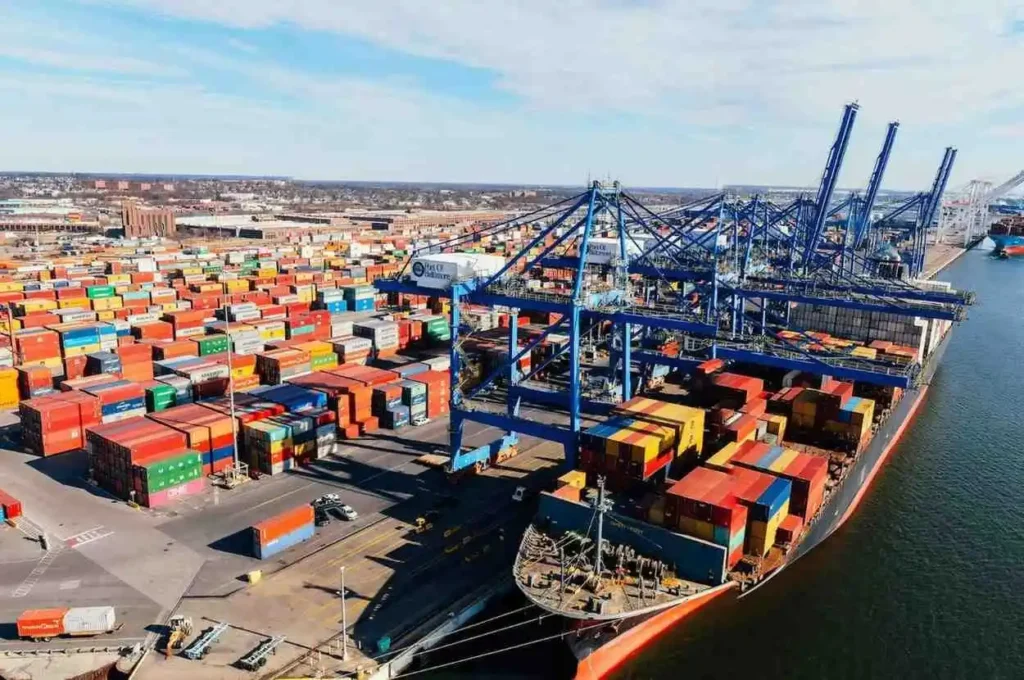
The trade relationship between the United States and Canada is facilitated by several key ports that serve as vital conduits for the movement of goods across the border.
These ports handle a significant portion of the bilateral trade, encompassing a wide range of commodities and products. Below is an overview of the top port locations instrumental in U.S.–Canada trade:
The Ambassador Bridge is the busiest international border crossing in North America by trade volume, handling over 25% of all merchandise trade between the U.S. and Canada. In 2024, approximately 2.3 million trucks crossed the bridge, underscoring its critical role in facilitating the movement of goods, particularly in the automotive and manufacturing sectors.
The Blue Water Bridge is a major commercial crossing, accounting for about 14.4% of U.S.–Canada truck trade. It serves as a key route for transporting goods such as chemicals, machinery, and agricultural products, linking the industrial regions of Michigan and Ontario.
Connecting Buffalo, New York, to Fort Erie, Ontario, the Peace Bridge handles approximately 11.4% of truck traffic between the two countries. It is a vital corridor for the movement of consumer goods, food products, and other commodities between the northeastern U.S. and southern Ontario.
As Canada’s largest and most diversified port, the Port of Vancouver plays a significant role in U.S.–Canada trade, especially for goods moving through the Pacific Northwest. It handles a wide array of cargo, including automotive parts, forest products, and agricultural commodities, with extensive rail and road connections facilitating distribution into the U.S.
The Port of Montreal serves as a critical hub for trade between Canada, the U.S., and international markets. Its strategic location allows for efficient transportation of goods such as machinery, electronics, and consumer products into the northeastern United States via rail and trucking networks.
These ports are integral to the seamless flow of goods between the United States and Canada, supporting economic growth and supply chain efficiency across various industries.
Related: How To Import Goods For Resale In The USA? A 2025 Guide
Despite recent trade tensions, Canada and the United States continue to explore new avenues for economic collaboration. Several emerging sectors present significant opportunities for both nations to strengthen their bilateral trade relationship.
Canada supplies approximately 19% of the United States critical mineral imports, including essential resources like nickel, aluminum, and zinc. These minerals are vital for the production of electric vehicles, batteries, and renewable energy technologies.
As the U.S. seeks to reduce dependence on non-allied sources, Canada’s stable and resource-rich environment positions it as a key partner in developing resilient and secure supply chains.
Canada exports clean electricity to the U.S., aiding regions such as New England and New York in achieving emission reduction targets. Transboundary infrastructure, including over 100 oil and natural gas pipelines and clean electricity transmission lines, facilitates the movement of massive amounts of energy, supporting investment, industry, jobs, and consumers.
The United States is Canada’s largest agricultural trading partner, purchasing over 60% of Canadian agricultural exports. This robust trade relationship encompasses a wide range of products, including grains, meats, and dairy.
With growing global demand for sustainable and high-quality food products, both countries have the opportunity to collaborate on food security initiatives and expand their agri-food trade.
The Canada–United States Regulatory Cooperation Council (RCC) works to promote economic growth and job creation by increasing regulatory transparency and coordination between the two countries.
By aligning regulations in sectors such as agriculture, transportation, and health products, the RCC aims to reduce unnecessary requirements and costs, facilitating smoother trade and investment flows.
Both Canada and the U.S. are investing in emerging technologies, including artificial intelligence, quantum computing, and cybersecurity. Collaborative efforts in research and development, as well as the commercialization of new technologies, can drive economic growth and enhance competitiveness on the global stage. Establishing joint innovation hubs and cross-border tech incubators can further strengthen this partnership.
Related: What Does The US Export To China? A Complete Guide
Artemus Transportation Solutions offers a comprehensive suite of web-based software applications designed to streamline trade compliance processes for businesses engaged in international shipping to and from the United States.
Our software solution supports critical filings such as Importer Security Filing (ISF 10+2), Automated Manifest System (AMS), and Automated Export System (AES), ensuring adherence to U.S. Customs and Border Protection (CBP) regulations.
By facilitating accurate and timely submissions, Artemus helps clients avoid costly delays and penalties associated with non-compliance.
Related: How To Get Import And Export License In USA: Quick Overview
Canada’s main exports to the U.S. include crude petroleum, vehicles, machinery, mineral fuels, aluminum, and agricultural products. Energy and automotive goods dominate the trade.
The top 5 exports are crude oil, vehicles, machinery, natural gas and refined fuels, and aluminum. These account for a significant portion of bilateral trade.
Canada’s five major global exports are crude oil, vehicles, gold, wood and lumber, and aluminum. The U.S. is the primary destination for most of these.
The U.S. relies on Canada for energy (especially oil and natural gas), critical minerals, auto parts, aluminum, and agricultural products like meat and grains.
Roughly 75–80% of Canada’s exports go to the United States, making it Canada’s largest and most important trade partner.
The United States is Canada’s biggest trading partner, accounting for the majority of both its exports and imports.
Main exports: oil, vehicles, aluminum, and machinery. Main imports: vehicles, machinery, electronics, and pharmaceuticals—mostly from the U.S. and China.
Yes, Canada heavily relies on trade with the U.S., as the U.S. accounts for the vast majority of Canada’s exports and imports.
Canada often runs a trade surplus with the U.S., particularly due to energy exports, though its overall trade balance can vary based on global commodity prices.
The Canada–U.S. trade relationship is one of the most robust and integrated in the world, with Canadian exports playing a critical role in fueling American industries and households.
From crude oil that powers U.S. cities, to vehicles and auto parts that keep America moving, and agricultural goods that stock grocery shelves—Canada’s contributions are diverse and indispensable. In 2023 and continuing into 2024, energy exports remained dominant, but sectors like aluminum, machinery, and forest products also showed consistent strength.
Related: Poland’s Exports To USA: The Complete List For Opportunities

International trade between the United States and Switzerland highlights the strong economic relationship between the two nations. With its highly

Cold Nordic waters, advanced engineering, and a strong maritime economy make Norway a powerful exporter despite its size. Many of

Trade between the United States and Canada is one of the largest bilateral trading relationships in the world. Understanding what
 Optimized by Seraphinite Accelerator