IEEPA Tariff Refunds: A 2026 CAPE Filing Guide
Roughly $166 billion in IEEPA tariffs were collected from US importers between February 2025 and February 2026. The Supreme Court



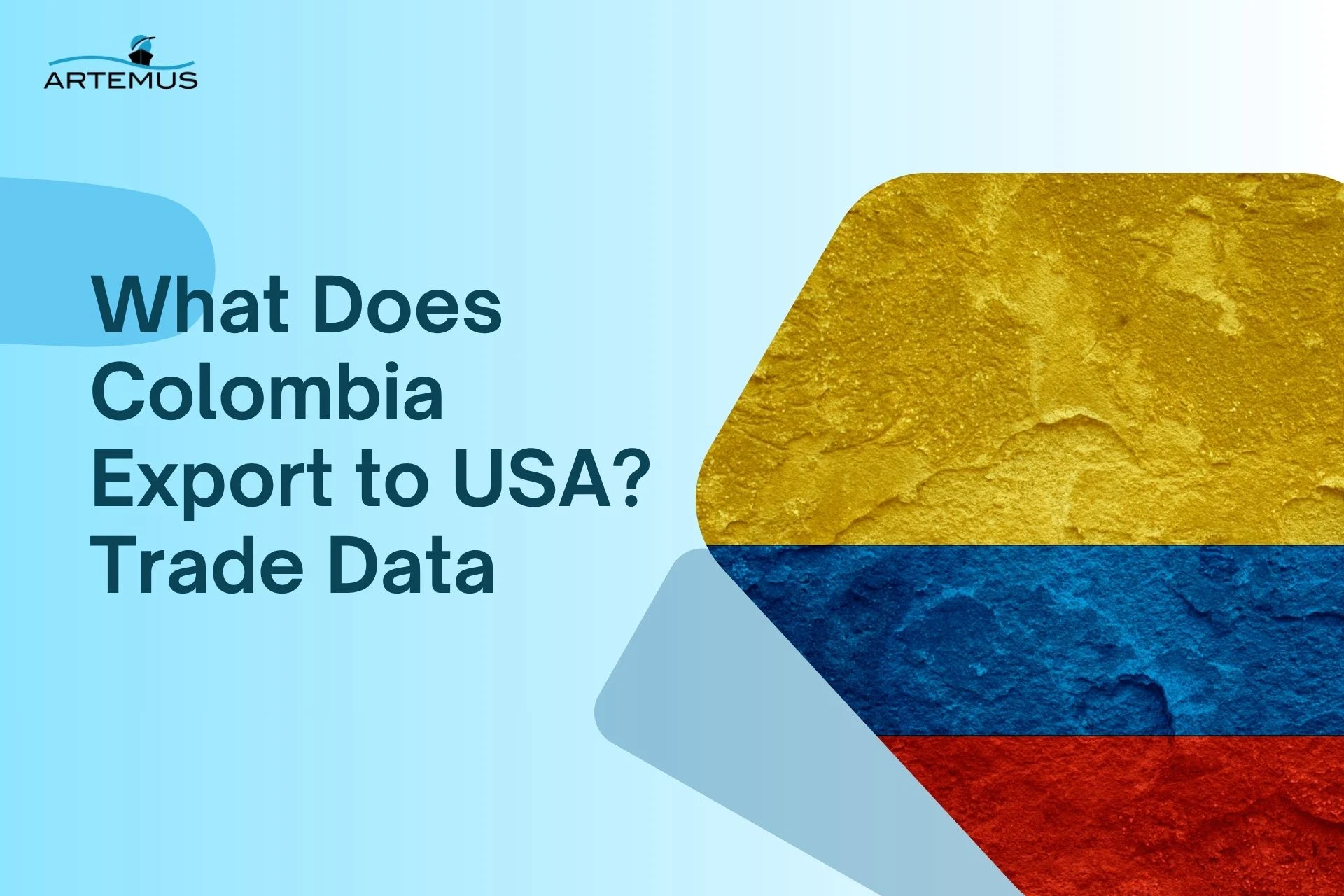
Most of what you read about Colombia-US trade is two years out of date. Pages still cite 2023 figures of $14 billion or $16 billion. The picture has moved on. Full-year 2025 data is now published, and it tells a different story: a $37 billion goods trade relationship, a widening US surplus, and a country that remains the United States’ third-largest trading partner in Latin America.
If you are a customs broker, freight forwarder or importer working the Colombia lane, you need three things in one place. The current numbers from a trusted source. A clear breakdown of what those goods actually are. And the practical rules for getting them through US customs without a duty bill or a penalty notice. Most articles give you one of the three. This one gives you all three.
At Artemus Transportation Solutions, our software has helped customs brokers and importers handle Importer Security Filing (ISF), Automated Manifest System (AMS) and Automated Export System (AES) filings since 1999. The Colombia lane is one we know well. Here is the current picture.
Table Of Contents
Colombia’s exports to the United States are dominated by five categories. Crude petroleum and refined oil products lead by a wide margin, followed by cut flowers and live plants, gold and precious stones, coffee, and edible fruit, including bananas and Hass avocados.
According to the US Census Bureau, US imports of goods from Colombia reached $17.81 billion in 2025. Most of that volume enters the country duty-free under the US-Colombia Trade Promotion Agreement (CTPA), which took effect in May 2012.
Know More About: What Does Canada Export To USA? A Complete Guide
Here is the most recent full-year picture of goods trade between the two countries. Every figure below is from the US Census Bureau’s monthly trade balance report (FT-900).
| Year | US Exports to Colombia | US Imports from Colombia | US Goods Trade Balance |
|---|---|---|---|
| 2023 | $17.60 billion | $16.11 billion | +$1.49 billion |
| 2024 | $18.70 billion | $17.86 billion | +$0.83 billion |
| 2025 | $19.39 billion | $17.81 billion | +$1.58 billion |
Total two-way goods trade hit $37.2 billion in 2025. Add services and the relationship was worth about $53.3 billion in 2024, the last year for which services data is published, according to the Office of the US Trade Representative.
The US surplus on goods nearly doubled from 2024 to 2025, climbing from $830.8 million to $1.58 billion, a 90.2% jump driven mainly by softer Colombian imports rather than a big change in US exports.
If you look up “Colombia exports to United States” online you will see three different totals for 2024. The US Census Bureau shows $17.86 billion. The UN COMTRADE database via Trading Economics shows $14.98 billion. Some aggregator sites quote figures above $18 billion. None of them is wrong.
The difference comes down to who is counting and how. The US Census figure is what US customs records as goods arriving at US ports, valued on a CIF basis (cost, insurance, freight to the US border).
The COMTRADE figure is what Colombia’s national statistics agency, DANE, reports as exports leaving Colombia, valued on an FOB basis (free on board at the Colombian port). Add insurance, freight and timing differences and the two figures diverge by a few billion dollars in any given year.
For a US importer or broker, the Census figure is the one to use, because it is what CBP and USTR cite. The COMTRADE figure is useful for cross-checking and for understanding the view from the Colombian side.
Know More About: Duty VS Tariff: Understanding The Key Differences

Here is where the headline number breaks down. All product-level figures below are 2024 full-year values from UN COMTRADE via Trading Economics, which is the most recent year with a complete category-level breakdown published.
Mineral fuels, oils and distillation products are by far Colombia’s largest export to the United States. In 2024, the category was worth $6.24 billion, according to Trading Economics’ COMTRADE data, or about 42% of Colombia’s total exports to the US.
Most of this is crude petroleum, with refined oil products making up the balance. Colombia is the third-largest Latin American supplier of crude to the US after Mexico and Canada.
Live trees, plants, bulbs and cut flowers were worth $1.89 billion in 2024. Colombia is the world’s second-largest flower exporter after the Netherlands and supplies the majority of cut flowers sold in US supermarkets and florists.
Roses, carnations and chrysanthemums dominate the mix. Volumes spike sharply in the weeks before Valentine’s Day and Mother’s Day, when freight forwarders on the Bogotá-Miami air-cargo lane run near capacity.
Pearls, precious stones, metals and coins, which is mostly gold in unwrought form, came to $1.62 billion in 2024.
Colombia is a significant gold producer and a leading source of high-quality emeralds, with the Muzo and Chivor mines among the most famous in the world. The category sits behind oil and flowers but ahead of coffee in dollar value.
Coffee, tea, mate and spices accounted for $1.42 billion in 2024. Almost all of that is unroasted Arabica coffee, which Colombia is famous for.
The category has real momentum: per Blue Book Services, citing DANE figures via Redagricola, unroasted coffee exports to the US grew 124% year-over-year in Q1 2025.
Edible fruits, nuts and citrus peel were worth $438.69 million in 2024, with bananas as the anchor product. The category is one of the fastest-growing on the lane. Blue Book Services reports bananas to the US rose 51% in Q1 2025 and Hass avocados surged 300% on the same year-over-year basis.
Antioquia department alone shipped over $686 million in non-mining and energy exports to the US in Q1 2025.
Several smaller categories round out the picture: aluminum at $656.27 million in 2024, electrical and electronic equipment at $433.77 million, plastics at $276.47 million, sugar and confectionery at $180.02 million, miscellaneous edible preparations at $165.52 million, and fish and crustaceans at $112.07 million.
Wood and articles of wood show up further down the list and have their own dedicated buyer base in the US, particularly for builders’ joinery, carpentry items and specialty hardwoods. All figures from UN COMTRADE 2024 via Trading Economics.
Know More About: What Does The USA Export To Canada? Trade Overview
The United States is, by a wide margin, Colombia’s number-one customer. Per World Bank WITS data, here is how Colombia’s export markets ranked most recently:
Put another way: the US takes more of Colombia’s exports than the next four countries combined. The lead is structural. Geography puts Colombian Caribbean ports a short voyage from Houston, New Orleans and Miami.
The CTPA removes most of the duty friction. And the product mix, particularly oil and flowers, fits US demand patterns closely.
Know More About: What Does Mexico Export To The US? Trade Insights
The trade lane runs both ways, and brokers handle filings in both directions. According to the US Census Bureau, the United States exported $19.39 billion of goods to Colombia in 2025, up 3.7% from $18.70 billion in 2024.
The top US export categories to Colombia in 2024, per UN COMTRADE via Trading Economics, were:
Note how complementary the two flows are. The US ships Colombia the inputs and capital goods (machinery, cereals, plastics, chemicals); Colombia ships back finished agricultural products and raw commodities. That symmetry is part of why the relationship has held up through tariff cycles and political changes.
Know More About: How Does Freight Forwarding Work? A 2025 Guide
The CTPA is the agreement that makes most of this trade duty-free. If you are filing entries on the Colombia lane, you need to understand three things about it: when it took effect, what duty treatment it provides, and how to claim that treatment correctly.
The agreement was signed on November 22, 2006. The Colombian Congress approved it in 2007 and Colombia’s Constitutional Court completed its review in July 2008. After several years of pause in Washington, the two countries implemented the CTPA on May 15, 2012.
The agreement is comprehensive: it covers goods, services, intellectual property, government procurement, labor and environment, per USTR’s official CTPA page.
Here is the practical bottom line, straight from US Customs and Border Protection: most Colombian goods currently enter the United States free of duty and free of the merchandise processing fee (MPF), and virtually all goods will enter free by the time the agreement is fully implemented in 2028.
That MPF exemption is a real saving on every entry, since MPF is normally 0.3464% of entered value with a per-entry cap.
The legal references brokers should know: the agreement is implemented through HTSUS General Note 34 and 19 CFR Subpart T. If you are unsure whether a specific HTS code qualifies for CTPA preference, those two references plus CBP’s Colombia TPA page will tell you.
Duty-free treatment is not automatic. The importer of record has to claim it on the entry summary and be able to support that claim if CBP asks. Three practical points:
Know More About: What Is Import Compliance & Why It Matters?
Even with duty-free CTPA treatment, every Colombia-to-US ocean shipment still has to clear the standard pre-arrival and arrival filings. Here is what you actually have to file, when, and what happens if you get it wrong.
The Importer Security Filing must be transmitted to CBP at least 24 hours before the cargo is loaded onto the vessel at the Colombian port. The importer is responsible for 10 data elements (manufacturer, seller, buyer, ship-to, container stuffing location, consolidator, importer of record, consignee, country of origin and HTS number); the carrier provides 2 elements (vessel stow plan and container status messages).
Late, inaccurate or missing ISFs trigger penalties of $5,000 per violation, with multiple violations possible on a single entry.
The carrier must transmit the Automated Manifest System filing 24 hours before vessel loading. The AMS filing is what gives CBP visibility into what is on the vessel before it sails.
Inaccurate or late AMS filings can result in a “Do Not Load” hold at the Colombian port, which is the worst possible outcome for time-sensitive cargo such as cut flowers before Valentine’s Day or perishable produce.
To claim CTPA preference on the entry summary, the importer should have on file:
The HTS classification is where most CTPA claims fail under audit. Classify carefully, document the reasoning, and keep the record for five years.
Know More About: Export Documentation Requirements To Export From The USA
The headline 2025 figures hide a more interesting story underneath. Per Blue Book Services, citing DANE data: Colombia’s exports to the US grew 15% in Q1 2025, triple the 5% growth Colombia recorded with the rest of the world.
The non-mining and non-energy share of those exports reached $2.413 billion in the quarter, up 25% year-over-year. That is the segment that matters for diversification away from oil dependence.
Inside the produce category, the swings are larger. Unroasted coffee +124%. Bananas +51%. Hass avocados +300%. The Antioquia department alone shipped over $686 million in non-mining and non-energy exports in Q1 2025.
Colombia is also benefiting from broader US efforts to diversify supply chains away from China-heavy lanes. As a US-aligned, geographically close country with a working free-trade agreement and a deep-water port at Cartagena, it sits in a structurally favorable position for the next several years.
For importers, the practical implication is that flower, produce, coffee, and gold volumes on this lane are likely to keep growing.
Know More About: List Of 20 Largest Shipping Ports In The World
Filing volume on the Colombia lane is steady year-round, with sharp peaks during the flower seasons and the coffee harvest cycle. Artemus Transportation Solutions has helped customs brokers, NVOCCs, and freight forwarders manage that filing workload since 1999.
Our Importer Security Filing (ISF) software submits the 10+2 filing directly to CBP before vessel loading, with built-in validation that catches the data errors that cause $5,000 penalties. The Automated Manifest System (AMS) module handles carrier manifest transmission with full status visibility. For the return flow, our Automated Export System (AES) software files the Electronic Export Information required for US exports to Colombia above the $2,500 threshold.
Customs brokers running Colombia-lane volume rely on our Customs Broker Software for end-to-end entry processing, and importers use the Importer of Record Profile tools to keep CTPA records audit-ready. The goal across all of it is the same: clean filings, no penalties, and shipments that move on schedule.
Crude petroleum and refined oil products. The mineral fuels category was worth $6.24 billion in 2024 per UN COMTRADE, roughly 42% of Colombia’s total exports to the US that year. Cut flowers, gold and coffee are the next-largest categories.
It depends on which side is counting. The US Census Bureau records US imports from Colombia at $17.81 billion in 2025 and $17.86 billion in 2024. UN COMTRADE, which uses Colombia’s own export filings, shows $14.98 billion in 2024.
The difference reflects valuation (CIF versus FOB) and timing, not a discrepancy in the underlying trade.
The United States. The US accounts for roughly 28% of all Colombian exports, more than three times the share of the next-largest partner, Panama (~9%). China and India each take about 5% and the Netherlands roughly 4%.
Yes. The US-Colombia Trade Promotion Agreement (CTPA) was signed on November 22, 2006 and entered into force on May 15, 2012. It is a comprehensive agreement covering goods, services, intellectual property, labor and environment.
Yes. Coffee, tea, mate and spices were worth $1.42 billion in 2024. Almost all of that is Colombian Arabica coffee. The category grew sharply in early 2025: unroasted coffee to the US was up 124% year-over-year in Q1 2025 per Blue Book Services, citing DANE.
US exports to Colombia were $19.39 billion in 2025. The top categories are mineral fuels and refined oil ($5.13B in 2024), cereals ($1.77B), machinery ($1.73B), plastics ($1.01B), and animal feed ($990.85M).
The two economies are largely complementary: the US ships inputs and capital goods, Colombia ships finished agricultural products and raw commodities.
Most do, under the CTPA. Per US Customs and Border Protection, most Colombian goods currently enter the United States free of duty and free of the merchandise processing fee (MPF), and virtually all goods will enter free by the time the agreement is fully implemented in 2028.
Duty-free treatment is not automatic, though: the importer has to claim CTPA preference on the entry summary and hold a valid certification of origin.

Colombia is a $37 billion trade partner for the United States and it is one of the easier lanes to work, provided you have the data and the filings right. The US is by far Colombia’s largest customer, most goods enter duty-free under CTPA, and the product mix (oil, flowers, gold, coffee, fruit) is concentrated enough that any broker handling the lane sees the same categories week after week.
Three things to take away. Use the US Census figure when you are quoting trade volumes to a US audience: $17.81 billion of imports in 2025, not the lower COMTRADE number. Plan filings around peak demand (Valentine’s Day, Mother’s Day, the coffee harvest) because the airfreight and reefer capacity tightens fast.
And get the CTPA paperwork right on entry, because reconstructing it during an audit five years later is a far more expensive exercise than doing it correctly the first time.
Know More About: Ocean Freight Documentation For Imports: A Crucial Checklist

Roughly $166 billion in IEEPA tariffs were collected from US importers between February 2025 and February 2026. The Supreme Court
The United Kingdom is one of the world’s largest trading economies and a top exporter of services. Cars, machinery, pharmaceuticals,
Mexico became the United States’ number-one trading partner in 2024, surpassing both Canada and China. According to the Office of
 Optimized by Seraphinite Accelerator