UK Imports & Exports: Trade Profile & Top Partners
The United Kingdom is one of the world’s largest trading economies and a top exporter of services. Cars, machinery, pharmaceuticals,


Tariffs can influence more than just the cost of goods, they often affect how much businesses pay to move those goods across borders. Understanding these impacts helps companies plan budgets, manage supply chains, and anticipate changes in shipping expenses.
This blog examines how tariffs affect shipping costs, explores both immediate and long-term effects, looks at shifts in trade routes and demand, and provides practical strategies to control shipping expenses when tariffs rise.
Artemus Transportation Solutions offers advanced ISF, AMS, and AES software to help businesses handle shipping with confidence. These solutions simplify regulatory compliance, streamline documentation, and enable businesses & importers to manage goods efficiently while reducing the risk of filing errors and delays.
Table Of Contents
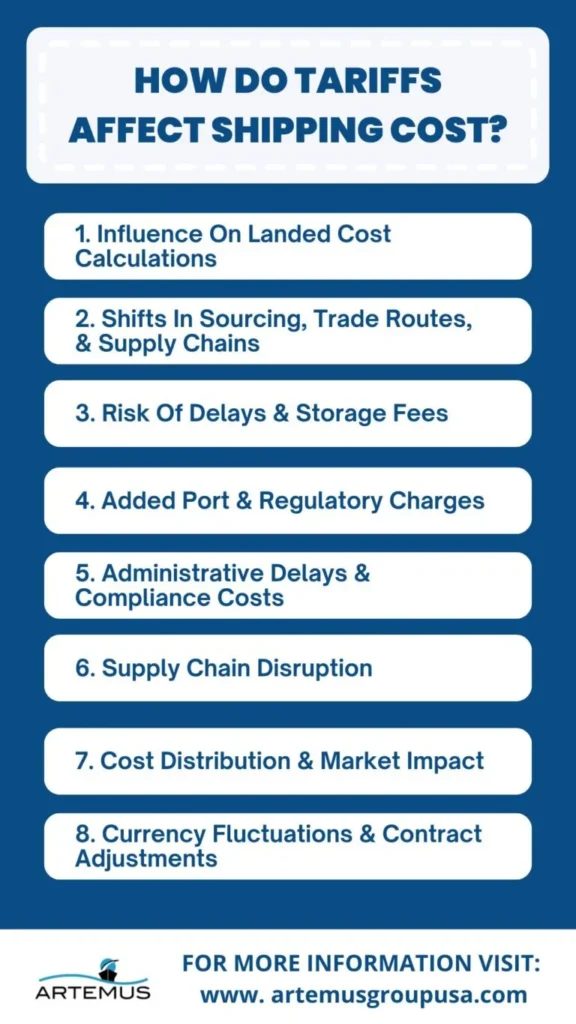
Tariffs may not directly change how much carriers charge for transportation, but they significantly influence the broader factors that determine total shipping expenses. Their impact often appears indirectly , through shifts in sourcing, customs operations, and supply chain pricing strategies.
Below are the key ways tariffs can affect shipping costs:
When tariffs are imposed, the landed cost, the total expense of bringing goods to market, increases. This includes higher product costs, added customs duties, and regulatory fees. Importers must adjust logistics budgets to absorb these higher costs, influencing freight rate negotiations. Sometimes carriers respond by introducing tariff-related surcharges or revising overall pricing terms.
Tariffs often drive companies to rethink sourcing strategies and shift suppliers to minimize tariff exposure. Changes in supplier location can lengthen trade routes and disrupt established shipping schedules, which increases transportation and handling costs. Major carriers have observed significant disruptions and reduced capacity on key, previously efficient routes.
Goods subject to tariffs may be delayed in customs or warehouses if duties are not resolved promptly, disrupting shipping schedules and causing further storage or handling fees.
Tariff measures are sometimes accompanied by port fees, retaliatory surcharges, or new regulatory costs. For example, U.S.–China routes have seen added port-related charges, raising vessel operating expenses. These fees contribute to higher freight rates on routes impacted by policy changes or reciprocal trade actions.
Higher tariffs often generate more detailed customs checks, additional classification reviews, and extra paperwork, increasing compliance costs. These steps contribute to slower clearance, potential risk of delays, and add storage fees or demurrage, all of which indirectly inflate overall shipping costs.
Tariffs can cause supply chains to become more complex and sensitive to delays or interruptions. Companies may need to navigate new regulations, which heightens operational complexity and can lead to increased costs through detours, alternative suppliers, or longer delivery times.
Recent studies suggest that a large share of tariff costs is borne by importers and consumers, not exporters. As end-product prices rise, logistics providers may adjust margins and cost-sharing arrangements with clients. Over time, this rebalancing can reshape freight rate structures and pricing models, even when tariffs themselves are not direct shipping fees.
Tariffs can also trigger exchange rate fluctuations, especially when trade tensions rise. Carriers and importers may need to renegotiate long-term contracts to account for currency volatility and shifting market conditions, which can further affect overall logistics spending.
Related: ISF Filing Cost: Elements, Hidden Costs, & Minimization Tips
Tariffs don’t just influence the cost of moving goods , they also reshape how much demand there is for global shipping. Their effects are often cyclical, with short-term surges followed by slower trade activity. Below are the key ways tariffs impact global shipping demand:
When new tariffs are announced or existing ones are set to rise, importers often accelerate shipments to beat the deadline. This “front-loading” temporarily boosts demand for vessel space and drives up freight rates. For example, in early 2025, many U.S. importers increased shipments ahead of expected tariff hikes, leading to capacity shortages and higher spot rates on major trade lanes.
Once the rush to import goods subsides, demand typically drops sharply. Buyers adjust to higher landed costs or hold off on restocking. Analysts project that U.S. seaborne container imports in 2025 could decline by around 0.7% following such early import surges.
Tariffs introduce uncertainty in global trade planning. When companies can’t predict future tariff rates, they often delay orders or scale back volumes. According to trade outlooks for 2025, global merchandise trade growth has been revised downward amid concerns over reciprocal tariffs and ongoing trade disputes.
To avoid higher tariffs, companies may relocate production or sourcing to other countries. This changes global shipping flows, boosting demand on new corridors while reducing it on traditional ones. For instance, Southeast Asia has gained share in manufacturing and exports as companies diversify away from China, altering established trade routes.
Different industries react differently to tariffs. Sectors like automotive, electronics, and machinery, which depend on complex cross-border supply chains, often reduce shipping volumes when tariff costs rise. Meanwhile, industries with inelastic demand, such as food or household goods, may absorb higher costs or adjust sourcing over time.
These variations also affect specific vessel types, with auto carriers and bulk ships showing greater volatility.
When shipping demand cools after tariff surges, carriers may face excess capacity. This oversupply can push down spot rates and reduce profitability. In 2025, with many new vessels still entering service amid modest trade growth, global capacity utilization remains under pressure, leading to rate competition among carriers.
Related: ISF Bond Cost Breakdown & Management For Import Success
Tariffs often lead to shifts in global shipping routes, as companies adjust sourcing to reduce duty exposure. Over time, these changes can reshape trade lanes, alter port activity, and redirect cargo volumes between regions.
When tariffs rise on goods from a specific country, importers often seek suppliers in nations with lower or no tariffs. This naturally changes shipping origins and destinations. For example, U.S. importers have increasingly sourced from Vietnam, India, and Mexico, redirecting cargo flows from traditional trans-Pacific routes to Southeast Asia–U.S. and Latin America–U.S. corridors.
These shifts influence vessel allocation and port activity. Ports that once handled large volumes from high-tariff countries may see declines, while emerging ports experience growth, sometimes creating congestion due to limited infrastructure.
Tariff-driven trade diversification also affects the type of shipping services used. Short-sea or regional routes may gain importance over long-haul freight, and carriers adjust schedules to serve new demand clusters. Additionally, more fragmented sourcing often increases the need for multimodal logistics and transshipment hubs.
Overall, tariffs reshape shipping routes by changing where goods are produced and how they move. While opportunities arise for some ports and carriers, challenges like capacity imbalances, longer transit times, and infrastructure demands also grow.
Related: What Is Global Trade Management? A Complete 2025 Guide
Tariffs influence shipping costs in both the short and long term, though their effects differ significantly. Understanding these distinctions helps businesses plan logistics, pricing, and sourcing strategies more effectively.
In the short term, tariffs often trigger immediate and noticeable increases in shipping-related expenses. Several factors drive this rise:
1. Front-Loading of Shipments: Importers frequently expedite shipments to avoid paying higher tariffs once new measures take effect. This rush increases demand for vessel space and short-term freight rates.
2. Port Congestion & Handling Delays: A surge in shipments can lead to port congestion, longer clearance times, and higher storage or demurrage charges.
3. Rate Volatility: Carriers tend to adjust rates dynamically in response to shifting demand, creating temporary fluctuations in shipping prices.
For instance, ahead of the proposed 100% U.S. tariff on certain Chinese imports set for November 2025, many importers accelerated orders to beat the deadline , a move that temporarily boosted freight demand and port traffic but also raised consumer price expectations.
Over time, the impact of tariffs tends to stabilize, but it can reshape supply chains and global trade patterns in lasting ways:
1. Sourcing & Trade Route Adjustments: Businesses often shift production or sourcing to countries with lower or no tariffs, which can alter shipping routes and eventually balance transportation costs.
2. Infrastructure & Capacity Investments: Ports, logistics firms, and carriers may invest in new infrastructure or capacity to accommodate evolving trade flows, influencing long-term cost structures.
3. Supply Chain Redesign: Companies may restructure their supply chains to reduce tariff exposure , for example, by nearshoring production or optimizing distribution hubs , improving long-term cost efficiency.
In 2025, following broad U.S. tariff measures (including a 10% general import tariff and targeted reciprocal duties on countries with major trade surpluses), analysts expect companies to continue diversifying sourcing strategies. This shift could gradually lower shipping costs on alternative routes while keeping overall trade costs elevated in the near term.
Related: 10 Supply Chain Best Practices In Shipping: A 2025 Guide
Managing the effects of tariffs is crucial for businesses involved in international trade. Tariffs can increase the landed cost of goods, disrupt supply chains, and affect pricing strategies. Implementing the right strategies helps companies minimize financial risks and maintain competitive advantage.
1. Diversify Sourcing & Suppliers: Relying on a single country for imports can expose businesses to tariff volatility. By sourcing products from multiple countries, companies can reduce dependency on regions with high tariffs and negotiate better rates with alternative suppliers.
2. Optimize Supply Chain Logistics: Efficient logistics planning, including route optimization and inventory management, can help offset some tariff-related costs. Consolidating shipments, using bonded warehouses, and leveraging free trade zones are practical ways to improve cost-efficiency.
3. Adjust Pricing Strategies: Companies may need to review pricing models to maintain profitability. This could involve passing a portion of the tariff cost to customers, offering bundled products, or adjusting profit margins strategically.
4. Leverage Trade Agreements: Free trade agreements and preferential trade programs can reduce or eliminate tariffs on certain goods. Staying informed about these agreements enables businesses to take advantage of duty savings and maintain competitive pricing.
5. Use Technology For Compliance & Forecasting: Software solutions like ISF, AMS, and AES platforms help track imports, automate tariff reporting, and forecast potential impacts. Technology enables more accurate cost analysis and ensures compliance with customs regulations.
6. Consider Tariff Mitigation Tools: Tools such as tariff engineering, modifying products to qualify for lower duty classifications, and tariff exemptions can be explored to reduce costs. Legal guidance is essential to ensure compliance with customs rules.
By adopting these strategies, businesses can manage the financial and operational effects of tariffs, maintain smoother supply chain operations, and stay competitive in global markets.
Related: What Is ISF Bond? Types, Cost, & Components To Know
When tariffs rise, shipping costs often follow, but there are several strategies businesses can use to manage or reduce these expenses. Below are practical approaches that companies have been adopting in 2025 to navigate higher tariffs without significantly increasing overall logistics costs.
Shifting procurement to countries with lower tariffs or regional suppliers can reduce overall import duties and associated shipping costs. Even partial diversification across suppliers may help balance volume across multiple trade lanes, minimizing congestion and lowering freight rates.
Combining smaller shipments into full container loads (FCL) instead of multiple less-than-container loads (LCL) can spread costs across more units, reducing per-unit shipping expenses. Consolidation also minimizes handling fees and can help avoid repeated customs charges triggered by multiple smaller shipments.
Exploring alternative shipping routes or modal options, like rail or short-sea transport, may lower costs compared to congested or long-haul ocean freight routes. Companies have increasingly used ports in Southeast Asia or Latin America as secondary hubs to bypass high-tariff zones.
With tariffs introducing volatility, carriers may be open to flexible contracts or volume-based discounts. Establishing long-term agreements or requesting multi-vessel contracts can stabilize shipping rates despite tariff-related cost fluctuations.
Using trade compliance software, such as ISF, AES, or AMS systems, helps reduce delays, errors, and associated fees. Automated customs filing, tariff classification, and documentation can lower indirect costs and improve shipment efficiency.
Maintaining slightly higher inventory levels before tariff changes or peak seasons can reduce the need for urgent, high-cost shipments. Strategic inventory management also helps balance supply chain risk while controlling shipping expenses.
Related: OTI License Requirements, Costs, Renewal, & Regulations
Precise management of duties and tariffs is vital for efficient U.S. trade compliance. Artemus’ ISF (10+2) web software enables importers, freight forwarders, and carriers to file inbound cargo with CBP accurately. The platform offers real-time updates and allows overseas partners to input data at the origin, reducing errors and streamlining the entire shipping process.
For comprehensive cargo reporting, AMS web software simplifies the submission of advance cargo information. With EDI integration, customizable reports, and mobile access, the software automates workflows, minimizes manual mistakes, and ensures compliance with CBP regulations.
On the export side, AES filing solutions make submitting Electronic Export Information (EEI) faster and more accurate. Real-time tracking, regulatory compliance checks, and flexible filing options allow exporters to handle duties and tariffs effectively, keeping global trade operations smooth and reliable.
Related: ISF Late Filing Fee: Exact Cost & 6 Tips To Manage Appeals
Tariffs on online orders are applied based on the country of origin and product type, and they are usually collected by customs before the package is delivered. The cost may be added to shipping fees or billed directly to the buyer.
Tariffs can put downward pressure on the US dollar by affecting trade balances and investor confidence, though the impact depends on overall economic conditions and policy responses.
Domestic producers of the taxed goods may benefit from reduced competition, while importers, consumers, and businesses relying on imported materials often face higher costs.
Companies that produce goods domestically or have alternative supply chains in low-tariff regions tend to gain the most from tariffs, as they face less competition from imports.
Yes, packages shipped internationally may be subject to tariffs and customs duties depending on their value, contents, and country of origin.
Tariffs can have a significant impact on shipping costs, influencing both short-term spikes and long-term changes in trade patterns. While immediate effects often come from rushed shipments, higher demand, and temporary rate fluctuations, the long-term impact tends to involve shifts in sourcing, shipping routes, and supply chain strategies.
Businesses that understand these dynamics are better positioned to manage costs, optimize logistics, and maintain flexibility in their operations. By monitoring tariff developments, planning shipments strategically, and exploring alternative routes or suppliers, companies can reduce the indirect effects of tariffs on their overall shipping expenses.
In a global trade environment that continues to evolve, staying informed and proactive can help businesses navigate tariff-related challenges while maintaining efficiency and controlling costs.
Related: AMS Filing Penalty Cost: Most Common Pitfalls & Solutions

The United Kingdom is one of the world’s largest trading economies and a top exporter of services. Cars, machinery, pharmaceuticals,
Mexico became the United States’ number-one trading partner in 2024, surpassing both Canada and China. According to the Office of
Colombia is one of Latin America’s most active trading economies. Crude oil, coffee, coal, and cut flowers flow out. Machinery,