IEEPA Tariff Refunds: A 2026 CAPE Filing Guide
Roughly $166 billion in IEEPA tariffs were collected from US importers between February 2025 and February 2026. The Supreme Court



In today’s global economy, a resilient and well-managed shipping supply chain is essential for businesses aiming to stay competitive. Geopolitical tensions, regulatory changes, labor enforcement actions, and ongoing transportation disruptions have increased the complexity of international trade.
To navigate these challenges, companies must follow proven best practices that support reliable deliveries, cost efficiency, and strong compliance.
Optimizing the shipping supply chain now goes beyond basic coordination between suppliers, manufacturers, and logistics partners. Businesses increasingly rely on digital tools such as automated workflows, real-time data integration, and predictive analytics to improve visibility, identify risks early, and respond quickly to disruptions across global trade networks.
Shipping compliance remains a critical component of supply chain performance. Accurate and timely customs filings are more important than ever as enforcement around data accuracy and security continues to intensify.
Artemus Transportation Solution supports this need with comprehensive ISF (Import Security Filing), AMS (Automated Manifest System), and AES (Automated Export System) filing solutions, helping businesses reduce compliance risk, avoid penalties, and keep cross-border operations running smoothly.
Table Of Contents
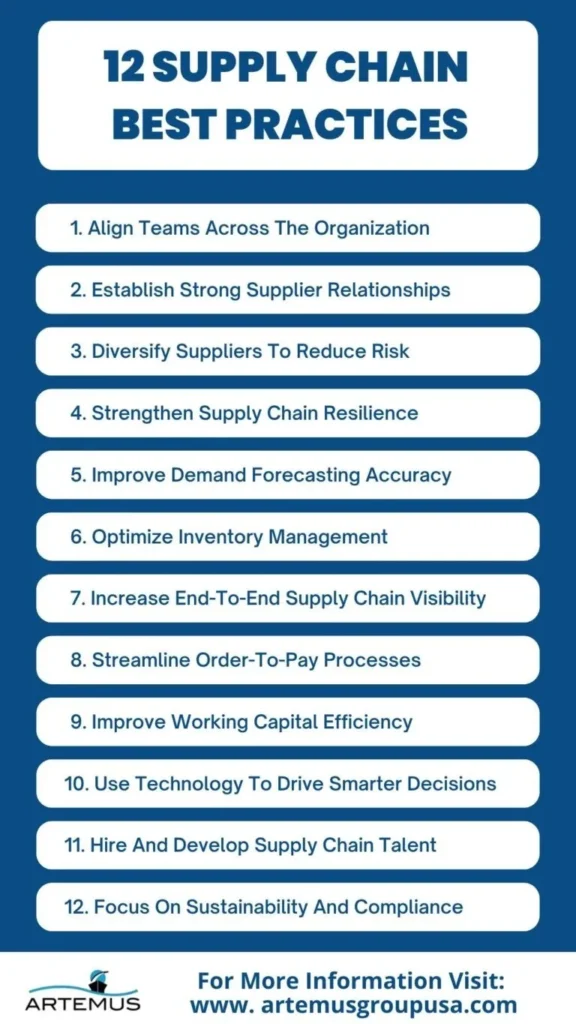
An effective supply chain is a strategic asset. When managed well, it improves cash flow, reduces operational risk, strengthens supplier partnerships, and helps businesses respond faster to market changes. These 12 supply chain best practices outline practical steps companies can take to build more efficient, resilient, and future-ready operations.
Supply chain inefficiencies often arise when departments work in silos. Procurement, finance, warehousing, logistics, and sales may all operate with different systems and priorities. Aligning these teams requires standardized processes, shared objectives, and open communication.
Assigning a central coordination role can help bridge gaps between departments. When everyone from leadership to warehouse staff understands how their role impacts the broader supply chain, execution improves and innovation becomes easier.
Suppliers play a critical role in keeping operations running smoothly. Companies should identify which suppliers are business-critical and manage those relationships strategically. Strong supplier relationship management goes beyond pricing and delivery timelines. It includes monitoring supplier financial health, offering fair payment terms, and supporting long-term stability.
When disruptions occur, businesses with trusted supplier relationships are more likely to receive priority support, faster communication, and flexible solutions. Strong partnerships also unlock efficiencies during normal operations by improving coordination, reducing errors, and enabling joint problem-solving.
Supplier delays are one of the most common causes of supply chain disruption. Weather events, regulatory changes, tariffs, labor shortages, and transportation issues can all halt supply unexpectedly. Relying on a single supplier increases exposure to these risks.
Diversifying suppliers across regions and markets gives businesses alternatives when problems arise. Strong communication with suppliers also helps identify potential delays early, allowing companies to adjust sourcing or inventory strategies before disruptions escalate.
The lowest-cost supply chain is not always the most reliable. Recent global disruptions have shown the importance of balancing efficiency with adaptability. Resilience starts with stress-testing the supply chain to understand how it reacts to delays, shortages, or geopolitical events.
Inventory strategy is a key factor. While holding extra stock ties up capital, strategic safety inventory can keep operations running during shipping delays or supplier interruptions. Sourcing decisions also matter. Companies should evaluate not just where goods are produced, but how they move across trade routes and how vulnerable those routes are to disruption.
Inaccurate demand forecasting leads to excess inventory or missed sales opportunities. Effective forecasting uses historical sales data, seasonality, promotions, and market trends to predict future demand more accurately.
Better forecasts allow businesses to purchase the right quantities at the right time, reducing carrying costs while ensuring product availability. Even small improvements in forecast accuracy can have a significant impact on revenue and profitability.
Inventory management works hand in hand with demand forecasting. Once demand is understood, businesses must determine optimal stock levels and replenishment strategies. Real-time inventory visibility is essential for this process.
Advanced inventory systems track stock movement, measure inventory velocity, and trigger automatic reordering based on demand patterns. This helps companies reduce excess stock, avoid shortages, and align inventory decisions with broader supply chain goals.
Visibility across the entire supply chain improves coordination and responsiveness. Businesses need real-time insights into suppliers, warehouses, transportation partners, and documentation.
End-to-end visibility allows companies to identify bottlenecks, respond quickly to delays, and provide customers with accurate delivery updates. It also supports better decision-making by giving leaders a clear view of how each part of the supply chain is performing.
The order-to-pay process involves multiple departments and systems, which often leads to delays and data inconsistencies. Centralizing and automating this process improves efficiency and accuracy.
A unified platform can manage everything from supplier onboarding and purchase orders to delivery confirmation and final payment. This reduces manual work, improves visibility, and shortens cycle times across the supply chain.
Working capital is often locked inside the supply chain through unpaid invoices and long payment cycles. Improving efficiency here directly strengthens cash flow and financial stability. Businesses can shorten the cash conversion cycle by reducing days sales outstanding and carefully managing payment terms.
Supply chain finance programs allow suppliers to receive early payments on approved invoices using the buyer’s credit strength, not their own. This helps suppliers access cash faster while buyers maintain their liquidity. When supply chain finance is not available, accounts receivable financing offers another option by allowing suppliers to sell invoices for immediate cash.
Technology has become essential to modern supply chain management. AI and machine learning tools can improve forecasting accuracy, assess customer credit risk, and optimize payment terms across different buyers. Predictive analytics help businesses anticipate demand shifts, supplier delays, and inventory needs before problems arise.
Smaller and mid-sized companies can gain a competitive edge by adopting digital tools early. As technology costs decline, businesses that understand how to apply these tools effectively can move faster and operate more efficiently than larger, slower-moving competitors.
A strong supply chain depends on skilled professionals who understand logistics, data, compliance, and technology. Many organizations face a talent gap, making recruitment and development a priority. Partnering with universities, offering internships, and working with specialized recruiters can help attract qualified candidates.
Equally important is investing in current employees. Ongoing training, clear career paths, and cross-functional mobility help retain talent and build teams that understand the supply chain end to end.
Sustainability and compliance are now core supply chain priorities. Customers, regulators, and partners expect businesses to minimize environmental impact and uphold ethical labor standards.
This includes working with responsible suppliers, reducing emissions through smarter transportation choices, and staying current with evolving regulations. Companies that lead in environmental and social responsibility strengthen brand reputation, reduce compliance risk, and build more resilient supply chains for the long term.
Related: Merchandise Processing Fee (MPF): A Complete Guide
Shipping supply chains form the backbone of global trade, ensuring goods reach their destinations efficiently and on time. However, this complex network faces numerous challenges that can disrupt operations, increase costs, and impact customer satisfaction.
Below are the key challenges that supply chain professionals in the shipping industry encounter:
Ports worldwide often face congestion due to increasing trade volumes, limited infrastructure, and inefficient operations. Delays in loading, unloading, and customs clearance can lead to cascading disruptions throughout the supply chain. Addressing port inefficiencies and improving turnaround times is critical for maintaining smooth shipping operations.
The shipping industry is highly susceptible to fluctuating fuel prices, which significantly affect operational costs. Additionally, increasing costs for labor, equipment, and compliance with regulations place further strain on shipping companies. Balancing cost-efficiency while maintaining service quality remains a pressing challenge.
Shipping involves navigating a maze of international laws, tariffs, and customs requirements. Frequent changes in trade policies, sanctions, and environmental regulations (such as IMO 2020) add complexity and demand constant vigilance. Non-compliance can result in heavy fines, shipment delays, or even bans.
Natural disasters, geopolitical conflicts, and pandemics can severely disrupt shipping supply chains. Events like port closures, strikes, or changes in trade routes create bottlenecks that ripple across global supply chains. Building resilient systems to withstand these disruptions is essential.
The absence of real-time tracking and transparency makes it difficult to monitor shipments, leading to inefficiencies and delays. Customers increasingly demand real-time updates, and the lack of visibility can damage trust and impact business relationships.
A mismatch between supply and demand often results in capacity shortages, especially during peak seasons. Limited availability of shipping containers, vessels, and trucking capacity compounds the problem, leading to delays and higher shipping costs.
With growing awareness of environmental impact, shipping companies are under pressure to reduce emissions and adopt sustainable practices. Transitioning to low-sulfur fuels, implementing energy-efficient technologies, and complying with environmental regulations require significant investment.
Despite advancements, many shipping companies still rely on outdated systems, leading to inefficiencies. Integrating modern technologies like IoT, blockchain, and AI into legacy systems remains a challenge for smaller players with limited budgets.
Related: Full Container Load Meaning (FCL) & Key Considerations
In 2026, supply chain management is shifting from reactive decision-making to more structured, forward-looking strategies. Ongoing trade uncertainty, economic pressure, and technology adoption are pushing organizations to prioritize resilience, cost efficiency, and operational flexibility.
Supply chain leaders are focusing on diversification, realistic technology deployment, and workforce readiness to navigate continued volatility while maintaining performance and profitability.
Persistent tariff volatility continues to make long-term supply chain planning more difficult for global organizations. To manage frequent policy shifts, many companies are adopting shorter planning cycles that allow faster adjustments to sourcing and routing decisions.
Nearshoring and regional sourcing strategies are gaining momentum as businesses look to reduce exposure to geopolitical risk. At the same time, the growth of bilateral and fragmented trade agreements is increasing complexity across global supply networks.
Slowing consumer spending is creating challenges for demand forecasting and inventory planning across multiple industries. Rising debt levels among suppliers are increasing financial risk, making supplier visibility and stress testing more important than ever.
Weakness in housing and construction continues to affect upstream sectors such as manufacturing, raw materials, and packaging. As a result, companies must manage inventory levels and pricing strategies more carefully to protect margins.
Organizations are reassessing their manufacturing and distribution footprints to address underutilized capacity and rising operating costs. Facility consolidation is becoming a common approach to improving efficiency and eliminating excess fixed costs.
Transportation contracts and freight strategies are being reviewed more frequently to adapt to fluctuating rates and market conditions. In parallel, greater use of multimodal transportation is helping companies maintain flexibility while controlling logistics expenses.
Many companies are recalibrating expectations around artificial intelligence as returns on investment take longer to materialize than initially anticipated. Despite this, predictive tools continue to play a growing role in demand planning, disruption management, and operational decision-making.
Agentic and generative AI applications are gaining traction, particularly in forecasting and scenario analysis. The focus in 2026 is shifting toward scalable, well-governed AI deployment supported by strong data foundations.
Labor shortages and an aging leadership base are placing increasing pressure on supply chain operations. To offset workforce constraints, companies are accelerating investments in automation and productivity-enhancing technologies.
However, skills gaps remain, especially in areas related to AI, data analytics, and advanced planning systems. As a result, upskilling and talent development are becoming essential to ensure that workforce capabilities keep pace with technology investments.
Related: What Happens After Custom Clearance Completed? 9 Next Steps
Artemus offers industry-leading solutions for Import Security Filing (ISF), Automated Manifest System (AMS), and Automated Export System (AES) filings, ensuring seamless customs compliance for international shipments. Our robust software simplifies complex regulatory processes, helping businesses stay compliant with U.S. Customs and Border Protection (CBP) requirements.
Whether it’s reducing the risk of penalties with accurate ISF filings, enhancing cargo visibility through AMS, or streamlining export declarations with AES, Artemus delivers efficiency and precision tailored to your needs.
With a user-friendly interface, real-time updates, and exceptional customer support, Artemus empowers freight forwarders, customs brokers, and logistics providers to navigate the complexities of global trade confidently. Our solutions are designed to enhance supply chain efficiency, reduce operational risks, and ensure timely clearance, making Artemus your trusted partner for comprehensive customs compliance.
Related: NVOCC Bond & OTI Bonds – Federal Maritime Commission
A supply chain encompasses all activities, resources, and entities involved in producing and delivering a product or service from raw material suppliers to the end customer.
Examples of supply chains include raw material procurement for automobile manufacturing, logistics networks for e-commerce companies, or the sourcing and delivery of fresh produce to grocery stores.
Supply chain management practices refer to strategies and processes used to optimize the flow of goods, services, information, and finances across the supply chain, ensuring efficiency and customer satisfaction.
The 7 C’s of supply chain management are Customer Centricity, Collaboration, Cost Management, Connectivity, Commitment, Consistency, and Continuous Improvement.
The 5 W’s refer to Who (stakeholders), What (goods/services), When (timelines), Where (locations), and Why (business goals) in the context of managing a supply chain.
The 5 R’s of supply chain management are delivering the right product, in the right quantity, at the right place, at the right time, and at the right cost to meet customer demand efficiently.
You can improve your supply chain by optimizing processes, embracing digital tools, diversifying suppliers, focusing on sustainability, and building strong collaborations with stakeholders.
The supply chain supports business strategy by ensuring timely delivery, reducing costs, improving quality, and enhancing customer satisfaction, all of which drive competitive advantage and profitability.
In the fast-paced world of global trade, adopting supply chain best practices in shipping is no longer optional, it’s a necessity. From optimizing inventory management to implementing advanced technologies for real-time tracking and sustainability, businesses can greatly enhance their efficiency, reduce costs, and improve customer satisfaction.
Related: Less Than Container Load (LCL) Shipping: 2025 Guide

Roughly $166 billion in IEEPA tariffs were collected from US importers between February 2025 and February 2026. The Supreme Court

The United Kingdom is one of the world’s largest trading economies and a top exporter of services. Cars, machinery, pharmaceuticals,
Mexico became the United States’ number-one trading partner in 2024, surpassing both Canada and China. According to the Office of
 Optimized by Seraphinite Accelerator