UK Imports & Exports: Trade Profile & Top Partners
The United Kingdom is one of the world’s largest trading economies and a top exporter of services. Cars, machinery, pharmaceuticals,



Trade between Brazil and the United States is a cornerstone of international commerce, making what does Brazil export to The US a key question for importers, exporters, and logistics professionals.
Brazil supplies the U.S. with essential commodities and manufactured goods, including energy products, metals, agricultural exports, and high value industrial items that support multiple American industries.
Throughout this blog, we covered Brazil’s major export categories to the U.S., the largest traded products, trade agreements, and the economic impact of these exports on both economies. We also highlighted how regulations, reporting requirements, and compliance obligations influence Brazil to U.S. trade flows in 2025.
Managing these processes efficiently requires the right technology. Artemus supports Brazil to U.S. trade with robust ISF, AMS, and AES compliance software, helping businesses streamline filings, meet regulatory requirements, reduce errors, and ensure smooth cross border shipping operations.
Table Of Contents
Brazil continues to be a major trading partner for the United States in 2025, supplying critical goods across energy, industrial, agricultural, and manufacturing sectors.
According to United Nations COMTRADE data, compiled and published by Trading Economics, Brazil exported USD 38.1 billion worth of goods to the United States in 2025. This keeps the US firmly among Brazil’s top three export destinations worldwide .
Brazilian exports play a strategic role in the U.S. economy. Mineral fuels and oils, including crude oil, are the single largest export category, supporting U.S. energy diversification. Iron and steel products form another major share, supplying raw materials for construction, automotive, and industrial manufacturing.
Machinery and mechanical appliances and aircraft and aerospace components, led by Embraer, highlight Brazil’s growing importance in advanced manufacturing supply chains. On the consumer side, coffee and agricultural products remain essential to U.S. food and beverage markets, with Brazil continuing as the largest coffee supplier to the US .
Trade conditions in 2025 were shaped by selective tariffs and ongoing bilateral negotiations. Reuters reports that while some Brazilian exports faced higher U.S. duties, energy and industrial goods largely maintained stable trade flows due to their importance to U.S. supply chains .
Overall, Brazil’s USD 38.1 billion export footprint in the U.S. reflects a balanced mix of commodities and value-added goods, positioning Brazil as a reliable and strategically important supplier to the American market in 2025.
Related: What Does Mexico Export To The US? Trade Insights

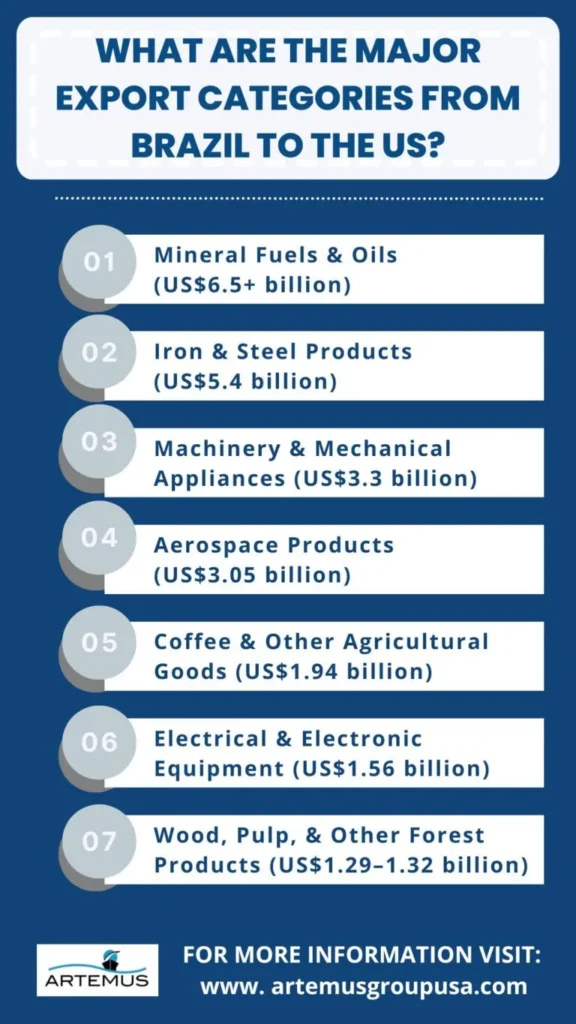
In 2025, Brazil’s exports to the United States included a broad mix of energy products, industrial materials, manufactured goods, and agricultural commodities. These categories reflect both the structure of Brazil’s economy and the specific demand from U.S. markets, with multiple product groups contributing to overall trade flows:
Energy products remain Brazil’s largest export category to the U.S. in 2025. This includes crude oil and petroleum distillates, which are essential for U.S. energy supply diversification and refining operations. In the aggregate export data, mineral fuels and oils formed a significant portion of Brazil’s overall exports, highlighting their central role in trade flows .
Industrial metals, particularly iron and steel, are among Brazil’s top exports to the United States. These products support major U.S. industries such as construction, automotive manufacturing, and heavy machinery production. In 2025, exports in this category were valued at over US$5.4 billion according to available trade figures .
Brazil exports industrial and mechanical equipment, including machinery parts and systems used in manufacturing and production facilities. Machinery exports to the U.S. reached roughly US$3.3 billion, reflecting demand for specialized industrial equipment .
Aircraft and aerospace components, particularly from established manufacturers like Embraer, are a strong export category. In 2025, aerospace goods accounted for around US$3.05 billion of Brazilian exports to the U.S. market .
Brazil remains a leading supplier of coffee to the United States, with exports of coffee and related agricultural products reaching nearly US$1.94 billion in 2025. Other food preparations, including vegetable and fruit products, also contribute to this category’s export value .
Electronic components and electrical machinery, valued at about US$1.56 billion, reflect Brazil’s growing capability in technology and equipment for industrial and consumer use .
Brazil exports wood products, wood pulp, and related materials to the United States. These categories supported US$1.29–1.32 billion in export value in 2025, adding diversity to Brazil’s agricultural and resource exports.
Related: What Does Colombia Export To USA? Key Products & Insights
As of 2025, the United States and Brazil do not have a free trade agreement that eliminates tariffs. Instead, their trade relationship is governed by a cooperation-based framework supported by ongoing bilateral dialogue.
The primary arrangement is the Agreement on Trade and Economic Cooperation (ATEC), signed in 2011. ATEC does not reduce tariffs but provides a formal platform for cooperation on trade facilitation, investment, regulatory transparency, and dispute resolution through the Commission on Economic and Trade Relations .
In 2020, both countries signed a Protocol Relating to Trade Rules and Transparency, which entered into force in 2022. This protocol modernized the framework by adding commitments on customs procedures, good regulatory practices, and anti-corruption measures, aiming to make bilateral trade more predictable without changing tariff levels.
There is no bilateral free trade agreement largely because Brazil negotiates major trade deals through the Mercosur bloc. While Mercosur has pursued agreements with other regions, no US-Mercosur trade agreement has been finalized .
In 2025, trade relations were further shaped by U.S. tariff actions on select Brazilian goods, prompting renewed negotiations. Both governments have emphasized dialogue to manage trade frictions while continuing to trade under World Trade Organization rules rather than a preferential trade pact .
Related: Top 10 Items Exported From India To The USA

In 2025, mineral fuels and oils are Brazil’s largest export to the United States. This category is driven mainly by crude oil and petroleum products, which are in strong demand across U.S. refining and energy markets.
Brazil exported US$6.58 billion worth of mineral fuels and oils to the U.S. in 2025, making it the single highest-value export category. These shipments play an important role in diversifying U.S. energy imports and supporting refinery operations, particularly in key industrial regions.
While Brazil also exports significant volumes of iron and steel, machinery, aerospace products, and agricultural goods, none exceeded the export value of mineral fuels and oils, reinforcing energy as the cornerstone of Brazil-U.S. trade in 2025.
Related: Poland’s Exports To USA: The Complete List For Opportunities

In 2025, Brazil continues to be a significant source of steel for the United States, especially in semi-finished and raw steel products used by U.S. mills and manufacturers.
According to the latest available data, the United States imported approximately US$5.42 billion worth of iron and steel products from Brazil in 2025. This includes semi-finished steel, pig iron, ferro-alloys, and other iron- and steel-related products that feed into U.S. industrial production, construction, and infrastructure sectors.
Brazil ranks among the top foreign suppliers of steel to the U.S., alongside Canada and Mexico, and its shipments remain essential despite tariff changes and market adjustments.
Related: Exporting From Australia To USA: A Complete Guide
Brazilian exports to the United States have a clear economic impact on both countries in 2025.
Related: How To Export Agricultural Products From India To The USA?
Artemus Transportation Solutions helps businesses manage compliance smoothly for shipments moving from Brazil to the United States. Its ISF, AES, and AMS software streamlines import and export filings while keeping every step aligned with U.S. regulations.
The ISF 10+2 solution supports importers and freight forwarders by ensuring inbound cargo data is filed accurately and on time. Real time visibility and remote access help reduce errors, avoid penalties, and prevent clearance delays.
Artemus AES software simplifies Electronic Export Information filing for exporters. It ensures timely submissions, minimizes manual mistakes, and keeps exports moving without disruption.
The AMS solution makes advanced cargo reporting efficient and secure. Automated workflows and an easy to use interface help teams manage manifests, arrival notices, and compliance reports with confidence.
With Artemus, companies trading between Brazil and the U.S. gain better control, fewer compliance risks, and clearer visibility across the entire shipping and filing process.
Related: AMS Fee In Shipping: Overview & 5 Key Considerations
No, the United States does not have a formal free trade agreement with Brazil. Trade between the two countries operates under World Trade Organization rules, along with bilateral dialogues and sector specific agreements.
Yes, Brazil and the United States have a strong and long standing trade relationship. The U.S. is one of Brazil’s top export destinations, importing energy products, metals, aircraft, agricultural goods, and manufactured items each year.
Yes, the U.S. imports beef from Brazil, primarily frozen and processed beef. These imports are subject to strict USDA inspections and quotas to meet U.S. food safety standards.
In 2024, the United States imported about 230,000 metric tons of beef from Brazil, valued at roughly US$1.35 billion. These imports include frozen and processed beef and are overseen under U.S. quotas and food safety inspections to meet domestic demand and supply chain needs.
Brazil’s largest overall export globally is crude oil, followed closely by soybeans. These commodities generate the highest export revenue and are central to Brazil’s trade profile.
Brazil–U.S. trade remains a vital link in global commerce, driven by strong demand for energy, industrial materials, agricultural products, and manufactured goods. Understanding what Brazil exports to the U.S., how these trade flows impact both economies, and the regulations involved helps businesses plan smarter and operate more efficiently.
With the right compliance tools and clear market insight, companies can navigate Brazil to U.S. trade confidently and keep their supply chains moving without disruption.
Related: What Is The Purpose Of Tariffs? Key Insights To Know

The United Kingdom is one of the world’s largest trading economies and a top exporter of services. Cars, machinery, pharmaceuticals,
Mexico became the United States’ number-one trading partner in 2024, surpassing both Canada and China. According to the Office of
Colombia is one of Latin America’s most active trading economies. Crude oil, coffee, coal, and cut flowers flow out. Machinery,