IEEPA Tariff Refunds: A 2026 CAPE Filing Guide
Roughly $166 billion in IEEPA tariffs were collected from US importers between February 2025 and February 2026. The Supreme Court



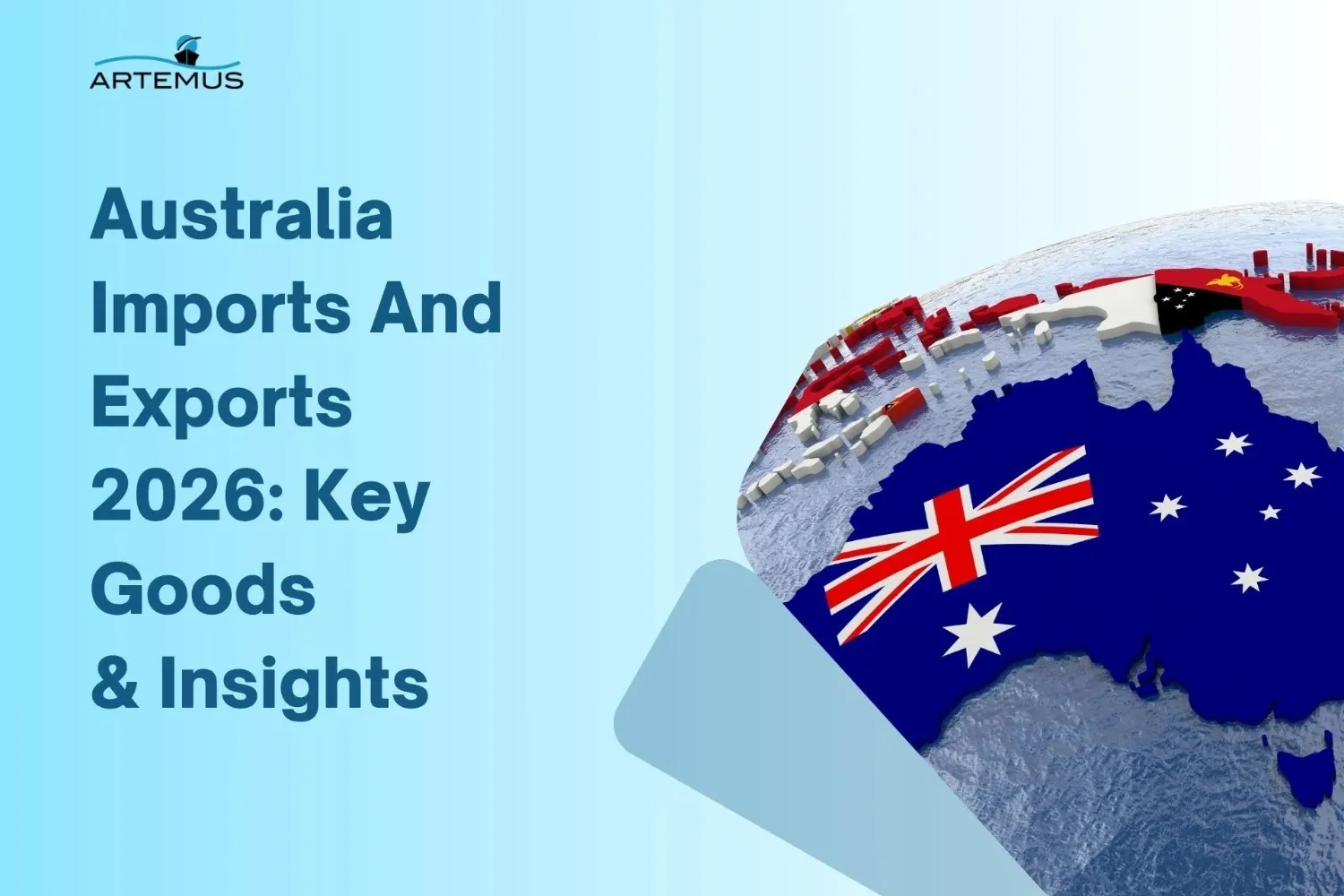
Australia’s imports and exports shape the country’s economy and influence global trade patterns. Importers bring in essential goods like machinery, vehicles, and pharmaceuticals to support industries and daily life, while exporters supply minerals, agricultural products, and energy resources that are in high demand worldwide.
Understanding these trade flows helps importers and exporters anticipate market trends, manage shipments efficiently, and navigate regulatory requirements. This blog explores what Australia imports and exports, highlights major trading partners, examines key products, and looks at the impact of trade policies.
Moreover, Artemus Transportation Solution provides advanced ISF, AMS, and AES software to support importers and exporters in managing compliance, streamlining documentation, and keeping shipments moving smoothly while minimizing delays and errors.
Table Of Contents
Australia’s trade in 2025–2026 continues to highlight its role as a major global exporter of natural resources while relying on strategic imports to support domestic industries and consumer demand. The country generally maintains a positive trade balance, driven by strong commodity exports and steady international demand.
Exports remain heavily dominated by resources such as iron ore, coal, liquefied natural gas (LNG), gold, and agricultural products, with resource-rich states like Western Australia, Queensland, and New South Wales contributing the largest share. China remains Australia’s largest export destination, accounting for a significant portion of total exports, followed by Japan, United States, South Korea, and India. Together, these five partners make up more than 60% of Australia’s total exports.
On the import side, Australia brings in a wide range of manufactured and industrial goods, including passenger vehicles, machinery, refined petroleum, electronics, and medical supplies. Key import hubs are located in New South Wales, Victoria, and Queensland. The largest sources of imports are China and the United States, followed by Japan, Singapore, and Thailand.
By combining strong commodity exports with essential imports that support manufacturing, infrastructure, and technology sectors, Australia maintains a competitive position in global trade while supporting long-term economic growth and industrial development.
Related: Exporting From Australia To USA: A Complete Guide

Australia’s export economy is heavily driven by natural resources, with a few key commodities accounting for a large share of the country’s trade revenue. According to recent government reports and market forecasts, these exports continue to play a central role in Australia’s global trade position.
Iron ore remains Australia’s largest export, generating around A$137.9 billion in 2023–24. Production is concentrated in Western Australia and exported mainly to China, Japan, and South Korea. Forecasts suggest export earnings may decline to about A$104–105 billion by 2025–26 and around A$97 billion by 2026–27, largely due to softer global prices.
Coal is another key export, with combined earnings of about A$91 billion in 2023–24. Metallurgical coal used in steelmaking is expected to remain relatively stable at around A$40–41 billion annually, while thermal coal earnings could decline from about A$32 billion in 2024–25 to around A$26 billion by 2026–27 as countries transition toward cleaner energy sources.
Liquefied natural gas (LNG) exports totaled roughly A$68.7 billion in 2023–24, with major demand from Asian markets. Export earnings are projected to decrease from around A$67 billion in 2024–25 to about A$53 billion by 2026–27 as global energy prices moderate.
Gold exports reached about A$32.9 billion in 2023–24, supported by strong global demand and high commodity prices. Export earnings are forecast to rise to around A$56 billion in 2025–26 before easing slightly to about A$52 billion by 2026–27.
Exports of aluminium ores, alumina, and related products generated about A$10.4 billion in 2023–24. With steady global industrial demand, export earnings are expected to grow and could reach around A$19 billion by 2026–27.
Copper exports were valued at approximately A$6.2 billion in 2023–24. Rising global demand for renewable energy infrastructure and electric vehicles is expected to boost exports to around A$16.7 billion in 2025–26 and about A$18 billion by 2026–27.
Critical minerals are becoming increasingly important to Australia’s export mix. Materials such as lithium and manganese, essential for batteries and clean energy technologies, are forecast to grow from around A$1.7 billion in 2024–25 to nearly A$4.8 billion by 2026–27, reflecting strong global demand for energy-transition resources.
Related: Import Cars From Australia To USA: A 2024 Detailed Guide

Australia relies heavily on imports to meet its domestic needs across industries ranging from energy to technology. Here are the key imports to Australia, along with the latest available statistics.
Refined petroleum remains Australia’s largest goods import category. In 2024–25, imports were valued at around A$ 43.8 billion, reflecting the country’s reliance on imported fuel to support transportation, mining, and industrial activities. Despite the growth of renewable energy, imported petroleum products continue to power much of Australia’s economy.
Passenger motor vehicles are another major import for Australia. In 2024–25, imports were valued at approximately A$ 34.5 billion. Since Australia no longer has large-scale domestic car manufacturing, it relies on imports from countries such as Japan, Thailand, South Korea, and China to meet consumer demand.
Commercial vehicles, including trucks, vans, and utility vehicles, accounted for about A$ 15.7 billion in imports in 2024–25. These vehicles are essential for logistics, freight transportation, mining, and construction sectors across the country.
Telecommunications equipment and parts were valued at around A$ 17.3 billion in 2024–25. These imports support Australia’s expanding digital infrastructure, including mobile networks, internet connectivity, and advanced communication technologies used by businesses and consumers.
Australia imported approximately A$ 13.7 billion worth of computers and related hardware in 2024–25. Computers, laptops, and servers are essential for education, business operations, and government services, highlighting the country’s growing digital economy.
Medicaments and veterinary medicines were imported to the value of about A$ 9.7 billion in 2024–25. These pharmaceutical imports ensure reliable access to medicines for both human healthcare and the agricultural sector.
Electrical machinery and parts not elsewhere specified accounted for roughly A$ 10.8 billion in imports in 2024–25. These components are widely used in appliances, industrial machinery, and electronic equipment across multiple sectors.
Civil engineering equipment and related machinery imports remain significant, supporting Australia’s large infrastructure and construction projects. Recent estimates place these imports at around A$ 8–9 billion annually, used in road construction, mining operations, and major development projects.
Related: Importing Motorcycle From USA To Australia: A 2024 Guide
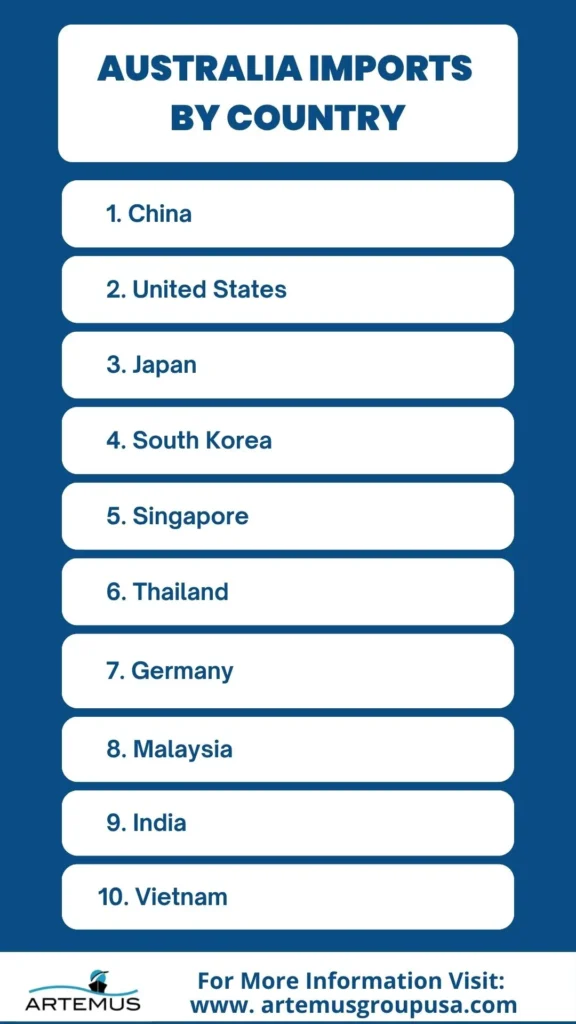
Australia’s imports are spread across a range of countries, with each playing a vital role in supplying goods and raw materials essential to the nation’s industrial, technological, and consumer sectors.
China is Australia’s largest import partner. In 2024–25, imports from China were valued at around A$120 billion, making it the dominant supplier of manufactured goods such as electronics, machinery, furniture, textiles, and consumer products. These imports are crucial for Australia’s retail, construction, and technology sectors.
The United States is Australia’s second-largest import partner. Imports from the U.S. reached approximately A$96.8 billion in 2024–25, including aircraft, advanced machinery, pharmaceuticals, and high-tech equipment. These products support Australia’s defense, healthcare, and industrial sectors.
Japan remains one of Australia’s key trade partners. In 2024–25, imports from Japan totaled around A$32.4 billion, mainly consisting of automobiles, industrial machinery, and precision electronic components used in manufacturing and transportation.
South Korea is another important supplier, providing vehicles, petrochemical products, electronics, and machinery. Imports from South Korea were valued at around A$25–26 billion annually, supporting Australia’s automotive, construction, and technology industries.
Singapore plays a strategic role in Australia’s imports, particularly in energy and refined petroleum products. In 2024–25, imports from Singapore reached about A$26.4 billion, including fuel, machinery, and electrical equipment used across industrial and transportation sectors.
Thailand is a major supplier of automobiles, automotive parts, electronics, and machinery. Australia imported around A$23–24 billion worth of goods from Thailand in 2024–25, reflecting strong trade ties in the automotive and manufacturing sectors.
Germany exports high-technology goods to Australia, including industrial machinery, automotive components, chemicals, and pharmaceuticals. Imports from Germany were valued at over A$23 billion in 2023–24, supporting advanced manufacturing and engineering industries.
Malaysia supplies Australia with electrical machinery, electronic components, refined petroleum, and industrial equipment. Imports from Malaysia were valued at around A$20 billion in recent years, playing a significant role in Australia’s electronics and energy supply chains.
India has emerged as a growing trade partner for Australia. In 2023–24, imports from India were valued at about A$15–16 billion, consisting mainly of pharmaceuticals, textiles, machinery, and chemicals used across consumer and industrial markets.
Vietnam has rapidly expanded its role in Australia’s supply chain. Imports from Vietnam reached around A$13–14 billion in 2023–24, including electronics, telecommunications equipment, textiles, footwear, and furniture.
These countries form the backbone of Australia’s import network, ensuring a steady supply of essential goods that support the nation’s economy, industrial development, and consumer markets.
Related: Poland’s Exports To USA: The Complete List For Opportunities

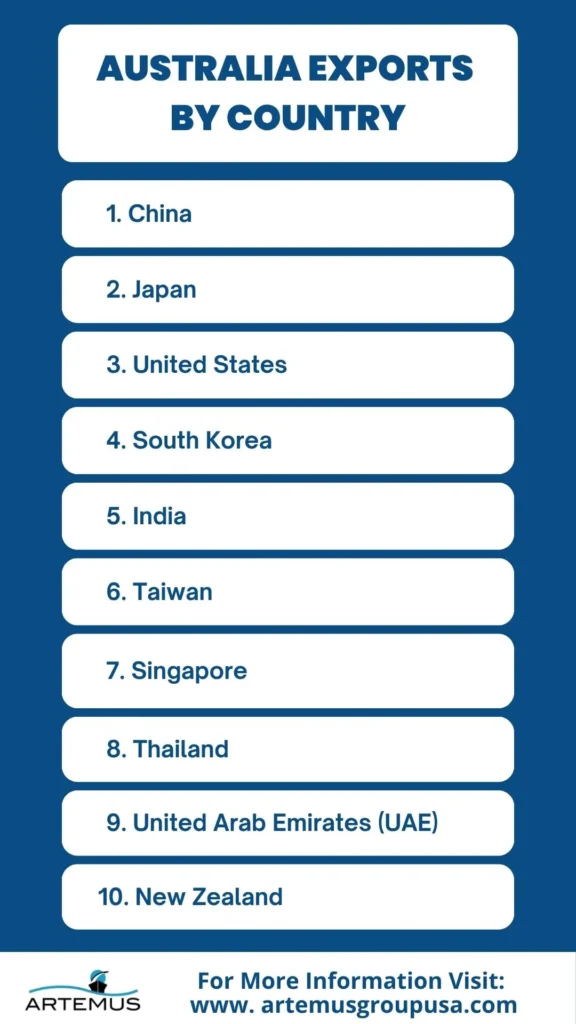
Australia’s exports are directed toward key trading partners, reflecting strong global demand for its natural resources, minerals, energy products, and agricultural commodities. These markets play a vital role in supporting Australia’s trade performance and economic growth.
China remains Australia’s largest export destination. In 2024–25, exports to China were valued at about A$188.7 billion, making it by far Australia’s biggest trading partner. Major exports include iron ore, coal, liquefied natural gas (LNG), and agricultural products that support China’s steel production, energy generation, and manufacturing industries.
Japan is Australia’s second-largest export market. In 2024–25, exports to Japan totaled around A$69.7 billion. Key exports include LNG, coal, and iron ore, which are crucial for Japan’s electricity generation, heavy industry, and steel manufacturing sectors.
The United States has become a rapidly growing export destination for Australia. In 2024–25, exports to the United States reached approximately A$54.6 billion, including gold, beef, pharmaceuticals, and specialised minerals used in advanced manufacturing and technology industries.
South Korea is another major trading partner, importing coal, LNG, iron ore, and aluminium from Australia. In 2024–25, exports to South Korea were valued at around A$41.3 billion, supporting the country’s power generation, shipbuilding, and industrial production sectors.
India is one of Australia’s fastest-growing export markets. In 2024–25, exports to India reached approximately A$35 billion. Major exports include coal, gold, copper ores, and LNG, which help meet India’s energy demand and industrial growth.
Taiwan is a significant destination for Australian energy and mineral exports. Australia exports coal, LNG, and iron ore to Taiwan, which are essential for its energy production and industrial manufacturing sectors.
Singapore functions as both a trading hub and a direct market for Australian exports. Key exports include petroleum products, aluminium, and minerals that are distributed across Southeast Asia through Singapore’s regional trade networks.
Thailand imports natural resources and metals from Australia, including coal, LNG, and copper ores. These exports support Thailand’s manufacturing industries and electricity generation.
The UAE imports gold, precious metals, and agricultural products from Australia. The country serves as an important trading and financial hub in the Middle East, particularly for bullion trading.
New Zealand is one of Australia’s closest economic partners. Exports include manufactured goods, food products, machinery, and petroleum products, reflecting strong bilateral trade under the Closer Economic Relations (CER) agreement.
Related: How To Export Agricultural Products From India To The USA?
Australia’s international trade is supported by several major industries that contribute significantly to exports and economic growth.
Together, these industries form the backbone of Australia’s trade economy and strengthen its role in global commerce.
Related: What Is The Purpose Of Tariffs? Key Insights To Know
Australia’s trade is supported by several major agreements that reduce tariffs, improve market access, and strengthen economic ties with key partners.
Related: What Are The Key Exports And Imports In Germany?
Several trends are shaping Australia’s trade landscape in 2026, influencing both exports and global supply chains.
Related: Japan Imports And Exports 2024: Top Products & Their Impact
Australia plays an important role in global trade due to its vast reserves of natural resources, strong agricultural production, and stable trading environment. As one of the world’s leading exporters of minerals, energy resources, and food products, Australia contributes significantly to global supply chains and industrial development.
Australia is one of the world’s largest exporters of iron ore, coal, liquefied natural gas (LNG), and gold. These commodities are essential for steel production, manufacturing, and energy generation in major economies such as China, Japan, and South Korea. The consistent supply of these resources helps support global infrastructure projects and industrial growth.
Australia is among the leading exporters of both thermal coal and LNG. These energy resources are vital for electricity generation and industrial operations in many countries, particularly in Asia. As a result, Australia plays an important role in maintaining energy security and supply stability in the global market.
Australia is a major exporter of agricultural commodities such as wheat, beef, wool, barley, and wine. These exports help meet food demand across international markets, particularly in Asia and the Middle East, and contribute to the stability of global agricultural supply.
Australia supplies important minerals such as iron ore, lithium, copper, and aluminium to global markets. These resources are essential raw materials for industries including steel manufacturing, electronics production, electric vehicles, and renewable energy technologies.
Australia maintains strong economic ties with major global markets including China, Japan, South Korea, the United States, and India. These trade partnerships support economic growth, investment opportunities, and long-term trade cooperation.
Australia is considered a reliable supplier of essential raw materials and energy resources. Many global industries depend on Australian exports for production and manufacturing. As a result, changes in Australia’s trade flows can influence commodity prices, supply chains, and industrial activity worldwide.
Related: What Is Global Trade Management? A Complete 2025 Guide
Australia’s trade policies play a significant role in shaping the country’s import and export performance. As a highly open and resource-driven economy, Australia is strongly influenced by global trade conditions, commodity demand, and international trade agreements.
Government policies such as low tariffs, free trade agreements, and a flexible exchange rate help maintain competitiveness and stability in international markets.
Trade policies in major economies can influence demand for Australian exports. When trading partners impose higher tariffs or trade restrictions, demand for some Australian goods may decline. However, many of Australia’s key exports, such as iron ore, coal, and liquefied natural gas (LNG), are difficult to substitute due to Australia’s large production capacity and competitive pricing.
Australia itself maintains relatively low import tariffs, which encourages trade, supports competition, and helps businesses access affordable imported goods.
Changes in global trade policies and supply conditions can shift where Australia sources its imports. If supply from one country becomes restricted or more expensive, Australian businesses often shift to alternative suppliers in other regions.
This diversification helps reduce supply risks and can lower costs if more competitive sources become available. Australia’s open trade environment allows businesses to adapt relatively quickly to global supply chain changes.
Australia operates under a floating exchange rate system, which helps stabilize trade performance during global economic changes. When global demand for Australian exports weakens, the Australian dollar often depreciates.
A weaker currency can make exports cheaper and more competitive internationally, while imports become more expensive. This automatic adjustment helps cushion the economy from external shocks.
The impact of trade policies varies across different industries.
Understanding these sector differences helps policymakers and businesses manage risks associated with global trade policy changes.
Australia’s trade framework is designed to support long-term resilience and economic stability. Key factors include:
These policies help Australia maintain stable trade relationships and remain competitive in the global economy.
Related: What Is Global Trade Compliance? A Complete Guide
Artemus Transportation Solutions provides software solutions that help businesses manage trade compliance for shipments between Australia and the United States.
It supports key U.S. customs filing systems, Importer Security Filing (ISF), Automated Export System (AES), and Automated Manifest System (AMS), helping businesses streamline import and export documentation while maintaining full regulatory compliance.
The ISF (10+2) solution enables importers and freight forwarders to submit required cargo data to U.S. Customs and Border Protection before shipments arrive, reducing the risk of delays and penalties.
For exporters, the AES filing system ensures accurate and timely submission of Electronic Export Information (EEI), improving efficiency and minimizing filing errors.
The AMS platform allows users to manage advanced cargo manifests, shipment notices, and compliance reporting through an intuitive interface with secure access controls.
Related: HS Code VS HTS Code: 10 Differences You Need To Know
China is Australia’s largest export market, purchasing a significant share of the country’s iron ore, coal, liquefied natural gas (LNG), and agricultural products.
Iron ore remains Australia’s top export commodity by value. It accounts for a large portion of the country’s export revenue and is primarily shipped to Asian steel-producing economies.
The leading Australian export to the United States is gold, followed by products such as beef, pharmaceuticals, and specialized manufactured goods. Gold exports dominate due to strong investment demand and bullion trading.
China is Australia’s largest overall trading partner, accounting for the biggest share of both exports and imports combined.
Australia’s trade plays a vital role in its economy and in the global market. Understanding what the country imports and exports, as well as its major trading partners, helps businesses and investors navigate opportunities effectively.
Monitoring trade trends and policies allows for better planning, reduces risks, and supports smoother international transactions. Staying informed about Australia’s trade patterns ensures that companies can make strategic decisions and maintain strong connections in the global marketplace.

Roughly $166 billion in IEEPA tariffs were collected from US importers between February 2025 and February 2026. The Supreme Court

The United Kingdom is one of the world’s largest trading economies and a top exporter of services. Cars, machinery, pharmaceuticals,
Mexico became the United States’ number-one trading partner in 2024, surpassing both Canada and China. According to the Office of
 Optimized by Seraphinite Accelerator