IEEPA Tariff Refunds: A 2026 CAPE Filing Guide
Roughly $166 billion in IEEPA tariffs were collected from US importers between February 2025 and February 2026. The Supreme Court



Roughly $166 billion in IEEPA tariffs were collected from US importers between February 2025 and February 2026. The Supreme Court struck those tariffs down in a 6-3 ruling, and US Customs and Border Protection has now opened the refund channel inside the Automated Commercial Environment (ACE).
The catch is that not every importer is getting paid. Some are still waiting. Others have missed deadlines they did not know existed. This guide walks through who is eligible for IEEPA tariff refunds, how the Consolidated Administration and Processing of Entries (CAPE) portal actually works, and the exact steps to file.
Artemus Transportation Solutions builds customs broker software used by brokers managing high-volume CBP filings, including IEEPA refund claims on behalf of their importer clients.
Table Of Contents
The International Emergency Economic Powers Act (IEEPA) is a 1977 federal law that lets the President regulate international economic transactions during a declared national emergency.
Between February 2025 and February 2026, the Trump administration used IEEPA to impose two broad categories of tariffs on US imports.
The first category covered fentanyl-related tariffs starting February 4, 2025. The second covered reciprocal tariffs of 10 percent on most countries, with higher rates for specified jurisdictions, beginning April 2025.
Additional tariffs on Indian-origin goods of 25 percent were also imposed in August 2025 and rescinded the following February.
On February 20, 2026, the Supreme Court issued a 6-3 decision in Learning Resources, Inc. v. Trump. The Court held that IEEPA does not authorize the President to impose tariffs absent clear congressional authorization. According to Norton Rose Fulbright’s analysis of the ruling, the decision invalidated all IEEPA-based tariffs from inception.
PwC’s commentary on the decision notes that the Court applied separation-of-powers principles. Tariff authority of significant economic and political magnitude requires explicit statutory delegation from Congress, which IEEPA does not provide.
Only tariffs imposed under IEEPA authority are refundable. Section 232 duties on steel, aluminum, and auto parts remain in place. Section 301 duties on goods from China also stand.
The Supreme Court ruling and the resulting refund process apply strictly to the IEEPA framework, not to other tariff authorities the administration continues to use.
Know More About: Duty Vs Tariff: Key Differences You Should Know
Eligibility for IEEPA tariff refunds depends on three things: who paid the duties, when the entries were filed, and what tariff codes were declared. Not every importer who paid duties in 2025 is eligible.
The Importer of Record (IOR) is the legal party responsible for the entry and the party that paid the IEEPA duties. Any IOR who paid IEEPA duties during the window from February 4, 2025 to February 24, 2026 has standing to claim a refund. The refund follows the IOR number on the entry summary, not the broker who filed it.
A licensed customs broker can submit CAPE Declarations on behalf of an IOR, provided the broker filed the original entries on behalf of that client. Brokers can include up to 9,999 entries on a single CAPE Declaration, even across multiple IORs they represent. This makes brokers a central operational layer in the refund process.
If an entry was assessed Section 232 or Section 301 duties only, those duties are not refundable. The refund applies strictly to the IEEPA portion of the duties paid. According to Steptoe’s status update on IEEPA refunds, CAPE removes the IEEPA Chapter 99 HTS codes from the entry summary and recalculates duties as if IEEPA had never applied.
Know More About: Importer Of Record Profile By Artemus
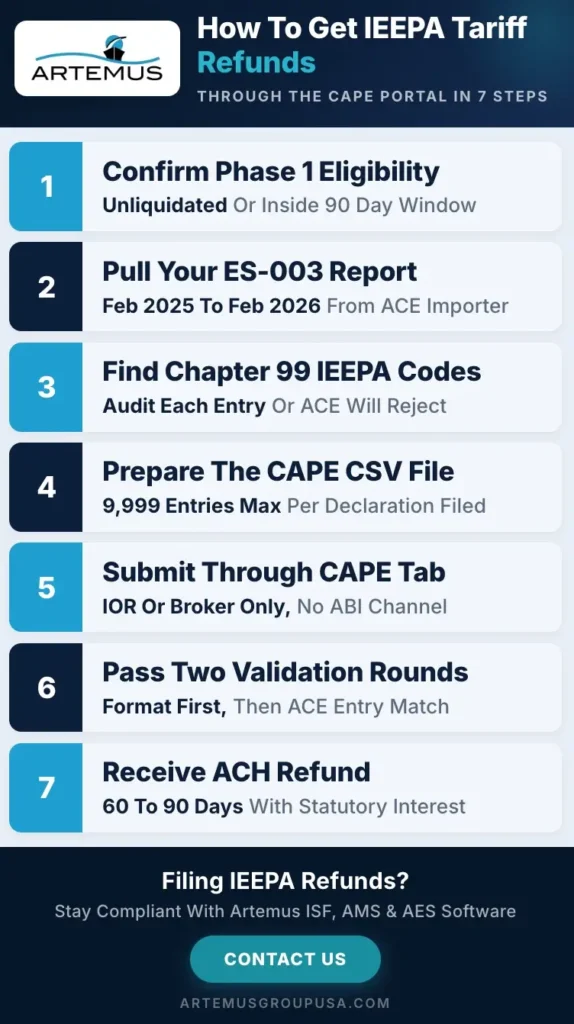
Filing for IEEPA tariff refunds requires using the CAPE portal inside ACE. CBP has confirmed this is the only channel. Post Summary Corrections and Automated Broker Interface filings are both blocked for this purpose. The seven steps below cover the full process.
Step 1: Confirm Your Entries Are Eligible For Phase 1
CAPE Phase 1, launched on April 20, 2026, accepts two categories of entries. The first is unliquidated entries with IEEPA duty payments or deposits. The second is entries liquidated within the preceding 80 days that remain inside the 90-day voluntary reliquidation window under 19 USC 1501. Entries past 180 days of liquidation need a different recovery path.
Step 2: Pull Your ES-003 Importer Activity Report From ACE
The ES-003 report shows your entry history during the IEEPA period, including which entries carry Chapter 99 IEEPA codes.
Pull this report from the ACE Importer view for the window February 2025 to February 2026. This becomes the foundation of your refund claim.
Step 3: Identify Entries With Chapter 99 IEEPA HTS Codes
Not every entry during the period qualifies. ACE will reject entries that do not carry a Chapter 99 IEEPA HTS code.
Audit your entry list against the ES-003 data, confirm each entry has an IEEPA-related Chapter 99 code, and segment by liquidation status before filing.
Step 4: Prepare The CSV File For CAPE Upload
CBP provides a downloadable CAPE Upload Template available through the CAPE tab in the ACE Portal.
The CSV file lists the entry summary numbers for which refunds are requested. CBP does not require any other information in the CSV.
Each CAPE Declaration is capped at 9,999 entries; importers and brokers can file multiple declarations to cover larger volumes.
Step 5: Submit The CAPE Declaration Through The ACE Portal
The CAPE tab appears as a new tab within importer and broker ACE Portal accounts. The official CBP IEEPA Duty Refunds page confirms that only the IOR or the authorized broker who filed the entries on behalf of the IOR may file the CAPE Declaration. The Automated Broker Interface is not a valid channel.
Step 6: Await Two Rounds Of Validation By CBP
ACE runs two validation rounds. The first checks the file format, required fields, and submitter authorization. The second validates each entry number against ACE records and confirms the Chapter 99 IEEPA code is present.
Accepted entries move forward; rejected entries return an error code that the filer must correct before resubmitting.
Step 7: Receive Your ACH Refund Within 60 To 90 Days
Once a CAPE Declaration is accepted, ACE removes the IEEPA duties from the entry summary lines and reliquidates the entry. The refund, including statutory interest, is paid electronically to the ACH account on file.
According to Holland & Knight’s guide on the CAPE process, refunds are typically issued within 60 to 90 days of CAPE Declaration acceptance.
Know More About: Artemus Customs Broker Software
ACE access is the gating step. Without it, no refund moves. CBP has automated the account creation process for importers, but a few details often trip up first-time applicants. The five steps below cover the full setup.
Step 1: Verify Your Company Does Not Already Have An ACE Top Account
A sub-account identifier cannot exist in multiple ACE top accounts. Before applying, confirm your company does not already have an account, often set up by a customs broker years earlier.
If one exists, you only need to be added as a user. Checking this avoids a system rejection later in the process.
Step 2: Confirm Your CBP Form 5106 Email Is Current
The 5106 importer record holds the Point of Contact email CBP uses to send the verification code during account creation.
If the email is stale or belongs to a former broker, the code cannot reach you. Update the email through your broker or directly with CBP before applying.
Step 3: Complete The Automated ACE Portal Application For Importers
Visit the Applying for an ACE Secure Data Portal Account page on CBP.gov and choose the Importers application. You will need your EIN, your IOR number including the CBP-assigned suffix, the Trade Account Owner’s legal name and contact details, and your organisational structure. Approval typically takes three to five business days.
Step 4: Add ACH Bank Account Details For Electronic Refunds
CAPE refunds are paid by ACH. If your ACE Portal account does not have current ACH bank account information on file, CBP will hold your refund until that information is provided. Add the bank routing and account numbers in the ACE Portal as soon as the top account is approved.
Step 5: Link Your Customs Broker To Your ACE Account
Once the account is live, request that your customs broker link their ABI filings to your ACE Portal so you can see entries filed under your IOR number. This visibility matters not just for CAPE filings but for ongoing entry oversight, liquidation tracking, and audit readiness.
Know More About: How To Do Custom Clearance In USA For Goods?
CAPE is not a standalone system. It is a module built inside ACE that consolidates IEEPA refund processing into a four-component workflow. Understanding the workflow helps filers anticipate what CBP is doing at each stage.
The first component is the Claim Portal, where the IOR or broker submits the CAPE Declaration CSV file. The second is Mass Processing, where ACE removes IEEPA HTS lines and recalculates the duty.
The third is the Liquidation Module, which reliquidates the entry without IEEPA duties. The fourth is the Payment Module, which calculates interest and disburses the refund via ACH.
The first validation round is file-level. ACE checks formatting, required fields, and that the submitter is the IOR or an authorized broker. The second validation round is entry-level.
ACE checks each entry number against its records and confirms an IEEPA Chapter 99 code was declared on the original entry summary.
Once ACE accepts the declaration and reliquidates each entry, the system calculates the refund principal plus statutory interest. Interest is calculated using the IRS quarterly rate. The refund is paid electronically to the ACH account on file in the importer’s ACE Portal. CBP Form 4811 can be used to direct refunds to a designated party rather than the IOR.
Approximately 166,000 entries subject to Antidumping or Countervailing Duty orders are handled separately. Pre-liquidation refunds for suspended AD/CVD entries require manual CBP processing rather than the automated CAPE workflow.
CBP has not finalised its approach for these entries, so AD/CVD importers should track their cases closely and consult their broker before assuming Phase 1 covers them.
Know More About: Customs Compliance Software: Key Benefits And Top Suggestions
CBP has signalled that IEEPA refund claims may be audited. The biggest risks come from filing through the wrong channel, including ineligible entries, or missing the protest window for liquidated entries. The four mistakes below are the most common.
CBP has confirmed that Post Summary Corrections cannot be used for IEEPA refund claims. The Automated Broker Interface is also blocked.
The only valid channel is the CAPE tab in the ACE Portal. Brokers who attempt ABI submissions will find the requests rejected at the system level.
If an entry does not carry a Chapter 99 IEEPA HTS code, ACE rejects it during the second validation round. This catches importers who include entries where the goods were not subject to IEEPA duties, or where the Chapter 99 code was removed by a prior correction. Validate every entry against ACE records before adding it to the CSV.
Phase 1 of CAPE accepts entries within 80 days of liquidation. For entries already past 80 days of liquidation but within 180 days, the path is a formal protest under 19 USC 1514. Past 180 days, the only recovery option is litigation in the Court of International Trade.
Treating IEEPA refunds as open-ended is the single biggest operational mistake importers are making.
According to BDO’s IEEPA refund analysis, CBP may audit refund claims. Organise records by entry: entry summary, commercial invoice, classification documentation, country-of-origin records, and the duty calculation that supports the refund.
Audit-ready documentation reduces the risk of an adverse finding and supports faster claim approval.
Know More About: What Does A Customs Broker Do? 10 Key Responsibilities
The actual filers of CAPE Declarations are customs brokers acting on behalf of importers of record. Brokers managing high-volume claims need clean entry data, accurate Chapter 99 code records, and audit-ready documentation across every client they represent.
Artemus Customs Broker Software supports brokers managing CBP filings across ISF, AMS, AES, and customs entry workflows. The platform helps brokers maintain accurate entry records, reduce filing errors at the source, and keep documentation organised across multiple importer clients.
For brokers preparing CAPE Declarations on behalf of their clients, clean entry data is the foundation of every refund claim and every audit defense. Beyond CAPE work, Artemus also supports eManifest Canada, Japan AFR, and Panama B2B filings, giving brokers a single platform for cross-border compliance.
The deadline depends on each entry’s liquidation status. CAPE Phase 1 accepts unliquidated entries and entries within 80 days of liquidation.
For entries past 80 days but within 180 days of liquidation, a formal protest under 19 USC 1514 is the path. Past 180 days, the only recovery option is litigation in the Court of International Trade.
CBP typically issues IEEPA refunds within 60 to 90 days following acceptance of the CAPE Declaration. Refunds are paid electronically via ACH to the bank account on file in the importer’s ACE Portal. Delays usually occur when compliance concerns trigger further CBP review.
Yes. A licensed customs broker who filed the original entries on behalf of an importer of record can include up to 9,999 entries on a single CAPE Declaration, even across multiple IORs.
Brokers handling high-volume claims usually split filings across multiple declarations for tracking and validation purposes.
No. The Supreme Court ruling and the CAPE refund mechanism apply only to tariffs imposed under IEEPA authority. Section 232 duties on steel, aluminum, and auto parts remain in place.
Section 301 duties on goods from China also stand. Only the IEEPA portion of duties paid is refundable.
Entries liquidated more than 180 days ago fall outside the administrative protest window under 19 USC 1514. The only remaining recovery path is litigation in the Court of International Trade.
Importers in this position should consult with trade counsel before assuming a refund is still possible.
Yes. CBP pays statutory interest on IEEPA refunds calculated using the IRS quarterly rate.
Interest is added to the refund principal and disbursed together via ACH when the entry is reliquidated.
No. CBP has explicitly stated that Post Summary Corrections cannot be used to initiate IEEPA refund claims.
The Automated Broker Interface is also blocked. The only valid channel is the CAPE tab within the ACE Secure Data Portal.
Maintain the entry summary, commercial invoice, classification documentation, country-of-origin records, and the duty calculation that supports the refund.
Organising records by entry, rather than by month or shipment, makes audit response significantly faster and reduces the risk of an adverse finding.

IEEPA tariff refunds are not automatic, and they are not open-ended. The Supreme Court ruling created the legal basis, but every refund depends on the importer or broker meeting CBP’s filing rules through the CAPE portal in ACE. Eligibility runs on entry-level deadlines, not on a single program-wide clock.
For importers, the priority is straightforward: secure ACE access, register ACH refund details, pull entry history, and file before the protest window closes on each entry. For customs brokers, the priority is to handle CAPE claims across clients with clean data and audit-ready records. When the volume is high and the deadlines run by entry, the platform behind the filing matters as much as the legal entitlement.
Know More About: Artemus Customs Broker Software

Roughly $166 billion in IEEPA tariffs were collected from US importers between February 2025 and February 2026. The Supreme Court

The United Kingdom is one of the world’s largest trading economies and a top exporter of services. Cars, machinery, pharmaceuticals,

Mexico became the United States’ number-one trading partner in 2024, surpassing both Canada and China. According to the Office of
 Optimized by Seraphinite Accelerator