IEEPA Tariff Refunds: A 2026 CAPE Filing Guide
Roughly $166 billion in IEEPA tariffs were collected from US importers between February 2025 and February 2026. The Supreme Court



If you imported from China in 2023, the playbook was familiar. A formal entry above $2,500, a de minimis pass for anything under $800, a tariff bill you could roughly predict, and freight rates that swung with capacity. Plan a shipment in 2026 and almost none of that holds. The methods (sea, air, express) look the same on the surface, but the duty math, the paperwork, and even the question of whether a parcel can be cleared without a formal entry have all changed.
The change that mattered most was quiet. On May 2, 2025, the United States ended de minimis treatment for goods originating in China and Hong Kong. Every parcel, regardless of value, now needs formal or informal customs entry. Layer Section 301, the 10% Section 122 baseline, and Section 232 where it applies, and the total duty on a Chinese shipment can stack to 30-55% before freight is even counted.
This guide is the version of the China-to-USA shipping conversation that reflects 2026, not 2024. At Artemus Transportation Solutions, we run a customs brokerage alongside our ISF and AMS filing software, so we see the operational fallout of these changes every day. The pages below cover the current shipping methods, transit times, cost ranges, paperwork, tariff stack, and compliance requirements you actually have to handle on a China-origin shipment today.
Table Of Contents
Shipping from China to the USA in 2026 happens through three core modes: sea freight (FCL or LCL) for bulk at $1,800-$4,200 per 40-foot container in 15-35 days, air freight for time-sensitive cargo at $4-$8 per kg in 5-10 days, and express courier for small parcels at $7-$10 per kg in 3-7 days.
The biggest 2026 change is structural: the Section 321 de minimis exemption ended for Chinese-origin goods on May 2, 2025, so every shipment now requires formal or informal entry, full duty payment, and the Merchandise Processing Fee.
This is written for US importers and customs brokers who are planning, quoting, or compliance-reviewing a China-to-USA shipment in 2026. If you have done this before, the structure will be familiar but the numbers, tariff stack, and de minimis section reflect current rules. If this is your first shipment, the order of the sections (methods, transit, cost, documents, tariffs, compliance) mirrors the order you will actually have to think through.
Five shifts matter most. Section 321 de minimis ended for China on May 2, 2025, and globally on August 29, 2025. Section 301 tariff rates were increased on strategic sectors in late 2024 (EVs to 100%, semiconductors to 50%, batteries to 25%). A new 10% Section 122 baseline tariff was layered on top in April 2025.
The UFLPA enforcement regime continues to detain China-origin shipments at the border for forced-labor review. And US Customs user fees moved up for FY2026, including the MPF minimum at $33.58 and maximum at $651.50 per formal entry.
Know More About: Custom Clearance Charges & Fees: A Complete Guide
The mode you pick should follow shipment weight, urgency, and value, not just headline price. As a rough cut: under 150 kg, express is usually cheapest once you account for door-to-door handling. Between 150 and 500 kg, standard air freight wins. Above 500 kg, sea freight becomes the cheapest by a wide margin even though transit takes weeks instead of days.
Sea freight handles the bulk of US-China trade by volume. Full Container Load (FCL) means you book an entire 20-foot or 40-foot container regardless of how full it is. Less than Container Load (LCL) means your cargo is consolidated with other shippers’ goods in a shared container, and you pay by cubic meter.
FCL is faster and more secure once volume justifies a full container, typically anything that fills more than 14 to 15 cubic meters. LCL is the right call for shipments between roughly 2 and 14 cubic meters, but it adds 1-2 weeks of consolidation and deconsolidation time at both ends.
Air freight splits into two service levels. Standard air freight moves consolidated cargo on scheduled passenger or freighter flights between major Chinese and US airports, with door-to-door transit of about 5-10 days.
Express air freight uses priority airline capacity and trims that to 3-5 days at roughly a 20-30% premium per kilogram. The decision between the two usually comes down to whether the goods cost more in stockout losses than they save in slower freight.
Express courier services (DHL, FedEx, UPS) cover the small-parcel end: samples, single SKUs, low-volume e-commerce restocks. Transit is 3-7 days door-to-door including customs clearance.
The big advantage is that the courier handles everything: pickup, export clearance, transport, US customs entry, last-mile delivery, and the per-parcel fees that come with the post-de minimis world. The disadvantage is per-kilogram cost that becomes uncompetitive above roughly 150 kg.
| Method | Transit Time | Cost Range (2026) | Best For | Weight Sweet Spot |
| Sea FCL | 15-35 days | $1,800-$4,200 / container | Bulk, full pallets, low urgency | Above 15 CBM |
| Sea LCL | 25-45 days | $80-$200 / CBM | Mid-size cargo, no rush | 2-15 CBM |
| Air freight | 5-10 days | $4-$8 / kg | Time-sensitive mid-volume | 150-500 kg |
| Express courier | 3-7 days | $7-$10 / kg | Small parcels, samples | Under 150 kg |
Know More About: Freight forwarding software for digital freight management
Transit times are a useful planning baseline but they hide a lot of variance. The numbers below are door-to-door averages under normal conditions. Add buffers for Chinese New Year, peak season (August-October), customs holds, and port congestion.
| Mode | West Coast (LA, Long Beach, Oakland) | East/Gulf Coast (NY, Savannah, Houston) | Door-To-Door Notes |
| Sea FCL | 15-22 days port-to-port | 30-40 days port-to-port | Add 3-7 days for inland |
| Sea LCL | 25-32 days | 38-48 days | Includes consolidation buffer |
| Standard air | 5-7 days door-to-door | 7-10 days door-to-door | Includes export and import clearance |
| Express air | 3-5 days door-to-door | 4-6 days door-to-door | Priority customs processing |
| Express courier | 3-5 days | 4-7 days | All-inclusive door-to-door |
Sea freight transit varies meaningfully by departure port (Shanghai and Shenzhen are typically the fastest to the West Coast; Tianjin and Qingdao run a few days longer) and by US arrival port.
For a port-by-port breakdown specifically for ocean cargo, see our deeper guide on how long sea freight takes from China to USA, which covers the major Chinese-origin port pairs in detail. Dimerco’s breakdown of China-to-USA shipping time is also a useful third-party reference for city-level transit estimates.
Four delays show up most often. Chinese New Year (late January to mid-February) shuts factory output and slows freight bookings for roughly four weeks. Peak season congestion (August-October) inflates rates and stretches transit by 5-10 days.
Customs holds for documentation errors or random inspection can add 3-10 days. And port congestion on either end (Los Angeles/Long Beach on the West Coast, Suez rerouting effects on the East Coast) has been a recurring issue through 2025-2026.
Know More About: How To Do Custom Clearance In USA For Goods? The Process
Costs below are typical mid-2026 ranges. Rates move with capacity, fuel, season, and individual carrier contracts, so use these as a planning floor rather than a quote.
Per Freightos shipping data and current carrier benchmarks, a 20-foot container from a major Chinese port to the US West Coast typically runs $1,800-$2,800. A 40-foot container runs $2,300-$4,200. East Coast and Gulf Coast destinations add roughly $500-$1,500 because of the longer route. Surcharges (BAF, THC, demurrage if applicable) sit on top of the base rate.
LCL typically prices at $80-$200 per cubic meter, with a minimum charge of around 1 CBM whether you ship 0.3 or 1 CBM. Add consolidation fees at origin and deconsolidation at destination, which together usually run $50-$150 per shipment.
Standard air freight currently sits at $4-$6 per kg for shipments between 150 and 1,000 kg. Express air runs $6-$8 per kg. Both are priced on chargeable weight, which is the greater of actual weight or volumetric weight calculated as (length × width × height in cm) / 6,000.
Door-to-door express via DHL, FedEx, or UPS prices in the $7-$10 per kg range for shipments under 100 kg. Per-kg cost drops slightly above 100 kg but rarely matches air freight by the time you cross 150 kg. The price includes pickup, export clearance, transit, US customs entry, and last-mile delivery, which is why it is often the right call for low-volume e-commerce even at a premium per kilogram.
Headline freight rates exclude the smaller line items that add up to 15-25% of the total. The recurring culprits:
CBP publishes the current MPF and other customs user fee figures, and the FY2026 increase was set out in the Federal Register notice for fiscal year 2026. Build both fees into your landed cost from the quote stage.
Consider a $25,000 FCL shipment from Shanghai to Los Angeles, a 20-foot container of consumer electronics (List 3 Section 301).
Total landed cost: roughly $37,770, of which $9,500 (25%) is tariff and just $3,150 (8%) is freight and fees. For a 2023 version of this same shipment under Section 321 plus the pre-increase tariff regime, the duty bill was a fraction of this. The point is not to memorize the numbers but to see that, in 2026, the tariff stack often dwarfs the freight cost on China-origin goods.
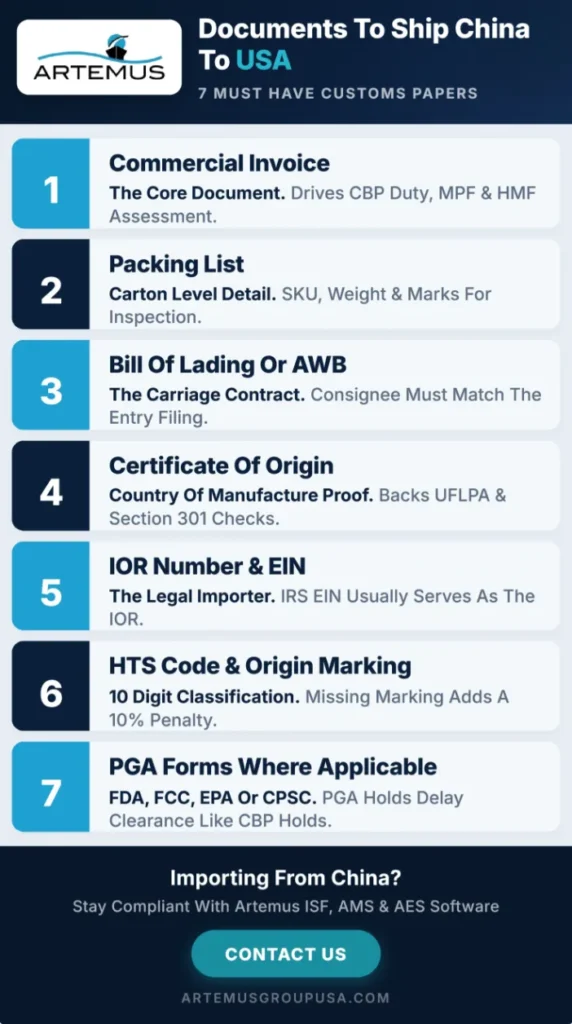
Paperwork is the single biggest controllable factor in clearance speed. CBP routinely deprioritizes release of shipments with missing or inconsistent documentation, and the holds add days that no freight method can recover. The list below covers what a typical commercial China-to-USA shipment needs.
The commercial invoice is the foundational customs document. It must show the seller, buyer, full description of the goods, country of origin, unit and total value, currency, Incoterms, and the HTS classification. CBP uses it to assess duty, MPF, and HMF, so accuracy on value and origin is non-negotiable. Mismatches between the invoice and the bill of lading or the entry summary are the most common cause of customs holds.
The packing list itemizes the contents of each carton or pallet: SKU, quantity, weight, dimensions, marks, and numbers. It is technical paperwork rather than financial, but customs and the freight forwarder both rely on it for inspection planning and consolidation accuracy.
For ocean cargo, the Bill of Lading (B/L) is the contract of carriage and the document of title. It identifies the shipper, consignee, vessel, ports, and cargo. For air cargo, the equivalent is the Air Waybill (AWB), which is a contract but not a document of title. Either one is what the carrier uses to release goods at destination, so the consignee details on it must match the entry filings exactly.
A Certificate of Origin states the country where the goods were manufactured. For Chinese-origin shipments in 2026, it does double duty: it confirms eligibility (or ineligibility) for any FTA exemption, and it is part of the evidence trail CBP uses for UFLPA enforcement and Section 301 application. Some products require a specific CO format issued by a recognized authority in China.
The Importer of Record (IOR) is the party legally responsible for the entry, duty payment, and compliance with US import law. The IOR number is usually the company’s IRS-issued Employer Identification Number (EIN). A foreign company without a US presence can still act as IOR but typically through a customs power of attorney granted to a US broker. For most US-based importers, the EIN itself serves as the IOR number.
Every product needs a 10-digit Harmonized Tariff Schedule (HTS) code, which determines the MFN duty rate, Section 301 list applicability, and any partner government agency flags. The goods themselves also need country-of-origin marking that is legible, conspicuous, and permanent, in line with 19 CFR Part 134. “Made in China” marking violations carry a 10% ad valorem penalty on top of any other duties.
Many product categories require additional filings beyond CBP. The four most common for China-origin shipments are: FDA Prior Notice for food, drugs, medical devices, and cosmetics; FCC Form 740 for radio-frequency electronics; EPA filings (TSCA, FIFRA, or vehicle/engine certifications); and CPSC General Certificate of Conformity for consumer products. PGA holds happen at the same border crossing as CBP holds, so missing PGA paperwork creates the same delays.
Know More About: Merchandise Processing Fee: 2026 Rates & How It Works
In the pre-2025 era, the compliance load varied with shipment value. A de minimis parcel needed almost nothing; a formal entry needed the full filing stack. With de minimis gone for Chinese goods, every shipment now sits in the formal-or-informal bucket. The filings and regulations below are not optional add-ons; they are the baseline.
The Importer Security Filing (ISF), often called “10+2,” must be transmitted to CBP at least 24 hours before cargo is loaded onto a vessel destined for the US. It covers 10 data elements from the importer (seller, buyer, manufacturer, ship-to, container stuffing location, consolidator, IOR number, consignee number, country of origin, HTS) and 2 from the carrier (vessel stow plan, container status messages).
Late or inaccurate ISF filings carry penalties of up to $5,000 per violation. Pre-2025, low-value shipments often avoided ISF through de minimis. Today, ISF is required on every ocean shipment regardless of value.
The Automated Manifest System (AMS) filing is the carrier-side manifest data transmitted to CBP 24 hours before vessel loading at the foreign port. AMS and ISF together give CBP the pre-arrival risk picture for every container. Most importers do not file AMS directly (the carrier or NVOCC does), but importers depend on accurate AMS for the ISF to match. ISF/AMS mismatches are a leading cause of holds.
Our AMS filing software handles this for NVOCCs and forwarders that need to file their own manifests under the 24-hour rule.
CBP Form 7501 is the entry summary, the document that finalizes the import declaration and calculates duty, taxes, and fees. It is filed within 10 working days of release. Filing electronically through the Automated Commercial Environment (ACE) is standard. Filing manually triggers a $4.03 surcharge on top of MPF, and manual filings are also more prone to errors that lead to Post Summary Corrections.
For high-frequency importers, accuracy on the 7501 is where MPF, duty, and HTS classification errors actually surface as cost or compliance problems.
Every formal entry requires a customs bond. The bond guarantees payment of duties, taxes, and fees, and CBP holds it as security against compliance failures. There are two options. A Single Entry Bond covers one specific entry, typically priced at 3-5% of total duty and tax owed, with a minimum of $50-$100. A Continuous Bond covers all entries by an importer for one year, priced at 10% of the importer’s annual duty and tax exposure (minimum $50,000 bond value, which costs roughly $400-$500 per year in premium).
For importers with more than 5-7 entries per year, continuous bonds usually pay for themselves. With de minimis gone, many first-time importers who previously moved goods under Section 321 now need a bond for the first time.
The Uyghur Forced Labor Prevention Act (UFLPA) took effect on June 21, 2022 and creates a rebuttable presumption that any goods produced wholly or in part in the Xinjiang Uyghur Autonomous Region, or by entities on the UFLPA Entity List, were made with forced labor and are therefore prohibited from entry into the United States. The presumption applies regardless of declared origin.
CBP enforces UFLPA aggressively on China-origin shipments and has detained billions of dollars of cargo since 2022. High-risk product categories include cotton and cotton-based textiles, polysilicon-based solar products, tomato and tomato-based products, certain aluminum, and any goods with Xinjiang supply chain exposure. Importers must be able to produce a complete, traceable supply chain map back to the raw material to rebut a UFLPA detention. This is the single biggest China-specific compliance risk in 2026 and is not optional.
With the de minimis change, most importers who previously self-cleared low-value parcels now benefit from a broker. A licensed customs broker handles HTS classification, the entry summary, duty calculation, ISF filing, bond setup, PGA filings, and post-entry corrections. Broker fees of $125-$300 per entry are usually a fraction of the cost of a classification error or an avoidable detention.
For high-frequency importers, the right tooling on the broker’s side (ACE-connected filing, automated entry summaries, accurate landed-cost calculation) is what keeps the per-entry cost stable as volume scales.
Know More About: Importer Security Filing (ISF 10+2) compliance
The operational reality of post-2025 China shipping is that every parcel needs formal entry tooling. The error modes that used to live in the high-volume FCL world (classification mistakes, manual surcharges, ISF-AMS mismatches, missing PGA filings) now apply to e-commerce parcels too. Each of these is automatable.
At Artemus, our ACE-connected filing platform handles ISF 10+2 transmissions, entry summary preparation, current FY2026 user fee application, and PGA flagging from a single dashboard. Our customs brokerage runs alongside, so importers who do not want to manage filings in-house can hand them off entirely.
The combined stack of ISF, AMS, customs broker software, and brokerage services means importers and brokers manage every layer of the China-to-USA compliance load in one place rather than stitching together four vendors. The result is fewer manual surcharges, fewer detentions, and landed-cost numbers you can trust.
Know More About: ISF Filing: A Compliance-Related Guide & Software Solution
Door-to-door transit times range from 3 days for express courier to 35-45 days for LCL sea freight. Standard air freight runs 5-10 days, express air freight 3-5 days, sea FCL 15-22 days to the West Coast and 30-40 days to the East Coast.
It depends on shipment size. Under roughly 150 kg, express courier wins on total landed cost once you factor in door-to-door handling. Between 150 and 500 kg, standard air freight is cheapest. Above 500 kg, sea freight (LCL or FCL) is the lowest-cost option per kilogram by a wide margin.
In mid-2026, a 20-foot FCL container typically runs $1,800-$2,800 to the West Coast and $2,400-$3,800 to the East Coast. A 40-foot FCL runs $2,300-$4,200 to the West Coast and $2,900-$5,200 to the East Coast. These figures exclude surcharges (THC, BAF), customs duties, MPF, HMF, and inland delivery, all of which typically add 20-40% to the headline rate.
Total duty depends on the HTS code. Most Lists 1-3 products face MFN + 25% Section 301 + 10% Section 122 for a combined rate around 35-45% before any Section 232 stacking. List 4A products face MFN + 7.5% Section 301 + 10% Section 122. Strategic categories run higher: EVs at 100%, semiconductors at 50%, batteries at 25%. Steel and aluminum carry 50% Section 232 duties stacked on top of Section 301. Use a current HTS lookup and a tariff calculator to confirm the rate for your specific product.
Yes. Section 321 de minimis treatment ended for goods originating in China and Hong Kong on May 2, 2025. Every shipment from China, regardless of value, now requires either formal entry (over $2,500) or informal entry (under $2,500), full duty payment, and the Merchandise Processing Fee. The change was extended to all countries on August 29, 2025.
Importer Security Filing (ISF) is a 10-element data filing the importer transmits to CBP at least 24 hours before ocean cargo is loaded onto a vessel bound for the US. It is required for all ocean shipments, including LCL. With de minimis gone for Chinese goods, ISF now applies even to small-value Chinese-origin ocean parcels that previously bypassed it. Late or inaccurate filings carry penalties of up to $5,000 per violation.
Potentially, yes. The Uyghur Forced Labor Prevention Act creates a rebuttable presumption that any China-origin goods linked to the Xinjiang region or to entities on the UFLPA Entity List are made with forced labor and are therefore inadmissible. High-risk product categories include cotton and cotton textiles, polysilicon-based solar products, tomato products, and certain aluminum. Even if your goods are produced outside Xinjiang, you should be able to produce a traceable supply chain map back to raw material to rebut a CBP detention.
Yes. Express courier services (DHL, FedEx, UPS) offer door-to-door by default, including customs clearance. For sea and air freight, a freight forwarder can arrange door-to-door service that bundles pickup, export clearance, transit, US customs entry, and last-mile delivery into a single quote, often under DDP (Delivered Duty Paid) Incoterms. DDP simplifies the importer’s workflow but the cost is built into a single bundled rate, so verify what is and is not included.
Shipping from China to the USA in 2026 is a different operation than it was in 2023. The modes have not changed, but the duty math, paperwork, and compliance regime have. Three takeaways are worth keeping. Pick your mode based on weight, urgency, and value rather than headline price. Build the tariff stack into your landed cost from the quote stage, because for most categories duty now exceeds freight by 3-5x. And treat compliance as a fixed cost of doing business, since every shipment now needs ISF, an entry summary, a bond, and UFLPA-clean sourcing evidence.
If you want to see how Artemus handles the full ISF, AMS, entry summary, and brokerage workflow for China-origin shipments from a single platform, our software and customs brokerage services are built for the post-de-minimis compliance load.
Know More About: How To Check ISF Filing Status? A Step-By-Step Guide

Roughly $166 billion in IEEPA tariffs were collected from US importers between February 2025 and February 2026. The Supreme Court
The United Kingdom is one of the world’s largest trading economies and a top exporter of services. Cars, machinery, pharmaceuticals,
Mexico became the United States’ number-one trading partner in 2024, surpassing both Canada and China. According to the Office of
 Optimized by Seraphinite Accelerator