
What Does Switzerland Export To The US? A Detailed Guide
Switzerland plays a vital role in U.S. trade, supplying a wide range of high-value and specialized products. From pharmaceuticals and



Why does trade between the United States and Brazil continue to attract the attention of exporters and global supply chain leaders? At the center of this relationship is a key question: what does the US export to Brazil.
The answer highlights a steady flow of high-value American goods that support Brazil’s core industries, including aerospace, manufacturing, food processing, healthcare, and advanced industrial applications.
In this blog, we explore the major U.S. export categories to Brazil, current market trends, important port gateways, and the key challenges exporters face.
As these trade flows grow in scale and complexity, smooth cross-border movement depends on getting the details right from the start. Artemus supports Brazil–U.S. trade with ISF, AMS, and AES compliance software, helping businesses streamline documentation, meet regulatory requirements, reduce errors, and keep shipping operations running smoothly across borders.
Table Of Contents
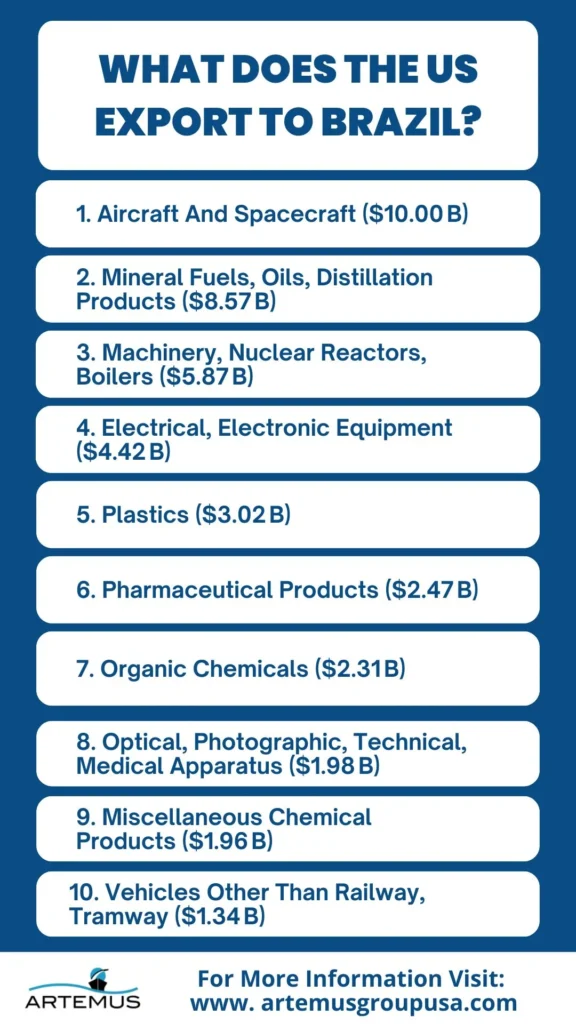
The United States exports a diverse range of goods to Brazil, reflecting strong industrial, technological, and consumer demand. According to official trade data, total U.S. goods exports to Brazil reached USD 49.1 billion in 2024. These exports include high-tech equipment, machinery, fuels, pharmaceuticals, and specialized chemicals, all supporting Brazil’s manufacturing, healthcare, and infrastructure development.
Below are the top 10 categories of U.S. exports to Brazil in 2024:
This category dominates U.S. exports to Brazil. It includes commercial airplanes, aircraft engines, spare parts, and related aerospace equipment. Brazil’s demand is driven by its commercial airline industry, air freight operators, and maintenance services. U.S. exports also include smaller executive aircraft for private use.
Leading suppliers like Boeing and associated aerospace component manufacturers are key contributors to this trade. These exports support Brazil’s aviation modernization and fleet expansion.
Mainly refined petroleum products, these exports supply Brazil’s industrial and transportation sectors. The U.S. provides diesel, gasoline, jet fuel, and other refined oils that complement Brazil’s domestic energy production.
Despite Brazil’s own oil reserves, there is strong demand for U.S. refined products due to quality, specifications, and availability for industrial and commercial use.
This broad category covers industrial and manufacturing machinery, turbines, boilers, construction equipment, and mechanical appliances. These products are essential for Brazil’s manufacturing, agricultural, energy, and infrastructure sectors.
Examples include power generation turbines, packaging machines, agricultural machinery, and industrial presses. U.S. machinery exports help Brazil enhance production efficiency and modernize industrial facilities.
Exports include electrical machinery, telecommunication equipment, electronic components, consumer electronics, and automation systems. These goods support Brazil’s technology modernization, industrial automation, and communication infrastructure.
Products range from circuit components and industrial electrical systems to telecommunication switches and computer hardware, reflecting Brazil’s demand for both industrial and consumer technology.
This category includes raw plastic materials, semi-finished plastic products, and polymers used in Brazil’s manufacturing, packaging, automotive, and construction industries. These imports serve as essential input materials for Brazil’s production chains, enabling the creation of consumer goods, industrial components, and infrastructure products. U.S. plastics are valued for quality and consistency in industrial applications.
U.S. pharmaceutical exports include finished medicines, active pharmaceutical ingredients (APIs), vaccines, and specialty medical formulations. These support Brazil’s healthcare system and private medical sector, providing access to advanced treatments and high-quality medicines.
Exports cover both human and veterinary applications, as well as generic and specialty drug markets.
This category consists of specialty and industrial chemicals, including reagents, solvents, intermediates for chemical synthesis, and other organic compounds. These exports support Brazil’s manufacturing sectors, including plastics, pharmaceuticals, agrochemicals, and industrial chemical production.
U.S. organic chemicals are often integrated into Brazilian production processes for high-value products.
Exports include medical devices, surgical instruments, laboratory equipment, microscopes, precision optical instruments, and technical apparatus. These products are crucial for Brazil’s healthcare, research, and scientific sectors.
Hospitals, research labs, and technical institutions rely on these high-precision instruments to maintain healthcare quality and support innovation.
This category covers specialty chemicals that do not fall into standard chemical categories, such as industrial blends, specialty polymers, adhesives, and niche chemical inputs for manufacturing. These exports support Brazil’s chemical, construction, and industrial sectors, enabling more complex production processes.
This includes cars, trucks, buses, commercial vehicles, and automotive parts. Brazil imports these products for both personal use and commercial applications. Specialized vehicles, components, and commercial trucks are a significant part of the trade, supporting Brazil’s transportation, logistics, and industrial sectors.
Related: What Does Brazil Export To The US? Trade Insights For 2026

The United States exports a wide range of goods and services to Brazil, with total goods exports reaching $49.1 B in 2024, contributing to a $127.6 B bilateral trade relationship. U.S. exporters enjoy a trade surplus, and services exports, including financial, technology, and professional services, grew rapidly to $29.6 B in 2024.
Brazil’s diversified economy drives strong demand for aerospace products, machinery, fuels, electrical equipment, and high-tech goods. Opportunities are growing in infrastructure, industrial modernization, and advanced technology sectors.
Exporters face regulatory and tax complexities, though recent reforms aim to simplify processes. Competition from other countries, particularly China, influences pricing and market strategies. Companies that understand local regulations and build long-term partnerships tend to succeed.
Despite challenges, Brazil remains a key market due to its large consumer base, diversified industrial sectors, and ongoing demand for U.S. machinery, technology, and services, offering long-term growth potential.
Related: How To Export Medicine From The USA? A 2025 Guide

The largest U.S. export to Brazil in 2024 is Aircraft and Spacecraft, totaling approximately $10.0 billion. This category includes commercial airplanes, engines, spare parts, and related aerospace equipment. Brazil’s strong demand reflects its expanding commercial airline industry, ongoing fleet modernization, and maintenance needs.
Leading U.S. manufacturers, such as Boeing, along with component suppliers, dominate this trade, making aerospace products the single most valuable U.S. export to Brazil.
Related: Can You Export Cars From USA? Rules To Know
Trade between the United States and Brazil moves through a well-established network of seaports and airports. These gateways support the flow of industrial goods, energy products, machinery, aerospace components, and consumer items, making them essential to bilateral supply chains.
1. Port of Houston, Texas: A leading US gateway for Brazil trade, handling machinery, chemicals, refined fuels, and industrial equipment through its deep-water terminals.
2. Port of New York and New Jersey: A major East Coast hub for containerized cargo, supporting exports such as machinery, electrical equipment, and consumer goods to Brazil.
3. Port of New Orleans, Louisiana: Handles bulk and container cargo, including agricultural equipment, industrial products, and project cargo bound for Brazilian ports.
4. Port of Charleston, South Carolina: Known for efficient container operations, supporting exports of manufactured goods and automotive-related cargo to Brazil.
5. Port of Jacksonville, Florida: A key Southeast port moving vehicles, machinery, and containerized exports to South American markets, including Brazil.
1. Port of Santos: Brazil’s largest and busiest port, serving as the primary entry point for US exports such as machinery, chemicals, electronics, and aerospace components.
2. Port of Itajaí and Port of Navegantes: Important container ports in southern Brazil, handling manufactured goods and industrial inputs from the United States.
3. Port of Paranaguá: A major bulk and general cargo port that also receives machinery, fertilizers, and industrial products from US suppliers.
4. Port of Suape and Port of Itaguaí: Strategic ports supporting energy, industrial, and project cargo linked to US–Brazil trade lanes.
1. Miami International Airport, Florida: The top US air gateway for Brazil trade, especially for high-value and time-sensitive cargo such as aerospace parts, electronics, and pharmaceuticals.
2. Hartsfield-Jackson Atlanta International Airport, Georgia: Supports air freight shipments of industrial components and high-value goods to major Brazilian cities.
3. São Paulo–Guarulhos International Airport: Brazil’s main air cargo hub, receiving US exports including medical devices, electronics, and precision equipment.
Strong intermodal connectivity across both countries links ports with highways, rail networks, and inland distribution centers. This infrastructure supports efficient transit, reduces delays, and enables reliable US–Brazil trade flows across ocean and air routes.
Related: Top 10 Ports In The USA: The Busiest Hubs Driving US Trade

Exporting to Brazil offers long-term potential, but U.S. exporters must navigate several regulatory, financial, and operational hurdles. Below are the major challenges that commonly affect trade flows and market entry.
Related: What Does The US Export To China? A Complete Guide
Brazil is a high-potential market for U.S. ingredient exporters, driven by strong domestic manufacturing, rising health awareness, and demand for quality inputs. U.S. suppliers benefit from a solid reputation for safety, consistency, and innovation across multiple ingredient segments.
Related: Export Car From USA To Canada: A Guide For 2025

Artemus Transportation Solutions supports smooth and compliant trade between the United States and Brazil by bringing essential filing and reporting tools into a single platform. With ISF, AMS, and AES working together, businesses gain better visibility, accuracy, and control across cross-border shipping operations.
Importer Security Filing (ISF 10+2) helps ensure required shipment data is submitted correctly and on time before cargo reaches U.S. ports. By improving data accuracy and providing real-time visibility, the platform helps reduce filing errors, minimize risk, and avoid costly delays during cargo processing.
Automated Export System (AES) Filing software simplifies Electronic Export Information filings through automation and built-in validation. This reduces manual effort, improves submission accuracy, and helps prevent delays that can disrupt outbound shipments.
Automated Manifest System (AMS) streamlines advanced cargo reporting and manifest management. Automated workflows and an easy-to-use interface make it easier to manage shipment data securely while meeting reporting requirements efficiently.
Together, Artemus compliance solutions help businesses reduce regulatory risk, improve operational efficiency, and maintain smooth cargo movement between the US and Brazil.
Related: AMS Fee In Shipping: Overview & 5 Key Considerations
The United States exports tens of billions of dollars’ worth of goods to Brazil annually, making Brazil one of the largest U.S. export markets in Latin America. Major export values fluctuate each year based on demand, currency conditions, and global trade trends.
Aerospace, industrial machinery, chemicals, food ingredients, and pharmaceuticals are among the biggest beneficiaries. These industries supply high-value products that support Brazil’s manufacturing, aviation, healthcare, and food processing sectors.
The U.S. and Brazil maintain a relatively balanced trade relationship, with periods of surplus or deficit shifting year to year. Trade balance changes are influenced by commodity prices, industrial demand, and global economic conditions.
U.S.–Brazil trade continues to present strong opportunities, supported by demand across aerospace, ingredients, industrial goods, and other high-value sectors. While exporters must navigate regulatory complexity, logistics challenges, and competitive market conditions, the long-term outlook remains positive for businesses that plan carefully and stay compliant.
Success in exporting to Brazil depends on accurate documentation, regulatory awareness, and efficient supply chain execution. With the right market insight and reliable compliance tools like Artemus AMS, and AES software, U.S. exporters can reduce risk, improve visibility, and move goods to Brazil with greater confidence and consistency.
Related: Top 10 Exports Of USA In 2024: Leading Export Categories

Switzerland plays a vital role in U.S. trade, supplying a wide range of high-value and specialized products. From pharmaceuticals and

In 2026, the US-Europe trade relationship continues to power global commerce, driven by exports of energy, advanced machinery, and pharmaceuticals

The economic partnership between the United States and Norway is a sophisticated and evolving pillar of transatlantic commerce. U.S. exports