
What Does Switzerland Export To The US? A Detailed Guide
Switzerland plays a vital role in U.S. trade, supplying a wide range of high-value and specialized products. From pharmaceuticals and



In 2026, the US-Europe trade relationship continues to power global commerce, driven by exports of energy, advanced machinery, and pharmaceuticals that support key European industries. Growing demand for energy security, along with rapid advances in digital and medical technologies, has increased Europe’s reliance on American goods across major ports and industrial centers.
Reaching these markets, however, requires more than quality products. Exporters must understand strict documentation, customs rules, and compliance requirements to avoid delays and penalties. Accurate and timely Automated Export System (AES) filings are especially critical for shipments such as LNG, aerospace parts, and agricultural goods.
This Artemus guide outlines the leading commodities shaping U.S.–Europe trade, highlights emerging trends, and shares essential regulatory insights to help businesses streamline their transatlantic supply chains.
Table Of Contents
In 2026, the United States continues to be one of Europe’s most important trading partners, with strong export performance across both goods and services. As per USTR data, total U.S.–EU goods and services trade reached about $1.5 trillion in 2024, including $369.8 billion in U.S. goods exports and $294.7 billion in U.S. services exports to the European Union. This reflects the scale, diversity, and strategic importance of American exports to European markets.
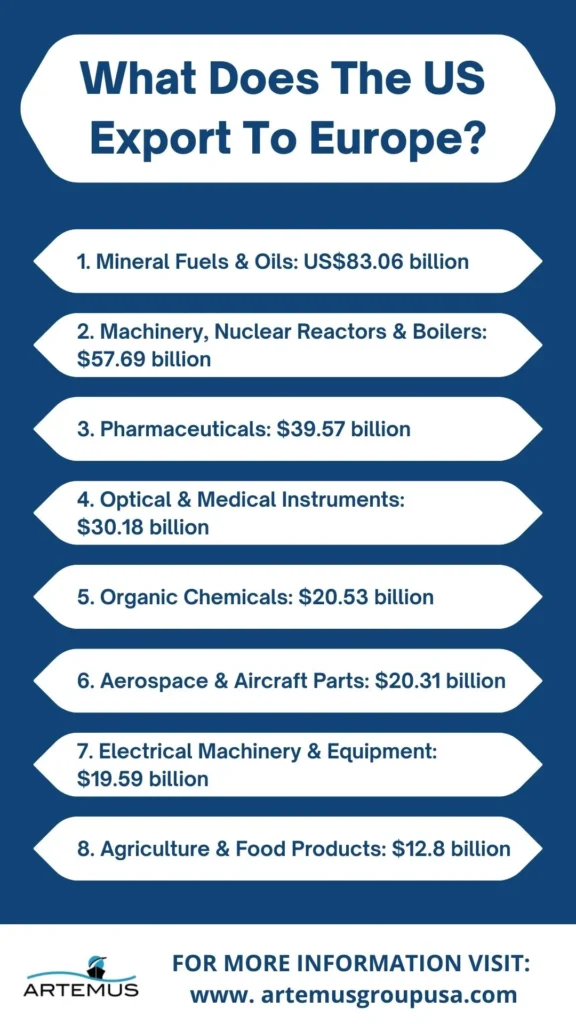
Energy remains a key U.S. export to Europe. In 2024, the European Union imported US$83.06 billion in mineral fuels, oils, and distillation products from the United States, including crude oil, refined petroleum, and liquefied natural gas. The U.S. is a major energy supplier to the EU, with countries such as the Netherlands acting as primary entry hubs for these shipments.
This broad category covers industrial machinery, engines, turbines, and heavy equipment widely used across European manufacturing and infrastructure sectors in 2024.
This includes vaccines, blood products, and packaged medicaments, making pharmaceuticals one of the highest-value U.S. export categories to Europe in 2024.
This segment includes medical devices, surgical and dental tools, precision measurement instruments, and optical equipment essential to healthcare and scientific industries in 2024.
These chemicals are widely used in pharmaceuticals, specialty manufacturing, and industrial formulations across Europe in 2024.
This includes aircraft, spacecraft, engines, and associated parts, supported by long-standing zero-tariff agreements between the U.S. and EU in the aerospace sector in 2024.
Telecom equipment, integrated circuits, generators, wiring systems, and navigational apparatus form a significant part of this export stream in 2024.
U.S. agricultural exports to the EU in 2024, led by:
Beyond physical goods, U.S. services exports to the EU totaled $294.7 billion in 2024. Financial services, software, consulting, intellectual property licensing, and travel services contribute to a services trade surplus of $88.6 billion, highlighting America’s strength in high-value, knowledge-driven sectors.
Although the U.S. runs a goods trade deficit with the EU, largely due to imports of automobiles, machinery, and pharmaceuticals, the picture changes when services are included.
With total bilateral trade around $1.5 trillion, the U.S.–EU trade relationship remains broadly balanced. Strong European demand for U.S. energy, aerospace products, advanced machinery, pharmaceuticals, and services continues to drive export growth into 2026.
Related: What Does The US Export To Norway? A Data-Driven Overview

The European Union (EU) is one of the most attractive and strategically important markets for U.S. exporters in 2026 due to its size, purchasing power, and stable trade environment.
1. Large, Affluent Market – With around 450 million consumers, the EU offers strong demand for premium U.S. goods and services across industries.
2. Strong Bilateral Trade Ties – U.S.–EU trade in goods and services exceeds $1.5 trillion annually, making it one of the world’s largest economic partnerships.
3. Diverse Sector Demand – Europe imports significant volumes of U.S. energy products, aerospace equipment, pharmaceuticals, agricultural goods, and technology services.
4. Predictable Regulations – Harmonized standards and a transparent legal framework make it easier for U.S. companies to access multiple EU countries through a single compliance pathway.
5. Strategic Global Gateway – Many U.S. exports integrated into EU supply chains are re-exported worldwide, expanding global reach for American businesses.
Together, these factors make the EU not just a large market, but a high-value, low-risk, and strategically vital destination for U.S. exporters.
Related: What Does The US Export To Brazil? 2026 Overview
The economic ties between the United States and Europe remain among the strongest in global trade. In 2026, several U.S. states continue to dominate exports to European markets, driven by advanced manufacturing, energy products, agricultural goods, and high-tech services.
These states benefit from strategic port access, well-developed logistics networks, and strong industry clusters that align with European demand.
Texas leads U.S. exports to Europe in both value and volume. Energy products, particularly liquefied natural gas (LNG) and petroleum derivatives, are major contributors, reflecting Europe’s ongoing focus on energy security.
Texas’s petrochemical and machinery sectors also ship significant volumes to major European markets. The state’s proximity to Gulf ports like Houston and Corpus Christi makes it a logistical powerhouse for transatlantic trade.
California stands out for its diversified export profile. Technology equipment, aerospace components, and agricultural products (such as nuts, wine, and fresh produce) form the backbone of its trade with Europe.
The ports of Los Angeles and Long Beach serve as major gateways, connecting West Coast manufacturing and innovation clusters to European buyers.
Another energy hub, Louisiana exports large quantities of LNG, refined fuels, and petrochemical products. Its deepwater ports, including the Port of South Louisiana and the Port of New Orleans, are among the busiest in the nation, facilitating bulk commodity movement and serving as critical nodes in Europe-bound supply chains.
Florida’s export strengths lie in aircraft parts, machinery, and high-value agricultural goods like citrus and sugar. Its geographic advantage, with year-round shipping access through ports such as Miami and Jacksonville, supports robust trade lanes to northern and southern Europe alike.
Driven by its automotive industry, Michigan remains a key exporter of vehicles, engines, and related parts to European markets. European automakers also maintain a manufacturing and supply presence in the state, reinforcing two-way industrial ties and boosting overall export volumes.
New York’s export portfolio includes machinery, electronics, pharmaceuticals, and agricultural products. The Port of New York and New Jersey (shared with New Jersey) offers extensive shipping services and strong connectivity to European ports, making it an essential node for international trade.
Related: How To Export Medicine From The USA? A 2025 Guide
The United States–Europe trade corridor is one of the busiest and most strategically important shipping lanes in the world. Moving energy, machinery, pharmaceuticals, automotive components, and agricultural goods across the Atlantic depends on highly efficient departure and arrival ports on both sides.
Below are the key seaports that power USA–Europe exports.
Related: Top 10 Ports In The USA: The Busiest Hubs Driving US Trade

The United States exports a wide variety of food products to European markets, ranging from agricultural commodities to high-value processed foods. Europe is one of the key destinations for U.S. food exports, driven by demand for quality ingredients, specialty goods, and consumer favorites.
According to recent USDA data, U.S. agricultural exports to the European Union (EU) were valued at roughly $12.8 billion in 2024, making the EU one of America’s top export markets for food and agriculture products.
Tree nuts such as almonds, pistachios, and pecans are among the largest U.S. food exports to Europe, reflecting strong European demand for healthy, high-value snacks and ingredients.
Soybeans remain a core U.S. bulk agricultural export to the EU, used for animal feed and food processing.
American whiskeys and other distilled spirits are major food-related exports, with Europe showing strong growth in demand for premium U.S. spirits.
U.S. processed food preparations, including baking mixes, sauces, and ingredient blends, are exported in growing volumes as European consumers seek diverse and convenient food products.
Essential oils and other concentrated food components from the U.S. serve European food manufacturers and niche markets.
Industrial and food-grade ethanol is also exported to Europe for use in food processing and beverage production.
While smaller in total value, other categories such as animal feed ingredients, poultry products, and specialty food products contribute to the diverse mix of U.S. exports reaching European tables.
Related: Exporting Mangoes From India To The USA: How To Ship?

Exporting from the United States to the European Union (EU) requires meeting both U.S. export control rules and EU import regulations to ensure smooth customs clearance and legal market entry.
U.S. exporters must follow the Export Administration Regulations (EAR) governed by the Bureau of Industry and Security (BIS). This includes:
AES Filing: Exporters must file shipment data electronically via the Automated Export System (AES) for licensed or high-value shipments.
To enter EU markets, exporters must ensure:
Certain products may require:
Related: Certificate Of Conformance (CoC): What Is It & Its Types
Exporting to Europe offers strong opportunities, but U.S. businesses often face a few key hurdles:
Proper preparation and compliance help exporters overcome these challenges and trade smoothly with Europe.
Related: How To Do Custom Clearance In USA For Goods? The Process
The U.S.–Europe trade relationship is expected to remain strong and strategically important through 2030, supported by deep economic ties, high trade volumes, and ongoing policy cooperation.
1. Stable Trade Growth
With goods and services trade already exceeding €1.6 trillion annually, both sides are working to reduce trade barriers and strengthen long-term partnerships.
2. Key Growth Sectors
Future trade expansion is likely in energy (LNG and renewables), technology, advanced manufacturing, and professional services, where U.S. exporters are highly competitive.
3. Policy and Tariff Influence
Trade agreements and tariff stability will play a major role in shaping predictable export flows. Policy shifts could either accelerate or slow trade momentum.
4. Geopolitical & Supply Chain Alignment
Shared concerns over global supply chains and competition from China are encouraging closer U.S.–EU cooperation in critical industries.
Overall, U.S.–Europe trade through 2030 is expected to grow steadily, driven by strategic collaboration, sectoral demand, and resilient transatlantic economic ties.
Related: Exporting From Australia To USA: A Complete Guide
Managing U.S.–Europe shipments requires precise customs filings and export documentation. Artemus helps businesses stay compliant by handling critical ISF, AMS, and AES filings accurately and on time for USA compliance.
With Artemus overseeing these compliance requirements, exporters benefit from fewer delays, reduced risk, and seamless transatlantic trade operations.
Related: ISF Form (Importer Security Filing): Elements & Top Practices
Key exports include energy products (LNG, oil), aerospace equipment, pharmaceuticals, machinery, technology products, and agricultural goods.
Yes. The U.S. exports tree nuts, soybeans, distilled spirits, food preparations, and other agricultural commodities to European markets.
Texas, California, and New York are leading exporters due to strong energy, technology, manufacturing, and pharmaceutical sectors.
Europe offers a large, affluent consumer base, stable regulations, and strong demand for high-value U.S. goods and services.
Common challenges include strict EU standards, customs documentation, VAT rules, labeling requirements, and logistics planning.
By following U.S. export regulations (EAR), meeting EU product standards, and maintaining accurate customs and export documentation.
The trade relationship between the United States and Europe remains one of the strongest and most valuable global partnerships in 2026. From energy, aerospace, and pharmaceuticals to technology, agriculture, and services, U.S. exports meet diverse European market demands. While exporters must navigate strict regulations, documentation, and compliance standards, the opportunities far outweigh the challenges.
With proper planning, adherence to U.S. and EU trade requirements, and reliable compliance support from partners like Artemus Group USA, businesses can confidently access and grow within the European market. Understanding what the U.S. exports to Europe is not just informative; it is essential for building successful transatlantic trade strategies.
Related: ISF Declaration: Meaning, Purpose, Timeline, & Process

Switzerland plays a vital role in U.S. trade, supplying a wide range of high-value and specialized products. From pharmaceuticals and
In 2026, the US-Europe trade relationship continues to power global commerce, driven by exports of energy, advanced machinery, and pharmaceuticals

The economic partnership between the United States and Norway is a sophisticated and evolving pillar of transatlantic commerce. U.S. exports