What Does Switzerland Export To The US? A Detailed Guide
Switzerland plays a vital role in U.S. trade, supplying a wide range of high-value and specialized products. From pharmaceuticals and


Trade ties between the United States and Vietnam continue to strengthen as Vietnam emerges as a key manufacturing and consumption hub in Southeast Asia. Against this backdrop, understanding what does the US export to Vietnam offers valuable insight into how American goods support Vietnam’s industrial growth, supply chains, and evolving consumer demand.
This blog takes a closer look at the products the United States exports to Vietnam, from high-value electronics and machinery to agricultural commodities and raw materials. It also walks through essential export documentation, key U.S. ports serving Vietnam, and the common challenges exporters face when navigating customs, tariffs, and logistics.
To help exporters manage these requirements with confidence, Artemus supports compliant trade operations through AMS and AES software solutions. By simplifying filings and reducing manual effort, Artemus helps ensure Vietnam-bound shipments move smoothly and on schedule.
Table Of Contents
Trade between the United States and Vietnam continues to strengthen as economic ties deepen across manufacturing, agriculture, and services. In 2024, U.S. goods and services trade with Vietnam reached an estimated $155.1 billion, up 20.5 percent, or $26.4 billion, from 2023.
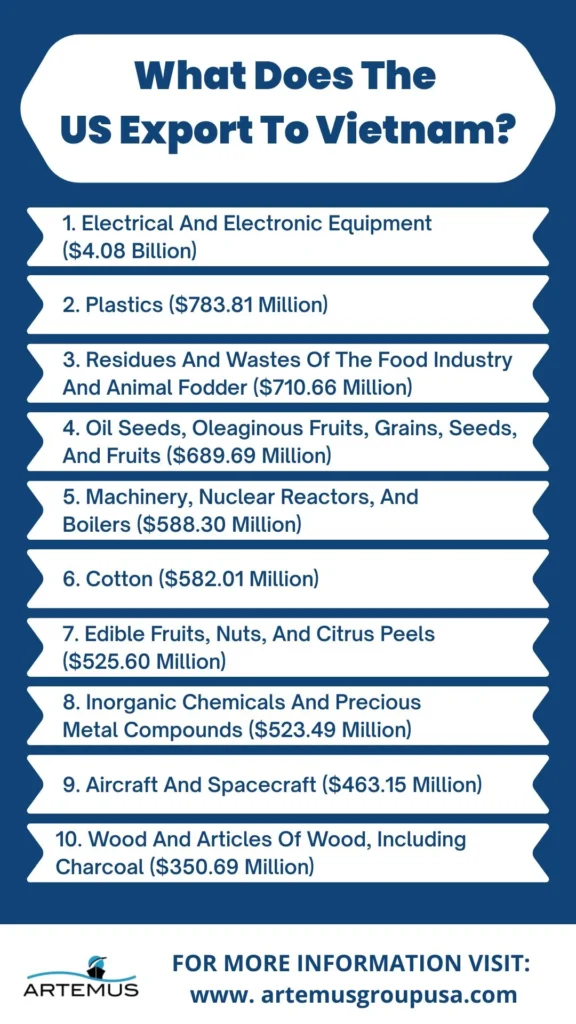
Within this expanding relationship, U.S. exports to Vietnam totaled $13.10 billion, reflecting steady demand for American industrial equipment, raw materials, and agricultural products that support Vietnam’s production and consumer markets.
Below is a breakdown of the leading U.S. export categories to Vietnam, based on exact trade values:
Electrical and electronic equipment is the largest U.S. export category to Vietnam. This includes semiconductors, integrated circuits, insulated wires, and telecommunications equipment that support Vietnam’s electronics manufacturing and assembly operations.
U.S. plastic exports provide essential raw materials for Vietnam’s packaging, industrial manufacturing, and consumer goods sectors. These materials are widely used across automotive, household, and industrial applications.
This category mainly includes animal feed ingredients and food-processing by-products. These exports support Vietnam’s livestock, poultry, and aquaculture industries.
U.S. exports of soybeans and other oil-bearing seeds are key inputs for Vietnam’s food processing, cooking oil production, and animal feed manufacturing.
Machinery exports from the U.S. help power Vietnam’s industrial facilities, energy projects, and infrastructure development, including specialized and heavy equipment.
Cotton remains a major U.S. agricultural export to Vietnam. It is a critical raw material for Vietnam’s textile and garment industry, which produces apparel for global markets.
This category includes U.S. exports of fresh and processed fruits and nuts, reflecting rising consumer demand and growth in Vietnam’s retail and food service sectors.
These exports include industrial chemicals and compounds used in manufacturing, chemical processing, and other specialized industrial applications in Vietnam.
Aircraft and aerospace exports from the United States support Vietnam’s civil aviation sector, including commercial aircraft and related components.
U.S. wood exports supply Vietnam’s construction and furniture manufacturing industries, as well as wood-processing businesses that serve both domestic and export markets.
Related: What Does Vietnam Export To The US? Key Products & Insights
Exporting goods from the United States to Vietnam requires a standard set of trade and customs documents. While requirements can vary by product and shipment type, the documents below are commonly required and should be prepared carefully to ensure smooth customs clearance.
1. Commercial Invoice: Details the transaction, including exporter and importer information, product description, value, HS codes, and country of origin.
2. Packing List: Shows how the shipment is packed, including package count, weight, dimensions, and contents.
3. Bill Of Lading Or Air Way bill: Serves as official proof of shipment and transportation. The Bill Of Lading is issued by the carrier for ocean freight, while an air waybill is used for air cargo shipments.
4. Export Declaration (AES Filing): Confirms that U.S. export information has been filed electronically and provides an Internal Transaction Number.
5. Certificate Of Origin: Confirms the country where the goods were manufactured. The Certificate Of Origin is often required by customs authorities to determine applicable duties, tariffs, or trade eligibility.
6. Import License: Authorizes entry of regulated goods into Vietnam and is required for specific product categories.
7. Product-Specific Certificates And Permits: Demonstrate compliance with Vietnamese regulations for items such as food, agricultural goods, chemicals, or machinery.
8. Insurance Certificate: Confirms that the cargo is insured during transit, depending on contractual terms.
9. Sales Contract Or Purchase Order: Supports the transaction by outlining agreed pricing, terms, and delivery conditions between buyer and seller.
Related: Export Documentation Requirements To Export From The USA
The United States relies on a mix of West Coast, East Coast, and Gulf ports to move goods efficiently to Vietnam. These ports handle the bulk of trans-Pacific container traffic and offer regular connections to Vietnam’s major gateways such as Ho Chi Minh City, Hai Phong, and Cai Mep Thi Vai.
West Coast ports are the preferred choice for many exporters due to shorter transit times and frequent direct sailings to Vietnam.
These twin ports are the primary gateways for the U.S.–Vietnam trade, offering the fastest and most direct container services across the Pacific.
This port complex plays a key role in serving exporters from the Pacific Northwest, with reliable routes to Southeast Asia.
A major hub for California-based exporters, especially for agricultural and manufactured goods.
East Coast and Gulf ports support exporters located farther from the Pacific, with strong intermodal connections and regular Asia-bound services.
The main gateway for cargo originating in the Eastern United States, handling high volumes of containerized exports to Vietnam.
An important port for Southeastern U.S. shipments, known for efficient container handling and growing Asia trade routes.
A key Gulf Coast port, particularly for industrial, energy-related, and agricultural exports.
For time-sensitive or high-value shipments, air freight is often used alongside ocean transport.
One of the largest air cargo hubs in the U.S., handling significant international export volumes.
The primary West Coast air hub for cargo shipments to Asia, including Vietnam.
U.S. shipments typically arrive at Vietnam’s largest and most advanced port facilities.
The largest container port complex in Vietnam and the main entry point for southern Vietnam.
The primary port for northern Vietnam, serving industrial zones around Hanoi.
A deep-water port capable of handling large post-Panamax vessels, increasingly used for direct international services.
Together, these U.S. ports form the backbone of shipping routes to Vietnam, offering exporters multiple options based on location, transit time, and cargo requirements.
Related: Top 10 Ports In The USA: The Busiest Hubs Driving US Trade
Shipping to Vietnam offers strong market potential, but U.S. exporters often encounter regulatory and operational hurdles that can affect cost, timing, and compliance. Understanding these challenges upfront helps reduce delays and unexpected expenses.
Incomplete or inconsistent documents are a common cause of delays. Vietnamese customs may question HS code classifications, leading to re-inspections, additional paperwork, and higher clearance costs.
Certain products face import tariffs of up to 40 percent. Tariff structures can change, making landed cost calculations difficult, especially for agricultural goods and electronics.
Many products must meet strict quality, technical, or sanitary standards. Specialized import licenses and pre-approvals are often required, adding time and complexity to the process.
Food products, chemicals, machinery, and electronics are subject to mandatory inspections, which can slow clearance if documentation or labeling does not fully comply.
While major ports are well developed, inland transport and warehousing links remain uneven, increasing transit time and costs for final delivery.
Exporters may face complex procedures and limited transparency, which can result in unexpected tax assessments or longer clearance timelines.
IP enforcement can be inconsistent, creating risks for branded or proprietary goods entering the Vietnamese market.
Related: What Is Export Declaration? A Complete Overview

Artemus Transportation Solutions helps U.S. exporters manage AMS and AES filings for Vietnam-bound shipments through a single, reliable trade compliance platform. Built to support end-to-end export operations, the system simplifies regulatory requirements while reducing errors, delays, and manual effort.
For Automated Manifest System (AMS), Artemus provides a CBP-compliant, web-based solution with full EDI capabilities for efficient electronic submissions and confirmations. The platform is accessible anytime, including on mobile devices, and allows exporters to manage vessel movements, amendments, and essential reports with secure user controls.
For Automated Export System (AES) Filing, Artemus streamlines Electronic Export Information submissions with faster processing and enhanced accuracy. Automated workflows, real-time EEI tracking, and expert support help exporters avoid delays and keep Vietnam-bound shipments on schedule.
Related: AMS Filing Penalty Cost: Most Common Pitfalls & Solutions
The United States exports goods worth $13.10 billion to Vietnam, covering a wide range of industrial, agricultural, and manufactured products.
The two primary U.S. export regulations are the Export Administration Regulations (EAR) and the International Traffic in Arms Regulations (ITAR), which control commercial and defense-related exports.
Ocean freight from the U.S. to Vietnam typically takes 20 to 35 days, depending on the port of origin, routing, and service type, while air freight usually takes 3 to 7 days.
As U.S.–Vietnam trade continues to grow, understanding what the United States exports to Vietnam is key for businesses entering or expanding in this market. Electronics, machinery, agricultural goods, and raw materials remain central to supporting Vietnam’s manufacturing and consumer demand.
Successful exports depend on more than product selection. Accurate documentation, regulatory compliance, and efficient shipping processes all play a critical role. With streamlined Automated Manifest System (AMS) and Automated Export System (AES) filings, Artemus helps exporters reduce complexity and keep Vietnam-bound shipments moving smoothly.
Related: AMS Fee In Shipping: Overview & 5 Key Considerations

Switzerland plays a vital role in U.S. trade, supplying a wide range of high-value and specialized products. From pharmaceuticals and
In 2026, the US-Europe trade relationship continues to power global commerce, driven by exports of energy, advanced machinery, and pharmaceuticals

The economic partnership between the United States and Norway is a sophisticated and evolving pillar of transatlantic commerce. U.S. exports