UK Imports & Exports: Trade Profile & Top Partners
The United Kingdom is one of the world’s largest trading economies and a top exporter of services. Cars, machinery, pharmaceuticals,



In 2024, Mexico solidified its position as the United States’ top trading partner, exporting goods valued at over $505.85 billion, marking a 6.4% increase from the previous year. This surge allowed Mexico to capture 15.5% of the U.S. import market, outpacing other major exporters like China and Canada.
In this blog, we’ll explore the top exports from Mexico to the US, including the booming automotive sector, agricultural products, electronics, and more. We’ll also unpack the factors driving this robust trade flow and the compliance steps necessary to ensure smooth cross-border shipments.
Navigating the complexities of international trade requires meticulous compliance with U.S. regulations like ISF (Importer Security Filing), AMS (Automated Manifest System), and AES (Automated Export System). Artemus offers streamlined solutions to ensure that businesses meet these compliance requirements efficiently.
Table Of Contents
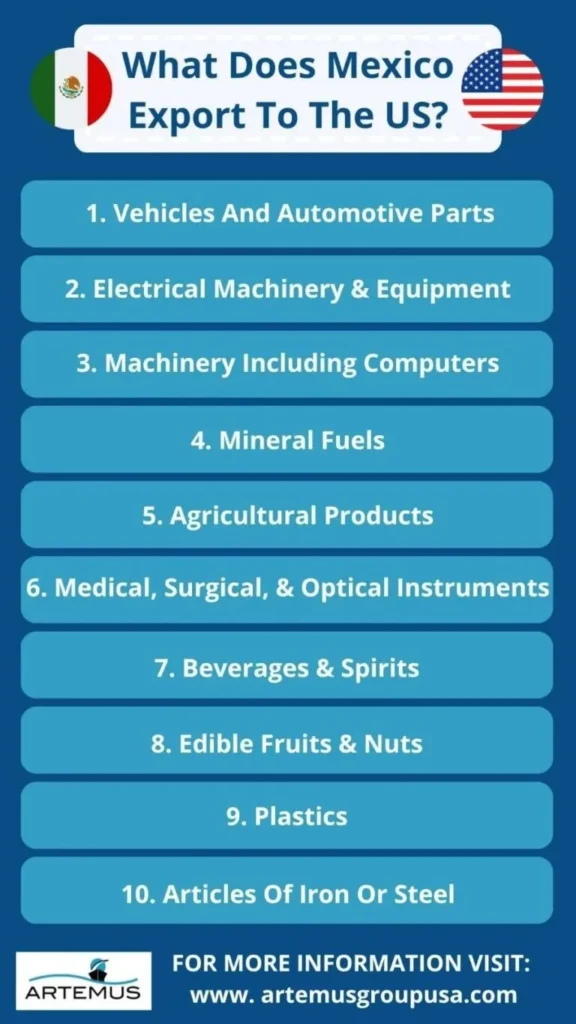
In 2023, Mexico exported approximately $475 billion worth of goods to the United States, maintaining its position as the top U.S. trade partner. The key export categories included automobiles and auto parts, electrical machinery, computers and machinery, mineral fuels, and medical instruments.
In 2024, Mexico’s exports to the United States reached a record high, totaling approximately $505.85 billion, marking a 6.4% increase from the previous year.
This growth underscores the deepening economic ties between the two nations, with Mexico solidifying its position as the United States’ leading trade partner, capturing a 15.5% share of the U.S. import market.
The automotive sector is the largest contributor to Mexico’s exports to the U.S. In 2023, exports in this category amounted to $130.03 billion. This includes cars, trucks, and various automotive components. Notably, American automakers operating in Mexico manufacture many vehicles and parts, underscoring the integrated nature of North American automotive production.
Electrical machinery and equipment constitute a significant portion of exports, totaling $85.55 billion in 2023. This category encompasses products such as electrical circuits, transformers, and related components. Mexico’s investment in this sector has positioned it as a key supplier to the U.S., meeting the growing demand for electrical infrastructure and consumer electronics.
In 2023, exports of machinery, including computers, reached $93.5 billion. This segment covers a broad range of products, from industrial machinery to computing equipment, reflecting Mexico’s expanding capabilities in technology and manufacturing.
Mineral fuels, including oil and gas, accounted for $32.6 billion of exports in 2023. Despite being a smaller percentage of total exports, this sector remains vital, with Mexico supplying crude oil and refined petroleum products to meet U.S. energy needs.
In 2023, Mexico’s agricultural exports to the United States reached a record high, underscoring the robust trade relationship between the two nations. The total value of these exports was approximately $44.2 billion, reflecting a 14% increase compared to the previous year.
Key contributors to this growth included:
In 2023, Mexico exported approximately $22.33 billion worth of medical, surgical, and optical instruments to the U.S. This category includes essential healthcare equipment such as diagnostic apparatus, surgical tools, and optical devices, reflecting Mexico’s growing role in the global medical equipment supply chain.

Beverages, including spirits like tequila and beer, accounted for about $11.75 billion in exports to the U.S. in 2023. Notably, Mexican beer and tequila have seen increasing popularity among U.S. consumers, contributing significantly to this export category.
Mexico exported edible fruits and nuts valued at approximately $10.86 billion to the U.S. in 2023. This includes a variety of produce such as avocados, berries, and citrus fruits, underscoring Mexico’s vital role in supplying fresh produce to the U.S. market.
The plastics industry has been on a continuous rise, with exports totaling $7.91 billion in 2023. This includes a wide range of plastic materials and products used across various industries, highlighting Mexico’s growing capabilities in this sector.
Exports of iron and steel articles reached $7.86 billion in 2023. This category encompasses a variety of products, including structural components and finished goods, reflecting the strength of Mexico’s metallurgical industries.
The trade dynamics between Mexico and the U.S. are influenced by various factors, including trade agreements like the United States-Mexico-Canada Agreement (USMCA), which facilitates tariff-free access to many products.
Additionally, Mexico’s strategic location and cost-effective manufacturing have made it an attractive hub for industries aiming to serve the U.S. market efficiently.
Related: What Does Colombia Export To USA? Key Products & Insights
Mexico–U.S. trade relations have evolved significantly over the past few decades. The signing of the North American Free Trade Agreement (NAFTA) in 1994 marked a turning point, eliminating tariffs on most goods and encouraging cross-border commerce.
In 2020, NAFTA was replaced by the United States–Mexico–Canada Agreement (USMCA), which modernized trade rules to address digital trade, labor rights, and intellectual property.
Over the last decade, bilateral trade between Mexico and the U.S. has steadily grown. In 2024, total goods trade between the two countries reached approximately $839.9 billion, with U.S. goods exports to Mexico at $334.0 billion and imports from Mexico at $505.9 billion.
This made Mexico the United States’ top trading partner, surpassing China. This growth reflects not only increased exports but also deeper integration of supply chains. The two countries maintain strong political and economic cooperation through trade commissions and cross-border infrastructure initiatives.
While Mexico typically enjoys a trade surplus with the U.S., this imbalance often sparks policy discussions around tariffs, reshoring, and regulatory enforcement, especially in sensitive sectors like automotive and agriculture. For instance, in 2024, the U.S. goods trade deficit with Mexico was $171.8 billion, a 12.7% increase over 2023.
Related: Export Documentation Requirements To Export From The USA
Mexico has solidified its position as a crucial trade partner for the United States, with exports reaching significant milestones in recent years. In 2024, the total trade in goods between the U.S. and Mexico was approximately $839.9 billion, with U.S. imports from Mexico accounting for $505.9 billion.
Related: How To Import Goods For Resale In The USA? A 2025 Guide
Mexico’s largest trade partner is the United States, accounting for over 80% of its total exports. The key products Mexico trades the most include automobiles, auto parts, machinery, electrical equipment, medical instruments, and agricultural goods.
The automotive sector is particularly dominant, with vehicles and auto parts making up nearly 25% of total exports. Additionally, Mexico is a major supplier of electronics, medical devices, and industrial machinery, supporting the U.S. manufacturing and healthcare industries.
Beyond the U.S., Mexico has significant trade relationships with Canada, China, and Germany, primarily exchanging raw materials, electronics, and manufactured goods.
The United States-Mexico-Canada Agreement (USMCA) has further strengthened Mexico’s trade in automobiles, steel, and energy resources, ensuring seamless supply chain integration within North America. Meanwhile, Mexico also imports essential goods like refined petroleum, industrial machinery, and electronic components to support its manufacturing sector.
Related: What Does The US Export To China? A Complete Guide
The U.S.–Mexico border is a vital artery for international trade, with goods flowing through a complex network of land, sea, and airports. These ports play a critical role in supporting supply chains across North America, facilitating the efficient movement of automotive parts, electronics, food, and raw materials.
Related: Top 10 Ports In The USA: The Busiest Hubs Driving US Trade
The United States–Mexico–Canada Agreement (USMCA), which replaced NAFTA in July 2020, has reshaped trade between Mexico and the U.S. by introducing provisions aimed at fair trade, stronger labor protections, and enhanced regional integration. These updates influence Mexico’s exports, particularly in manufacturing and agriculture.
Unlike NAFTA, USMCA enforces labor provisions, introduces tighter content rules, and includes a 16-year sunset clause for periodic review. While the agreement enhances customs procedures and attracts foreign investment, compliance costs and labor disputes pose challenges for Mexican exporters adapting to the new regulatory landscape.
Related: How To Get Import And Export License In USA: Quick Overview
Artemus simplifies ISF, AMS, and AES compliance, ensuring seamless and efficient trade operations for businesses shipping goods to and from the U.S. Our advanced software solutions streamline the filing process, minimize errors, and keep you compliant with U.S. Customs regulations.
Whether you’re an importer, exporter, or freight forwarder, Artemus helps you navigate complex trade requirements with ease. With automated data entry, real-time tracking, and expert compliance support, Artemus reduces delays and penalties while enhancing operational efficiency for customs compliance.
Mexico’s top exports to the U.S. include automobiles, auto parts, electronics, machinery, agricultural products, and crude oil.
As of 2023, Mexico exported over $475 billion worth of goods to the United States, making it America’s largest trading partner.
The automotive, electronics, agriculture, and manufacturing industries are the leading contributors to Mexico’s exports to the U.S.
Mexico’s proximity, cost-effective manufacturing, integrated supply chains, and free trade agreements like the USMCA make it a key trade partner.
The USMCA modernized trade rules, improving labor standards, tightening rules of origin, and streamlining customs procedures to support fair trade.
Mexico exports avocados, tomatoes, berries, peppers, and beer, among other fresh and processed agricultural goods.
Texas, California, and Michigan are top importers of Mexican goods due to their proximity and strong industrial ties.
These regulations ensure security and transparency in cross-border shipments, and non-compliance can cause costly delays or penalties.
Mexico provides a nearshoring solution with skilled labor, advanced factories, and quick transport routes, reducing U.S. supply chain risks.
Using platforms like Artemus helps businesses manage ISF, AMS, and AES filings, track shipments, and stay compliant with U.S. regulations.
Mexico’s exports to the United States form the backbone of a deeply interconnected supply chain—one that fuels industries, fills store shelves, and keeps both economies thriving. From automobiles and electronics to fresh produce and machinery, these exports not only reflect Mexico’s manufacturing and agricultural strength but also the growing demand from US consumers and businesses.
As trade volumes continue to rise, so does the need for efficient, accurate, and compliant cross-border processes. With robust solutions for ISF, AMS, and AES filings, Artemus empowers importers, exporters, and logistics providers to manage documentation and compliance with confidence and ease—minimizing delays, avoiding penalties, and maximizing efficiency.
Related: Poland’s Exports To USA: The Complete List For Opportunities

The United Kingdom is one of the world’s largest trading economies and a top exporter of services. Cars, machinery, pharmaceuticals,
Mexico became the United States’ number-one trading partner in 2024, surpassing both Canada and China. According to the Office of
Colombia is one of Latin America’s most active trading economies. Crude oil, coffee, coal, and cut flowers flow out. Machinery,