UK Imports & Exports: Trade Profile & Top Partners
The United Kingdom is one of the world’s largest trading economies and a top exporter of services. Cars, machinery, pharmaceuticals,


Exporting goods from the UK to the United States represents a significant opportunity for businesses seeking global growth. With the U.S. accounting for 16.2% of all UK goods exports in 2024, navigating this market effectively can deliver considerable returns. However, achieving success requires understanding complex regulations, documentation requirements, tariffs, and logistical nuances.
This blog provides a detailed overview of the UK–US export process. It covers the top goods exported, the impact of U.S. tariffs, required documentation, and key trade regulations that exporters must follow. You’ll also find a clear, step-by-step guide to exporting goods from the UK to the U.S., helping businesses stay compliant and efficient throughout the process.
For exporters needing expert support, Artemus Transportation Solutions offers reliable customs brokerage and trade compliance services. From ISF filing to AMS reporting, Artemus helps UK exporters meet U.S. regulations smoothly and focus on expanding their market presence.
Table Of Contents
In 2024, the United States continued to be the largest goods export partner for the UK, importing £59.3 billion worth of goods, which accounted for 16.2% of the total UK goods exports. This represented a decrease of £2.3 billion (3.7%) in comparison to 2023.
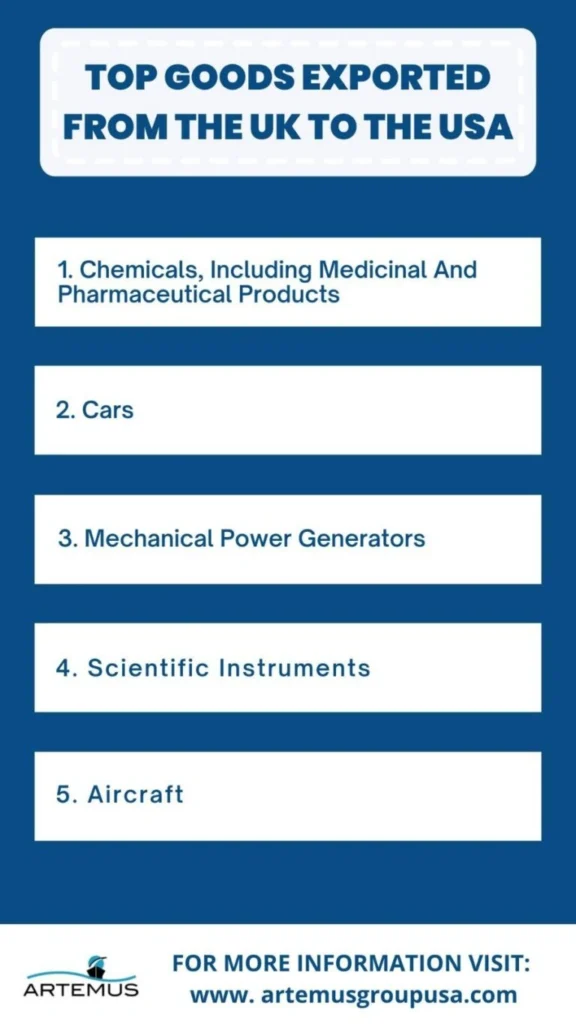
Below are the top five UK export categories to the US, ranked by value, with full 2024 data and comparisons to the previous year.
In 2024, the United Kingdom exported chemicals valued at £10.8 billion to the United States, establishing it as the largest single export category to the US. However, this reflected a £3.2 billion (22.7%) decrease compared to 2023.
Despite the decrease, the United States represented 19.6% of the total chemical exports from the United Kingdom, reaffirming its position as an essential export market.
In 2024, car exports from the United Kingdom to the United States amounted to £9.0 billion, establishing the US as the primary destination for UK automotive exports. This category represented 27.4% of all UK car exports, far ahead of China, the second-largest destination.
In addition to finished vehicles, the UK exported £0.6 billion in other road vehicles and car parts, including accessories, body parts, and motorcycle components. These figures emphasize the strength of the transatlantic auto trade, even ahead of the 2025 tariff changes.
Mechanical power generators, classified as intermediate goods like turbines, internal combustion engines, and power-generation machinery, accounted for £4.6 billion in exports to the US in 2024.
This category constitutes a significant part of the overall £29.1 billion in exports of machinery and transport equipment, which saw an increase of £1.8 billion (6.7%) compared to 2023. Mechanical power generators are essential in the US for energy, automotive, and industrial sectors.
Exports of scientific instruments totaled £2.4 billion in 2024, a slight £0.3 billion (11.6%) decrease compared to 2023. The United States remained the UK’s largest market for this category, which includes medical diagnostics tools, research equipment, and engineering instruments.
Despite the dip, this category remains strategically important due to its links to high-value, innovation-driven industries.
Aircraft exports to the United States stood at £2.2 billion in 2024, a £0.1 billion increase over 2023. These exports include complete aircraft, parts, and aerospace systems.
This growth, though modest, reflects sustained UK-US aerospace collaboration and demand consistency through long-term manufacturing contracts in both the civil and defense aviation sectors.
In total, these five key categories, chemicals, cars, mechanical power generators, scientific instruments, and aircraft, make up a substantial portion of the UK’s £59.3 billion in goods exports to the United States in 2024. While categories like chemicals and scientific instruments saw contractions, mechanical exports and aircraft held firm or grew, and automotive exports remained dominant.
This trade profile confirms the strategic, high-value nature of the UK’s goods trade with the US, with a strong emphasis on technology, innovation, and industrial capability.
the UK exports a range of other significant goods to the United States, contributing to the diverse trade relationship in 2024:
Related: What Does Canada Export To USA? A Complete Guide

In early 2025, the U.S. administration under President Donald Trump introduced a significant shift in its trade policy by announcing new tariffs on a broad range of imports.
Among these were a 10% blanket tariff on all goods imported from the UK (except for previously targeted categories like steel, aluminium, and automotive products), and a 25% tariff specifically imposed on cars and car parts, which came into effect in April 2025.
The U.S. has imposed a 10% reciprocal tariff on most UK goods since April 2025, increasing costs for British exporters and potentially reducing their competitiveness while services remain unaffected.
Additionally, under Section 232, a 25% tariff on UK steel and aluminum took effect on March 12, 2025; this is temporarily reduced to zero under the U.S.–UK Economic Prosperity Deal, but could return to 25% or rise to 50% after July 9, 2025, depending on compliance.
Related: What Does Mexico Export To The US? Trade Insights
When exporting goods from the United Kingdom to the United States, proper documentation is essential to ensure smooth customs clearance and legal compliance. Each document serves a specific purpose, verifying the origin, classifying goods, calculating duties, and facilitating logistics. Below is a list of the key documents required for UK exporters shipping goods to the U.S.:
This is a mandatory document that details the transaction between the UK exporter and the U.S. buyer. It includes information such as the description of goods, quantity, value, currency, payment terms, Incoterms (e.g., FOB, CIF), and both seller and buyer details. U.S. Customs uses this to assess duties and taxes.
The packing list complements the commercial invoice and describes how the shipment is packed. It includes information about the type of packaging (e.g., boxes, pallets), dimensions, weight, and contents of each package. This is crucial for both customs and the logistics provider.
Depending on the mode of transport, sea or air, either a Bill of Lading or Air Waybill is required. These documents act as a contract between the exporter and the carrier and serve as proof of shipment. The BOL is especially important for ocean freight, while the AWB is used for air cargo.
Before exporting, UK businesses must submit a customs export declaration through the CDS. This includes commodity codes (HS codes), origin, value, and destination country, helping HMRC record and authorise the export.
This certificate verifies the country where the goods were manufactured. While not always mandatory, it may be requested by U.S. customs authorities or required under trade agreement rules. It can be obtained from a Chamber of Commerce in the UK.
This is a U.S. Customs requirement for shipments arriving by sea. The importer (or their agent) must file advance data about the shipment at least 24 hours before loading at the foreign port. While the UK exporter doesn’t usually file it, they must provide the information in time.
If the exporter is responsible for insurance (as in CIF terms), an insurance certificate must be provided to cover potential loss or damage during transit.
Certain goods, such as chemicals, pharmaceuticals, food products, dual-use items, or defence-related goods, require export licenses from the UK and/or import permits from U.S. authorities like the FDA, EPA, or BIS.
Though not a standalone document, correctly classifying goods using HS codes is critical. These codes determine the applicable U.S. tariff and customs treatment. Errors may lead to delays, fines, or incorrect duty charges.
If using a U.S.-based customs broker to handle import clearance, the U.S. importer must provide a Power of Attorney. Although this is handled by the importer, UK exporters should ensure coordination to avoid delays.
Ensuring that all necessary documents are complete, accurate, and submitted in a timely manner reduces the risk of customs delays, fines, or shipment rejections. Exporters are also advised to stay up to date with both UK and U.S. regulations, especially in light of recent changes in trade tariffs and customs protocols.
Related: What Does Colombia Export To USA? Key Products & Insights

Shipping goods from the United Kingdom to the United States involves several cost components that vary based on the nature of the goods, shipping method, service level, and applicable tariffs or duties.
Understanding these cost elements is essential for UK exporters to accurately price their products and maintain profitability when accessing the U.S. market.
Freight is the core cost of physically transporting goods. This varies significantly based on:
As of early 2025, typical sea freight costs for a standard 20-foot container from the UK to the U.S. East Coast range from £1,200 to £1,800, while air freight for small shipments (under 100 kg) may cost £4.00–£8.00 per kg depending on urgency.
Costs are incurred for safely packaging goods to meet shipping and regulatory standards. This includes protective materials, palletizing, and any special handling required for fragile or hazardous goods. These costs can range from £50 to £500+ depending on the shipment size and complexity.
Insurance covers loss or damage in transit. It is optional but strongly recommended, especially for high-value items. Typical insurance costs are about 0.3% to 0.5% of the total cargo value.
Depending on the product classification (HS code), goods may be subject to U.S. import duties. As of April 2025, the U.S. has imposed:
These tariffs are applied on top of the standard Most Favoured Nation (MFN) duties. Exporters must factor this in when pricing for U.S. buyers, especially for products in affected categories like automotive, machinery, or metals.
Using a U.S.-based customs broker is often necessary to navigate the import process. Broker fees generally range from £100 to £300 per shipment, depending on complexity. Additional costs may apply for filing documents like the Importer Security Filing (ISF) or for classification consulting.
Both UK departure ports and U.S. entry ports impose charges for loading, unloading, and cargo handling. These costs are usually built into freight quotes but can amount to £100–£400 per container.
If cargo is not cleared or collected within the allotted free time at port terminals, demurrage or storage fees apply. These fees can accrue rapidly, ranging from £40 to £100 per day, depending on the location.
Shipping from the UK to the U.S. is a cost-sensitive endeavour that requires thorough planning. While ocean freight offers lower per-unit costs for bulk goods, air freight suits time-critical or high-value shipments.
With the recent imposition of U.S. tariffs on many UK products, exporters must factor in additional duty costs to remain competitive. Working with reliable freight forwarders, customs brokers and staying updated on trade regulations is essential for smooth and cost-effective shipping operations.
Related: How To Import Goods For Resale In The USA? A 2025 Guide
Navigating trade regulations is essential for UK exporters trading with the United States. Below are key highlights to help businesses stay compliant and competitive:
All goods must be correctly classified using Harmonized System (HS) codes. These codes determine tariff rates and import restrictions. Inaccurate classification can result in customs delays, fines, or incorrect duty assessments.
Some goods, such as dual-use items, military equipment, or certain chemicals, require an export licence from UK authorities. Exporters must consult the Export Control Joint Unit (ECJU) to ensure compliance before shipping.
As of April 2025, a 10% blanket tariff is applied to most UK goods entering the U.S. In addition, a specific 25% tariff now applies to cars, car parts, steel, and aluminium. Exporters should price products accordingly to remain competitive.
If exporting food, beverages, cosmetics, or pharmaceuticals, UK businesses must register with the U.S. Food and Drug Administration. Products must meet U.S. labelling, safety, and testing standards before entry is permitted.
Customs documentation such as commercial invoices, packing lists, and bills of lading must be complete and accurate. Any missing or incorrect information can cause customs holds or the denial of entry at U.S. ports.
For ocean freight, the U.S. importer must file an Importer Security Filing at least 24 hours before goods are loaded at the UK port. Exporters must ensure all data shared is accurate to prevent shipment delays or penalties.
Every product must be clearly marked with “Made in UK” or an equivalent statement. Improper or missing origin labels can lead to goods being seized, fined, or rejected at the U.S. border.
Goods must not violate U.S. sanctions or trade bans. Exporters should verify that their goods and suppliers are not on restricted or denied-party lists, particularly for sectors like defence or technology.
These guidelines are vital for ensuring successful trade with the United States. UK exporters are encouraged to work closely with customs brokers and trade advisors to maintain compliance and manage cross-border risks effectively.
Related: List Of 12 Largest Shipping Ports In The World
Exporting goods from the UK to the United States requires a well-structured process to ensure regulatory compliance and efficient delivery. Here’s a step-by-step overview:
Start by selecting the right product for the U.S. market and assessing demand. Conduct market research to understand U.S. consumer preferences, competition, pricing, and legal requirements for your product category.
Assign the correct Harmonized System (HS) code to your product. This determines duty rates and applicable U.S. import regulations. Accurate classification is essential to avoid customs issues and fines.
Verify whether your goods require an export licence from the UK government. Products such as military components, dual-use items, or certain chemicals may fall under export control regulations.
Gather necessary documents, including the commercial invoice, packing list, bill of lading or airway bill, and certificate of origin. These are required for customs clearance and shipment acceptance at U.S. ports.
Ensure your goods meet relevant U.S. regulations. For example, food and pharmaceutical products must comply with FDA standards, while consumer goods must meet U.S. safety and labeling requirements.
Select a reliable logistics partner and decide on the mode of transport, air, sea, or courier. Agree on Incoterms with the U.S. buyer to define shipping responsibilities, costs, and risks.
For regulated goods like food, medical devices, or cosmetics, register your business and products with U.S. agencies like the FDA before exporting.
Submit your export declaration through the National Export System (NES) to HMRC. This is a mandatory step for shipments above the threshold value and ensures legal departure from the UK.
Once documentation is complete and regulatory checks are cleared, dispatch the goods via your chosen logistics provider. Share tracking and customs paperwork with the importer in the U.S.
The U.S. importer or customs broker files an entry with U.S. Customs and Border Protection (CBP). Once approved, the goods are released, tariffs paid, and delivered to the final destination.
Following this step-by-step process helps UK exporters minimize delays, avoid compliance issues, and build strong trading relationships with U.S. partners.
Related: Top 10 Ports In The USA: The Busiest Hubs Driving US Trade
When it comes to importing into the U.S., compliance isn’t optional, it’s critical. That’s where Artemus steps in.
We simplify the complexities of ISF (Importer Security Filing) and AMS filing (Automated Manifest System), helping businesses stay fully compliant with U.S. Customs regulations without the stress!
Whether you’re an importer, NVOCC, or carrier, our intuitive, cloud-based platform makes submitting, tracking, and managing filings a breeze.
With real-time updates, smart automation, and expert support just a click away, Artemus ensures your cargo moves smoothly and penalties stay off your radar.
Yes, most goods exported from the UK to the USA are subject to import duties. In 2025, a 10% blanket tariff applies to most UK goods, with specific categories like cars and steel facing a 25% tariff.
Generally, most goods do not require an export license from the UK to the USA. However, certain controlled items like military goods, high-tech equipment, and hazardous materials may need special licenses.
The most exported goods from the UK to the USA are machinery and transport equipment, particularly cars, aircraft, and power generators, followed by pharmaceuticals and scientific instruments.
As of 2024, the United States is the UK’s largest trading partner for both goods and services exports.
The UK exports a range of premium and luxury vehicles to the USA, including brands like Jaguar, Land Rover, Bentley, Mini, and Rolls-Royce.
Exporting goods from the UK to the United States remains a major opportunity, with categories like cars, pharmaceuticals, power generators, and aircraft leading the way.
With the U.S. as the UK’s top export partner for goods, it’s vital to understand key trade volumes, tariff implications, documentation requirements, and compliance regulations to ensure smooth and successful cross-border transactions.
As a trusted partner in global trade, Artemus helps streamline UK–US exports with compliance services, allowing you to focus on growing your business across international markets.
Related: Export Documentation Requirements To Export From The USA

The United Kingdom is one of the world’s largest trading economies and a top exporter of services. Cars, machinery, pharmaceuticals,

Mexico became the United States’ number-one trading partner in 2024, surpassing both Canada and China. According to the Office of
Colombia is one of Latin America’s most active trading economies. Crude oil, coffee, coal, and cut flowers flow out. Machinery,