UK Imports & Exports: Trade Profile & Top Partners
The United Kingdom is one of the world’s largest trading economies and a top exporter of services. Cars, machinery, pharmaceuticals,


Germany’s trade network forms the backbone of its economy, with imports like machinery, electronics, raw materials, and energy fueling industries and supporting domestic demand. This wide-ranging import system ensures that German businesses stay competitive while meeting global standards.
On the export side, Germany leads with vehicles, machinery, pharmaceuticals, and high-tech products, reflecting the country’s emphasis on quality, innovation, and precision. Key partners such as the U.S., France, China, and the Netherlands rely heavily on these goods, underscoring Germany’s influence in international trade.
This blog provides a complete overview of Germany’s trade landscape, highlighting key export and import categories, major trading partners, export strategies, and trade surplus trends.
To make Germany-U.S. trade seamless, Artemus Transportation Solution offers ISF, AES, and AMS software, simplifying Importer Security Filing (ISF), Automated Export System (AES), and Advanced Manifest System (AMS) processes. These tools ensure compliance, reduce errors, and streamline cross-border operations efficiently.
Table Of Contents
Germany remains one of the world’s largest trading economies, with its merchandise trade reflecting both strong industrial output and significant cross-border flows. As of July 2025, Germany recorded a trade surplus of approximately €14.9 billion, with exports totaling around €130.2 billion and imports about €115.4 billion. These numbers highlight Germany’s continued strength in global commerce, even amid fluctuating international demand.
Germany’s exports are dominated by high-value manufactured goods, particularly vehicles, machinery, and electrical equipment. These sectors have long defined the country’s global reputation for engineering and industrial excellence. Exported products cater to both EU and non-EU markets, with strong demand in the United States and other major trading partners, ensuring Germany maintains its competitive position internationally.
On the import side, Germany brings in large volumes of industrial machinery, electrical and electronic equipment, vehicles, mineral fuels, and pharmaceuticals. Many of these imports are used as inputs for domestic manufacturing, which in turn supports Germany’s export-oriented economy. Additionally, some imports meet domestic consumer demand, reflecting a balanced need for raw materials, industrial inputs, and consumer goods.
Germany’s trade relationships remain highly diversified. According to Destatis, the United States was Germany’s largest export destination in early 2025, while China remained the main source of imports. The EU continues to be a critical trading partner, with countries like the Netherlands, France, and Italy playing significant roles in cross-border commerce. This broad network helps Germany absorb shocks from individual markets and maintain steady trade flows.
The country’s trade dynamics also reveal certain risks and opportunities. While Germany enjoys a surplus in trade, the growth of imports highlights its exposure to global economic cycles, energy price fluctuations, and shifts in international demand.
Maintaining competitiveness in core industrial sectors, particularly automobiles, engineering, and high-tech manufacturing, will be key to sustaining export growth. At the same time, careful management of import dependencies, especially for energy and critical raw materials, will help Germany navigate global uncertainties effectively.
Overall, Germany’s trade profile combines strong industrial output with a steady need for imports to fuel both production and domestic consumption. This balance keeps Germany at the forefront of global commerce and underscores the importance of diversified trade partnerships in maintaining economic resilience.
Related: Importing A Car From Germany To USA: A 2024 Detailed Guide
Germany’s export strength in 2024 reflects its global reputation for engineering, technology, and high-value manufacturing. Here are the major export categories based on the latest available data, along with reliable sources.
Germany remains one of the world’s largest vehicle exporters. In 2024, exports of cars and related vehicles were valued at about 276 billion dollars. This category continues to dominate Germany’s industrial output and global trade presence.
Machinery is another backbone of Germany’s export economy. In 2024, machinery exports reached roughly 263 billion dollars. This includes industrial equipment, turbines, engines, and precision tools used across global manufacturing.
Germany exported close to 175 billion dollars in electrical and electronic equipment. These products cover everything from electrical machinery to industrial electronic systems that support automation and high-tech industries worldwide.
Pharmaceutical exports continue to grow, reaching around 120 billion dollars in 2024. Germany is a major producer of medicines, diagnostic materials, and medical formulations that supply healthcare systems across Europe, the Americas, and Asia.
This category, valued at about 83 billion dollars, includes medical devices, optical instruments, and precision measurement tools. Germany’s strong research and engineering base helps it maintain high global demand in this sector.
Plastics made up roughly 64 billion dollars of Germany’s exports in 2024. These include industrial polymers, plastic components, and manufactured plastic goods used across consumer and industrial applications.
Exports of aircraft, spacecraft, and related parts reached about 35 billion dollars. Germany contributes significantly to the global aerospace supply chain through high-tech components and engineering services.
Although Germany is not a major producer of energy resources, it exports refined petroleum and related goods worth around 34 billion dollars. These products support energy demand in nearby European markets.
Germany exported about 34 billion dollars in various chemical goods beyond pharmaceuticals. This includes industrial chemicals, specialty chemicals, and materials used in manufacturing and research.
Exports of iron and steel products reached nearly 33 billion dollars in 2024. These materials are essential for global construction, engineering, and infrastructure development.
Related: What Does Mexico Export To The US? Trade Insights
Germany relies on a mix of imported goods to keep its industries running, meet consumer demand, and cover energy needs. Based on 2024 data, here’s a closer look at the major import categories along with their values.
Germany’s biggest import is electrical and electronic equipment. In 2024, the country brought in 201.17 billion dollars worth of items like integrated circuits, electronic devices, and industrial systems. These are crucial for Germany’s advanced manufacturing, automotive, and tech sectors.
Machinery imports hit 168.13 billion dollars. This includes things like industrial machines, engines, reactors, and precision tools that keep Germany’s engineering and production sectors moving.
3. Vehicles
Even though Germany is a global car powerhouse, it still imported 143.63 billion dollars in vehicles and related products. A lot of these go into assembly lines, especially specialized parts, electronics, and fully built vehicles for domestic use.
Germany imported 111.83 billion dollars in mineral fuels, oils, and similar products. With limited domestic energy production, these imports are vital to keep industries and homes powered.
5. Pharmaceutical Products
Imports of pharmaceuticals totaled 76.40 billion dollars. This covers medicines, vaccines, medical formulations, and biotech goods that support healthcare and research across the country.
Germany brought in 48.31 billion dollars worth of precision medical devices, optical instruments, and technical equipment. These are widely used in healthcare, scientific research, and industrial applications.
7. Plastics
Plastic materials and finished plastic goods made up 47.04 billion dollars of imports in 2024. These are key for manufacturing, packaging, and chemical production.
Germany imported 41.52 billion dollars worth of aircraft, spacecraft, and related parts. This includes commercial planes, military aircraft components, satellites, and aerospace equipment, all supporting the aviation and space tech sectors.
Related: Import European Car To USA: All You Need To Know In 2024
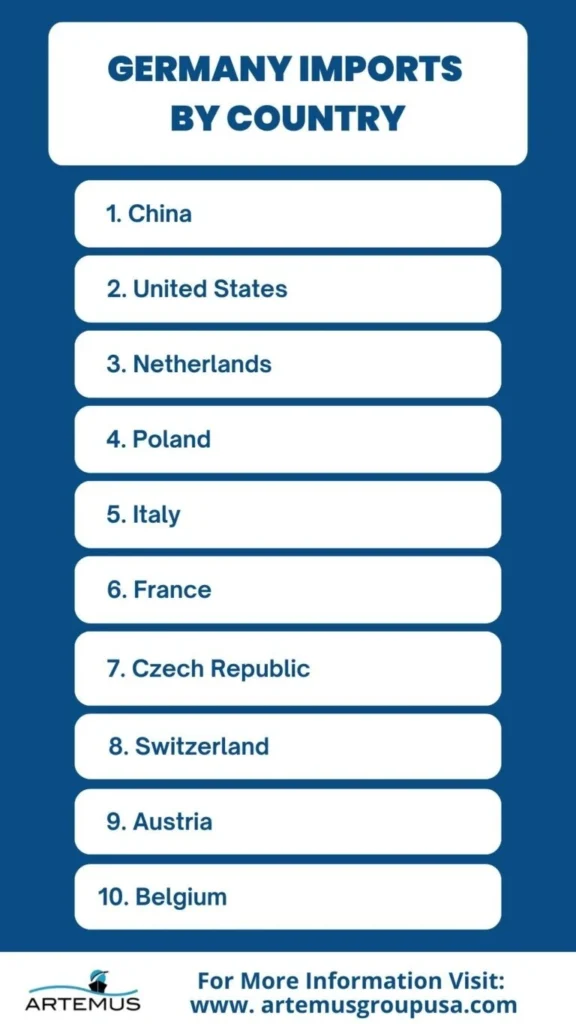
Germany sources its imports from a wide range of countries, each playing a key role in keeping industries, technology, and consumer needs well supplied. Based on 2024 data, the total value of Germany’s imports reached $1,376.92 billion, reflecting the country’s strong reliance on global trade for raw materials, machinery, energy, and high-tech products.
Here’s a closer look at the top 10 import partners and their import values:
China is Germany’s biggest supplier, with imports totaling $169.53 billion in 2024. A lot of these goods are industrial components, electronics, and manufactured products that feed into Germany’s factories and tech sectors.
Germany imported $95.41 billion worth of goods from the U.S. This includes high-tech machinery, aerospace components, and various industrial and consumer products that complement domestic production.
Imports from the Netherlands reached $93.96 billion. Its strong logistics network and proximity make it a key gateway for products entering Germany, from machinery to industrial supplies.
Germany imported $81.01 billion from Poland, mainly machinery, automotive parts, and other industrial materials that support manufacturing and assembly lines.
Italy supplied Germany with $70.46 billion worth of goods, including vehicles, machinery, and manufactured products that are crucial for Germany’s industrial base.
Imports from France were $70.15 billion, covering chemicals, vehicles, machinery, and some agricultural products that help sustain both industry and consumer demand.
Germany brought in $61.52 billion from the Czech Republic. Much of this includes machinery, automotive components, and industrial goods used across German factories.
Switzerland exported $57.28 billion worth of products to Germany, mainly pharmaceuticals, precision instruments, and chemical products, which are highly valued in healthcare and high-tech sectors.
Imports from Austria totaled $52.55 billion, including machinery, metals, and industrial supplies that feed into German manufacturing and construction.
Belgium supplied Germany with $47.28 billion in goods, such as chemicals, machinery, and other industrial products that are important for maintaining Germany’s diverse industries.
These top countries provide Germany with a steady flow of essential goods, keeping its industries competitive and ensuring that technology, energy, and consumer sectors continue to thrive.
Related: Importing Motorcycle From USA To Australia: A 2024 Guide
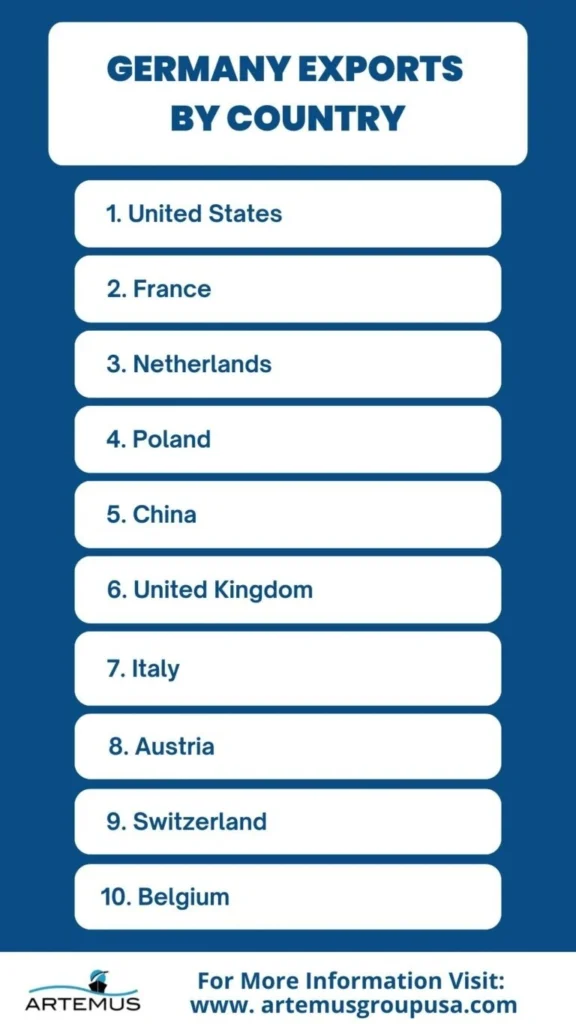
Germany is one of the world’s leading exporters, sending goods to countries across the globe. In 2024, the total value of German exports reached $1,630.71 billion, reflecting the country’s strong industrial base, technological expertise, and global trade network.
Here’s a closer look at Germany’s top 10 export partners:
The U.S. is Germany’s largest single export market, receiving $169.97 billion worth of goods in 2024. These exports include vehicles, machinery, pharmaceuticals, and high-tech equipment that support American industries and consumers.
Germany exported $120.51 billion to France. Key exports include cars, industrial machinery, and chemicals, highlighting the strong trade ties between these neighboring European economies.
Exports to the Netherlands reached $113.84 billion. Many of these goods pass through Dutch ports as part of broader European supply chains, including machinery, vehicles, and industrial components.
Germany sent $97.73 billion worth of goods to Poland, including vehicles, machinery, and industrial products that support Poland’s manufacturing and infrastructure sectors.
Exports to China totaled $94.62 billion, covering vehicles, machinery, chemical products, and electronics that feed into China’s growing industrial and consumer markets.
Germany exported $84.65 billion to the U.K., including cars, machinery, and pharmaceutical products, reflecting strong business ties even after Brexit.
Exports to Italy were $83.84 billion, largely consisting of vehicles, machinery, and industrial equipment that support Italian manufacturing and construction.
Germany exported $78.40 billion to Austria, with key goods including vehicles, machinery, and chemical products that complement Austria’s domestic industries.
Exports to Switzerland reached $73.46 billion, including high-value products such as pharmaceuticals, precision instruments, and machinery used in medical and industrial sectors.
Germany sent $61.09 billion worth of goods to Belgium, covering machinery, chemicals, vehicles, and industrial products that are crucial for Belgium’s manufacturing and trade networks.
These countries form the backbone of Germany’s export network, ensuring that German-made products reach key global markets and continue to support the country’s position as a leading exporter.
Related: How To Get Import And Export License In USA: Quick Overview
Germany’s export strategy is all about leveraging its strengths in advanced manufacturing, high-quality engineering, and innovative technology to maintain a leading position in global trade. The country focuses on producing goods that are in high demand worldwide, from vehicles and machinery to pharmaceuticals and electronics.
A key part of this strategy is maintaining strong trade relationships with major partners like the United States, China, France, and the Netherlands. By diversifying its export markets, Germany reduces dependency on any single country while ensuring steady demand for its products.
Another critical element is specialization. German industries focus on high-value, high-precision goods, such as automobiles, industrial machinery, medical instruments, and chemicals. This focus on quality and innovation allows Germany to remain competitive even as global markets evolve.
Logistics and infrastructure also play a big role. Germany’s central location in Europe, combined with its efficient ports, road networks, and rail systems, makes exporting smoother and faster, helping companies reach international markets quickly.
Finally, the country invests in research and development to stay ahead of technological trends. By continuously innovating, Germany ensures that its exports remain cutting-edge, whether it’s in green technologies, high-performance vehicles, or advanced manufacturing solutions.
Related: Australia Imports And Exports 2025: Top Products & Trade
Germany’s trade surplus happens when the country exports more than it imports, and it’s been a consistent part of its economy for years. In 2024, the surplus was around €239 billion, with exports at €1.555 trillion and imports at €1.316 trillion. That really shows how much the world relies on German products.
Back in 2023, the surplus was €218.5 billion, a jump from previous years mainly because imports dropped faster than exports. Early data for January to May 2025 shows a surplus of €88.9 billion, with exports rising a bit but imports growing more.
Historically, Germany hit a peak surplus of $261.64 billion in 2017, and while it has gone up and down since then, it has always stayed positive. That consistency highlights the strength of German manufacturing and industrial sectors.
At the heart of this surplus are high-demand products like cars, machinery, chemicals, and electronics. Germany keeps this advantage by focusing on innovation, quality, and efficiency, making sure its products stay competitive around the globe.
Related: Japan Imports And Exports 2024: Top Products & Their Impact
Artemus makes it easier for businesses to stay on top of trade compliance between Germany and the United States. The ISF, AES, and AMS software simplify import and export processes while keeping everything fully compliant with regulations.
The ISF (10+2) software helps importers and freight forwarders file inbound cargo information correctly. With real-time updates and the ability to submit data from anywhere, it prevents fines and shipment delays, keeping the process smooth and hassle-free.
The AES filing solution ensures exporters submit Electronic Export Information (EEI) on time and without mistakes. It speeds up processing, keeps shipments on track, and ensures all regulations are met.
The AMS software makes submitting advanced cargo information straightforward. Its intuitive interface and automated workflows make managing manifests, arrival notices, and reports quick, secure, and easy to customize.
With Artemus software, businesses can manage Germany and US trade compliance confidently. The tools save time, reduce errors, and provide clear visibility throughout shipping and filing, making international trade simpler and more reliable.
Related: What Does Colombia Export To USA? Key Products & Insights
Germany is the largest exporter of vehicles, including cars and automotive components. It also leads in machinery, electrical equipment, and high-tech industrial products.
China is Germany’s largest source of imports, supplying electronics, machinery, and industrial components. Other key import partners include the United States, the Netherlands, and Poland.
In 2024, Germany exported approximately $169.97 billion worth of goods to the United States. Imports from the U.S. totaled around $95.41 billion.
Germany’s trade ecosystem highlights the country’s strength as a global economic powerhouse. Its exports, led by vehicles, machinery, and high-tech products, showcase quality and innovation, while imports of machinery, electronics, raw materials, and energy keep industries running smoothly.
With strong trade relationships across the world, from the U.S. and China to neighboring European countries, Germany continues to balance a robust export strategy with a steady inflow of essential goods.
Overall, understanding Germany’s imports, exports, and trade patterns provides insight into how the country maintains its industrial edge and remains a key player in international commerce.

The United Kingdom is one of the world’s largest trading economies and a top exporter of services. Cars, machinery, pharmaceuticals,

Mexico became the United States’ number-one trading partner in 2024, surpassing both Canada and China. According to the Office of
Colombia is one of Latin America’s most active trading economies. Crude oil, coffee, coal, and cut flowers flow out. Machinery,