What Does Norway Export To The US? Key Products & Trade Data
Cold Nordic waters, advanced engineering, and a strong maritime economy make Norway a powerful exporter despite its size. Many of


Supply chain and logistics are often used interchangeably, but they serve distinct functions in the movement of goods and services. Logistics focuses on the efficient transportation, storage, and delivery of products, ensuring they reach the right destination at the right time.
On the other hand, supply chain management (SCM) encompasses a broader scope, including procurement, production, inventory management, and distribution—essentially overseeing the entire process from raw materials to the final customer.
Businesses that master both logistics and supply chain management gain a competitive advantage by reducing delays, optimizing costs, and improving customer satisfaction.
At Artemus, we specialize in streamlining U.S. import and export compliance with cutting-edge filing solutions. Our Importer Security Filing (ISF), Automated Manifest System (AMS), and Automated Export System (AES) solutions help businesses & individuals navigate regulatory requirements seamlessly.
Table Of Contents
Supply Chain Management (SCM) is the strategic coordination of all activities involved in sourcing, producing, and delivering goods — from raw material to the final consumer. It includes procurement, production planning, inventory control, logistics, distribution, and customer service.
Related: 10 Supply Chain Best Practices In Shipping: A 2025 Guide
Logistics is a subset of supply chain management focused specifically on the planning, execution, and control of the movement and storage of goods. It ensures that products are delivered to the right location, in the right condition, and at the right time.
Related: Top 10 Ports In The USA: The Busiest Hubs Driving US Trade
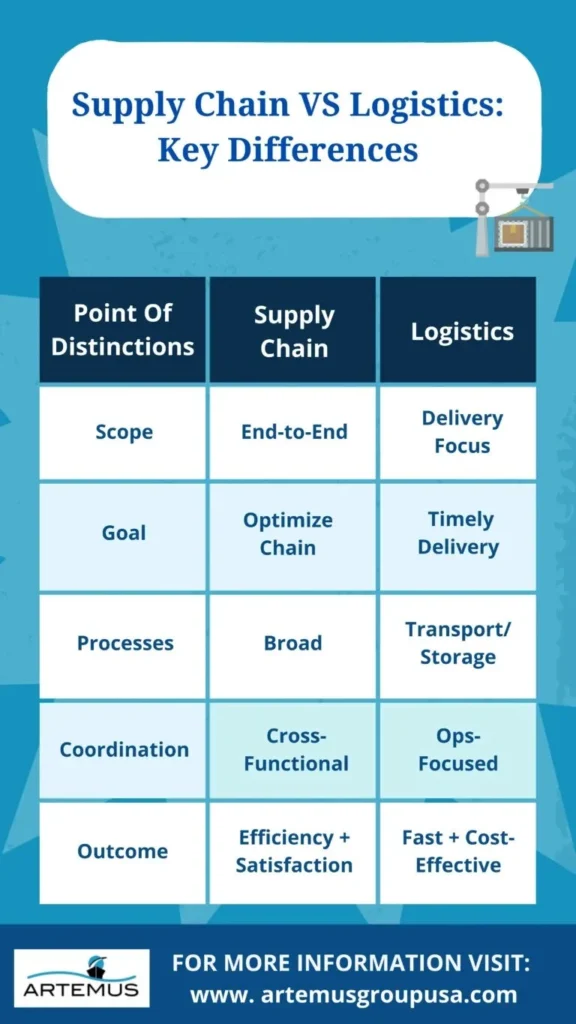
While Supply Chain Management (SCM) and Logistics are closely connected, they serve different roles in the movement of goods, services, and information. Understanding their key differences can help businesses optimize their operations and improve efficiency.
Related: What Is Inbound Logistics & Outbound Logistics? A 2025 Guide
Supply Chain Management (SCM) and Logistics are closely related disciplines that collaborate to ensure the efficient movement of goods, information, and resources from suppliers to end customers. While they have distinct roles, they share several key similarities:
Both SCM and Logistics aim to optimize the flow of products, services, and information throughout the supply chain. They strive to ensure that goods move seamlessly from the point of origin to the final destination, meeting customer demands effectively.
Enhancing customer satisfaction is a central goal for both fields. By ensuring timely delivery and maintaining product quality, SCM and Logistics contribute to building customer loyalty and meeting service expectations.
SCM and Logistics require coordination across multiple departments, such as procurement, production, and distribution. This integration facilitates a cohesive approach to managing the supply chain, ensuring all functions work towards common objectives.
Both disciplines seek to minimize costs associated with the movement and storage of goods. By optimizing processes and resource utilization, they aim to enhance overall profitability and operational efficiency.
Related: How To Get Import And Export License In USA: Quick Overview
Logistics plays a crucial role in Supply Chain Management (SCM) by ensuring the smooth and efficient movement of goods, services, and information across the supply chain. It acts as the backbone of SCM, optimizing operations to enhance productivity, reduce costs, and improve customer satisfaction.
Related: What Is Global Trade Management? A Complete 2025 Guide
Technology has revolutionized Supply Chain Management (SCM) and Logistics, enabling businesses to optimize operations, reduce costs, and improve efficiency. Advanced digital solutions ensure seamless coordination, real-time tracking, and enhanced decision-making, making supply chains more agile and resilient.
Related: NVOCC Bond & OTI Bonds – Federal Maritime Commission
Navigating U.S. customs regulations and international trade compliance can be challenging, especially for importers, exporters, NVOCCs, and freight forwarders. That’s where Artemus Transportation Solutions simplifies the process with cutting-edge, automated filing solutions.
With Artemus Transportation Solutions, you streamline compliance, eliminate costly errors, and keep your supply chain moving—all through one powerful, intuitive platform.
No. Logistics is a part of the broader supply chain process focused on movement and storage, while supply chain management includes procurement, production, and coordination.
Technology enhances visibility, reduces errors, improves speed, and enables smarter decisions through automation, tracking, and real-time data.
Efficient logistics ensures on-time delivery, while effective supply chain management ensures product availability and quality — both key to customer satisfaction.
Absolutely. Cloud-based SCM solutions and third-party logistics providers (3PLs) make advanced logistics accessible to businesses of all sizes.
Inbound logistics deals with receiving raw materials or goods; outbound logistics handles delivery of finished products to customers.
Reverse logistics involves managing product returns, recycling, or disposal. It enhances sustainability, customer satisfaction, and cost recovery.
A: Almost all industries rely on them, especially manufacturing, retail, e-commerce, automotive, healthcare, and food & beverage sectors.
A: Events like pandemics, geopolitical tensions, or natural disasters can cause delays, shortages, or increased costs—highlighting the need for resilience and diversification.
A: A Transportation Management System (TMS) automates carrier selection, route optimization, shipment tracking, and freight auditing to improve efficiency and lower costs.
A: Artemus provides top-tier ISF, AMS, and AES filing software, helping businesses comply with U.S. Customs regulations, avoid penalties, and ensure timely cargo processing.
While closely related and often used interchangeably, supply chain and logistics serve distinct yet complementary roles in the movement of goods and services.
Logistics focuses on the efficient transportation, storage, and delivery of products, whereas supply chain management takes a broader view—strategically coordinating everything from sourcing raw materials to delivering the final product to the customer.
By recognizing these distinctions, businesses can better align their strategies, improve operational efficiency, and respond more effectively to market demands. Whether you’re managing inventory, optimizing delivery routes, or planning long-term sourcing strategies, knowing where logistics ends and supply chain begins gives you a competitive edge.

Cold Nordic waters, advanced engineering, and a strong maritime economy make Norway a powerful exporter despite its size. Many of
Trade between the United States and Canada is one of the largest bilateral trading relationships in the world. Understanding what

Switzerland plays a vital role in U.S. trade, supplying a wide range of high-value and specialized products. From pharmaceuticals and