
What Does Switzerland Export To The US? A Detailed Guide
Switzerland plays a vital role in U.S. trade, supplying a wide range of high-value and specialized products. From pharmaceuticals and



Exporting from Australia to the USA presents a lucrative opportunity for Australian businesses looking to tap into one of the world’s largest consumer markets. With strong bilateral ties, a robust free trade agreement, and growing demand for high-quality Australian goods, the U.S. remains a top destination for exports ranging from beef and wine to pharmaceuticals and advanced machinery.
However, navigating the compliance landscape, managing documentation, and meeting U.S. customs regulations can be complex.
That’s where Artemus steps in. With its powerful software solutions for ISF, AMS, and AES filings, Artemus simplifies the regulatory process, ensures compliance with U.S. import and export requirements, and helps businesses streamline their logistics operations.
Whether you’re a seasoned exporter or just starting your U.S. trade journey, understanding the full export process and having the right tools in place is key to success.
Table Of Contents
Curious about what fuels the strong trade ties between the U.S. and Australia? Here’s a quick look at the top goods and services exchanged between these two major allies and why their economic partnership continues to thrive.
In 2024, US goods exports to Australia totaled approximately 34.6 billion USD, while imports from Australia reached around 16.7 billion USD. This resulted in a goods trade surplus of about 17.9 billion USD for the US.
The total two-way goods trade between the countries stood at around 51.3 billion USD, supported by the Australia–US Free Trade Agreement (AUSFTA), which has been in effect since 2005.
These exports are bolstered by AUSFTA, which eliminates or reduces most tariffs, making US goods highly competitive in the Australian market.
Related: Exports From UK To USA: Everything You Need To Know

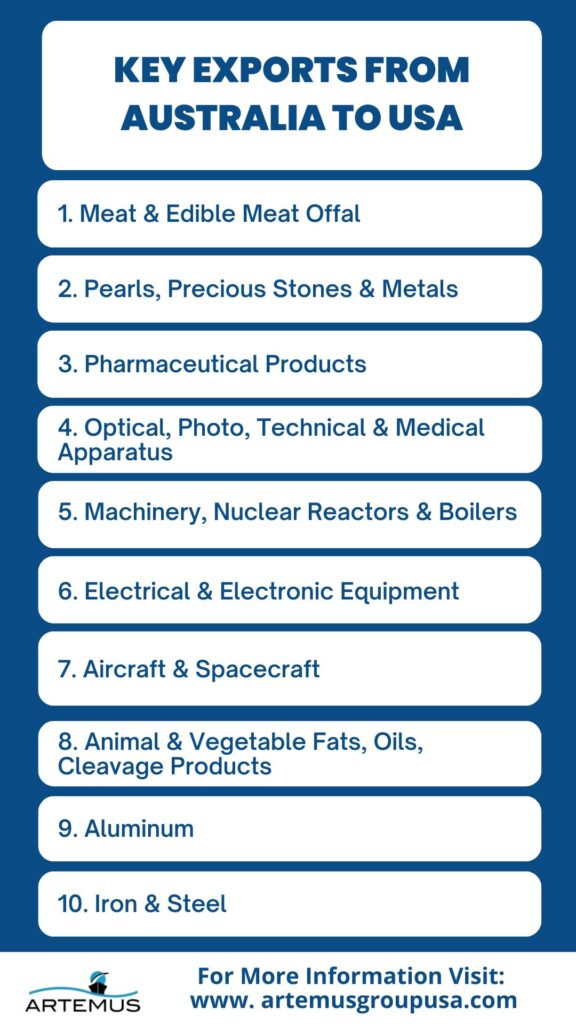
Australia’s export relationship with the United States remains strong and diversified, driven by high demand for both natural resources and advanced manufactured goods.
The following breakdown highlights the top 10 exports from Australia to the U.S. in 2024, based on the latest available trade data.
Australia is one of America’s leading suppliers of beef, lamb, and mutton. High‐quality, grass‐fed Australian meat, particularly lean beef for fast food and lamb for grills, is in strong demand. In 2024, approximately US$4 billion worth shipped to the U.S.
This includes Australian gold, opals, and rare gems. Notably, non‑monetary gold exports surged to around US$2.9 billion, an all‑time monthly record, as U.S. buyers stockpiled amid global uncertainty.
Australia exports medicines, biologics, and vaccines to the U.S., leveraging its high regulatory standards and R&D capabilities.
This category includes medical imaging, optometry equipment, and precision instruments, an emerging sector in Australia–U.S. trade.
Australia exports industrial equipment, turbines, and specialised boilers to sectors like mining and energy in the U.S.
Consisting of circuit boards, electronic controls, and telecommunication components, this growing category reflects Australia’s manufacturing diversification.
Including parts for aerospace integration, regional turboprops, and training aircraft systems. This niche yet strategic trade highlights Australia’s aviation collaboration with the U.S.
Covers edible oils, lanolin, and specialized fats used in food processing, cosmetics, and pharmaceuticals.
Despite new U.S. tariffs, Australia continued to ship aluminum, citing its importance to U.S. manufacturing and defense supply chains.
Australia supplies iron and metallurgical steel for U.S. infrastructure and manufacturing, supported by the close ties in defense industries.
Related: What Does Canada Export To USA? A Complete Guide
Exporting to the United States involves more than just shipping goods; it requires a thorough understanding of the country’s detailed and often strict import regulations. These rules are designed to ensure safety, compliance, transparency, and fair trade.
For businesses exporting to the U.S., navigating these regulations correctly is crucial to avoid delays, penalties, or rejected shipments.
The CBP is the primary agency overseeing the importation of goods into the United States. Importers (and exporters shipping to the U.S.) must comply with CBP’s requirements, which include:
For ocean shipments, the U.S. requires an Importer Security Filing at least 24 hours before goods are loaded onto the vessel. Known as the “10+2” rule, it includes 10 data elements from the importer and 2 from the carrier. Failure to comply can lead to fines or cargo holds.
Many products must meet additional requirements from specific U.S. regulatory agencies:
The U.S. has strict labeling laws based on product type. Common requirements include:
Imported goods may be subject to customs duties, which vary based on classification under the HTSUS. Exporters from countries with free trade agreements (like Australia under AUSFTA) may benefit from reduced or zero tariffs, provided rules of origin are met and documented properly.
While not mandatory, many importers use licensed customs brokers to navigate U.S. regulations, prepare and file entry documents, and liaise with U.S. customs authorities. This can significantly reduce compliance risks and processing delays.
Certain items are either banned or restricted from entering the U.S., including:
Related: What Does Mexico Export To The US? Trade Insights
When exporting from Australia to the United States, understanding how tariffs and duties apply and how to leverage the Australia–United States Free Trade Agreement (AUSFTA) can significantly impact your cost competitiveness and ease of market entry.
The AUSFTA, which came into effect on January 1, 2005, provides a powerful framework for reducing or eliminating tariffs on most goods traded between the two nations. Key features include:
While most goods enjoy preferential treatment under AUSFTA, certain sectors or specific product lines may still attract:
To claim preferential tariff rates under AUSFTA, exporters must:
Thanks to AUSFTA:
For businesses importing from the U.S. into Australia, AUSFTA also offers reciprocal benefits:
Related: What Does Colombia Export To USA? Key Products & Insights
The United States is one of Australia’s top trading partners, offering a mature market with high demand for everything from beef and wine to pharmaceuticals and precision technology. However, successfully exporting to the U.S. requires more than just identifying a buyer, it involves navigating compliance, logistics, and documentation every step of the way.
Here’s a step-by-step breakdown of the complete export process from Australia to the USA.
Before entering the U.S. market, start with in-depth research:
Tip: Use tools like Austrade, DFAT, and U.S. Census trade databases to gather insights.
Ensure your product meets U.S. regulatory standards:
Non-compliant goods may be held, returned, or destroyed at the U.S. port of entry.
Use the Harmonized System (HS Code) to:
You’ll also need to provide a Certificate of Origin to claim AUSFTA benefits (a declaration by the exporter often suffices).
Accurate and complete documentation is critical. Common documents include:
Your choice of logistics depends on cost, time, and product type:
Don’t forget to follow Incoterms (e.g., FOB, CIF, DDP) to clarify who handles costs, risk, and customs at each step.
Protect your shipment with marine cargo insurance to cover risks during transit. Also:
Upon arrival, your shipment must pass through U.S. Customs and Border Protection (CBP):
Ensure all documents are in order to avoid clearance delays.
Once cleared, goods are transported to the buyer’s warehouse, retail outlet, or distribution center. After delivery:
Related: How To Import Goods For Resale In The USA? A 2025 Guide
When exporting goods from Australia to the United States, having the correct documentation is essential to ensure smooth customs clearance, avoid delays, and comply with both Australian and U.S. regulations.
Below is a comprehensive list of the most commonly required export documents.
The commercial invoice is a core document for any international shipment. It includes:
U.S. Customs and Border Protection (CBP) uses this to assess import duties and verify the legality of the shipment.
This document outlines:
While not always mandatory, it helps customs and freight handlers check cargo during transit and inspection.
This is the contract of carriage between the exporter and the carrier:
It serves as proof of shipment and may be required for cargo release at the destination.
This document certifies that the goods originate from Australia and may be:
U.S. Customs may ask for this to verify eligibility for tariff concessions.
Mandatory for ocean freight to the USA, the ISF must be filed at least 24 hours before cargo is loaded at the Australian port. It requires:
Failure to comply can result in delays or penalties.
Before departure, Australian exporters must file an Export Declaration (EDN) through the Integrated Cargo System (ICS). This satisfies Australian Border Force export requirements and enables the cargo to leave the country legally.
Some goods require special permissions to enter the U.S., such as:
You may need to coordinate with your U.S. importer to ensure proper licenses are in place.
Though not always required, an insurance certificate:
When using this payment method, ensure:
Related: List Of 12 Largest Shipping Ports In The World
Artemus offers powerful, user-friendly software solutions for ISF (Importer Security Filing), AMS (Automated Manifest System), and AES (Automated Export System) filing ensuring seamless compliance with U.S. customs regulations.
Designed for freight forwarders, NVOCCs, customs brokers, and shippers, Artemus simplifies the complex filing process through real-time data validation, secure submissions, and easy integration with logistics operations.
Whether you’re managing ocean imports into the U.S. or coordinating exports, Artemus helps eliminate errors, reduce penalties, and improve speed-to-clearance with U.S. Customs and Border Protection (CBP). With dedicated support and a compliance-first approach, Artemus is the smart choice for global trade professionals seeking reliable and efficient U.S. filing solutions.
You can export a wide range of goods including beef, wine, pharmaceuticals, medical devices, machinery, and precious metals.
Australia’s major exports include iron ore, coal, natural gas, gold, beef, wine, and education-related services.
Most Australian goods enjoy zero or reduced import duties under the Australia–U.S. Free Trade Agreement (AUSFTA).
Yes, the AUSFTA eliminates or reduces tariffs on most goods traded between the two countries.
You generally don’t need a permit for most goods, but restricted items like pharmaceuticals, military goods, or wildlife products may require one.
Australia imports packaged foods, processed snacks, fresh fruits like apples and grapes (when out of season), and alcoholic beverages like bourbon.
Yes, ISF is mandatory for ocean freight to the U.S. and must be filed at least 24 hours before loading at the port of origin.
By ensuring your goods meet the rules of origin, you can claim tariff concessions and speed up customs clearance in the U.S.
Key documents include a commercial invoice, packing list, bill of lading, certificate of origin, and (for some goods) import permits.
U.S. Customs and Border Protection (CBP) is the main authority, supported by agencies like the FDA, USDA, and EPA depending on the product type.
Exporting from Australia to the USA offers immense potential for growth, especially with the support of the Australia–U.S. Free Trade Agreement, which reduces tariffs and simplifies market access. From regulatory compliance and documentation to logistics and customs clearance, each step plays a crucial role in ensuring a successful export journey.
By staying informed, leveraging expert tools like Artemus’s ISF, AMS, and AES filing software, and aligning with U.S. import standards, Australian businesses can confidently expand into the American market. With the right strategy and support, exporting to the USA can become a powerful driver of long-term business success.
Related: Top 10 Ports In The USA: The Busiest Hubs Driving US Trade

Switzerland plays a vital role in U.S. trade, supplying a wide range of high-value and specialized products. From pharmaceuticals and

In 2026, the US-Europe trade relationship continues to power global commerce, driven by exports of energy, advanced machinery, and pharmaceuticals

The economic partnership between the United States and Norway is a sophisticated and evolving pillar of transatlantic commerce. U.S. exports